
Can You Charge a LiFePO4 Battery in Cold Weather?
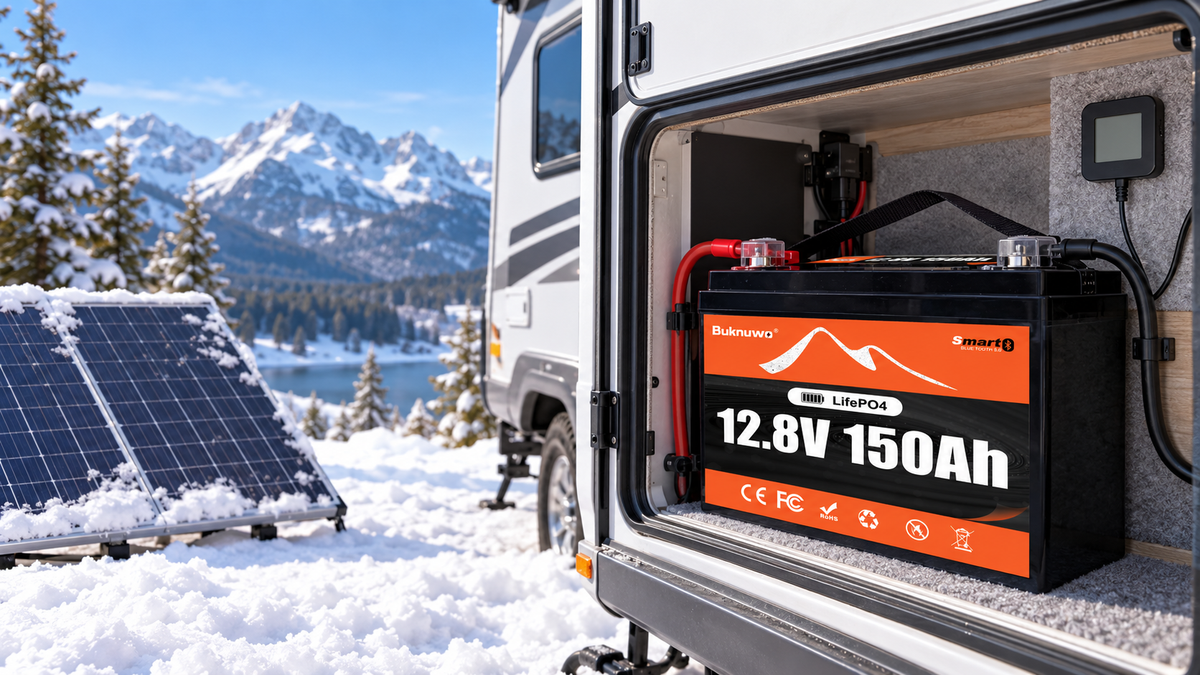
Can you charge a LiFePO4 battery in cold weather? Sometimes—but only when the battery temperature is within the charging range specified for that exact model. Cold-weather use does not have one universal temperature limit, and charging limits are usually stricter than discharging limits.
If a battery is too cold, the safest response is not to force it to accept charge. Stop the charging source, confirm the battery specification, and allow the battery to warm gradually to an approved temperature. A compatible battery management system may automatically block charging when its low-temperature threshold is reached.
Short answer
Do not charge a LiFePO4 battery below the minimum charging temperature published for its model unless the manufacturer specifically permits it or an approved system first warms the cells into the allowed range.
For a concrete BUKNUWO example, the current 12.8V 150Ah Bluetooth LiFePO4 battery specification lists a charging-temperature range of 32°F to 122°F (0°C to 50°C), low-temperature charging protection, and no self-heating function. Other BUKNUWO models may have different specifications, so this example should not be copied to every battery.
Why is cold charging different from cold discharging?
Inside a LiFePO4 cell, lithium ions move between the positive and negative electrodes. At low cell temperatures, this process becomes slower. If charging is forced under unsuitable cold conditions, lithium can deposit on the anode rather than being stored normally. This is commonly called lithium plating.
Lithium plating may contribute to permanent capacity loss, increased internal resistance, faster aging, and possible safety concerns. Damage may not be obvious immediately, which is why a battery that still appears to work should not automatically be considered safe to charge outside its stated limits.
Discharging is a different electrochemical process and is often permitted over a wider temperature range. For example, the same BUKNUWO 150Ah product page lists a broader discharging range than its charging range. However, cold-weather discharge performance may still be reduced, and the limits for the exact model remain controlling.
Battery temperature matters more than the weather forecast
The outdoor air temperature is useful context, but it is not necessarily the same as the battery's internal temperature. A battery inside an insulated RV compartment may remain warmer than the overnight air. Conversely, a large battery that has been cold-soaked for many hours may still be below its charging limit after the sun comes out.
Use the battery's available temperature data, a correctly positioned temperature sensor, and the product manual. Do not assume that a warm charger, sunny panel, or heated room means the cells have already reached an acceptable charging temperature.
What does low-temperature charging protection do?
A BMS with low-temperature charging protection monitors battery temperature and can stop charge current when the configured threshold is reached. Charging may be allowed again after the battery warms to its recovery range.

This protection is a safeguard, not a heating system. It does not necessarily warm the cells, and it should not be repeatedly bypassed or treated as the normal method for testing whether charging is safe. Exact cutoff and recovery temperatures can vary by model and BMS tolerance.
If you want a detailed comparison of the two features, read LiFePO4 Low-Temperature Protection vs Self-Heating.
Low-temperature protection is not self-heating
| Feature | What it does | What it does not do |
|---|---|---|
| Low-temperature charging protection | Blocks charging when the battery reaches its configured low-temperature limit | Does not actively warm the battery |
| Self-heating | Uses a designed heating system to raise cell temperature under specified conditions | Does not mean charging is permitted at every temperature |
| Insulated enclosure | Can slow temperature change | Does not create heat by itself |
Do not describe a battery as self-heating unless its product page or manual specifically lists that function. The BUKNUWO 150Ah model used as the example in this article lists low-temperature protection but states that self-heating is not included.
What should you do when the BMS stops charging?
- Stop forcing charge current. Disconnect or disable the charger according to its instructions.
- Check the battery model and manual. Confirm the permitted charging range and whether the model includes low-temperature protection or self-heating.
- Check battery temperature. Use available app data or an appropriate sensor, recognizing that surface and internal temperatures may differ.
- Allow gradual warming. Move the battery to a dry, temperature-controlled location if the product and installation permit it.
- Inspect for moisture. Moving cold equipment into warmer air may cause condensation. Keep terminals and connections dry.
- Reconnect only when permitted. Wait until the battery is within the model's approved charging range and any BMS recovery condition has been satisfied.
- Verify normal operation. Observe voltage, current, temperature, and charger behavior after charging resumes.
Do not open the battery, bypass the BMS, short terminals, or attempt an improvised recovery procedure. If charging does not resume after the battery is within specification, contact BUKNUWO support and provide the model, temperature, voltage, charger information, and app screenshots where available.
How should a cold battery be warmed?
Gradual, controlled warming is preferable to concentrated heat. If the installation permits removal, place the battery in a dry location within its specified environmental range and allow its temperature to stabilize. Follow the manual for reconnection and charging.

Avoid open flames, heat guns, hair dryers, unapproved heating pads, and direct contact with high-temperature surfaces. These methods can create uneven heating, damage the case or wiring, and introduce ignition or moisture risks. Never place a battery beside a stove, exhaust component, or other uncontrolled heat source.
Does solar charging count as charging in cold weather?
Yes. Solar charging is still charging. A bright winter morning can cause a solar controller to begin sending current while the battery remains cold from the night before. The same low-temperature rules apply whether energy comes from solar panels, shore power, a generator-powered charger, or a vehicle charging system.

A winter solar system should coordinate the battery, BMS, temperature sensing, and charge controller. Do not connect a solar panel directly to the battery. Use a compatible controller and confirm how it behaves when the battery blocks charging. Also account for shorter days, low sun angles, snow cover, and weather-related production changes.
Does alternator or DC-to-DC charging count?
Yes. A DC-to-DC charger connected to a vehicle or another DC source is also a charging source. Starting the vehicle does not make a cold battery ready to accept charge. The charging system must respect the battery's permitted temperature and voltage limits.
The BUKNUWO batteries discussed here are intended for compatible energy-storage and deep-cycle applications. They are not designed to start the vehicle engine.
Can you use the battery while it is too cold to charge?
Possibly. Many LiFePO4 batteries allow discharge at temperatures below their minimum charging temperature, but the exact range, allowable current, and available performance vary by model. Cold conditions can reduce usable capacity and voltage performance.
A battery continuing to power loads does not prove that it can safely accept charge. Treat charging and discharging limits as separate specifications.
How insulation helps—and where it does not
An insulated enclosure may slow heat loss and reduce rapid temperature changes. It can be useful when the battery starts warm and the surrounding temperature falls. Insulation alone does not warm a battery that is already cold, and an enclosure must not create moisture, cable, clearance, or overheating problems.
For unattended winter installations, consider:
- The coldest expected battery-compartment temperature
- How temperature will be measured
- How every charging source will be disabled when necessary
- Whether the exact battery includes approved self-heating
- How condensation and water entry will be controlled
- How the system will recover after temperature rises
Cold-weather charging mistakes to avoid
- Using outdoor air temperature as the only measurement.
- Assuming discharge capability means charging is also allowed.
- Assuming low-temperature protection means the battery is self-heating.
- Bypassing the BMS because the charger will not start.
- Using an open flame, heat gun, or other concentrated heat source.
- Forgetting that solar and DC-to-DC systems may begin charging automatically.
- Charging immediately after moving a cold battery indoors without checking temperature and condensation.
- Applying one model's temperature specification to every LiFePO4 battery.
Winter preparation checklist
- Identify the exact battery model.
- Record its charging, discharging, and storage temperature ranges.
- Confirm whether it has low-temperature protection, self-heating, both, or neither.
- Check the temperature behavior of every charger and solar controller.
- Place the battery in a dry, secure installation that follows the manual.
- Test low-temperature shutdown and recovery behavior before relying on unattended operation.
- Keep the battery at a suitable state of charge for storage and check it periodically.
For broader seasonal planning, see Seasonal LiFePO4 Power Planning: Summer Heat, Winter Cold and Changing Loads. For troubleshooting after a protection event, see How to Recover a LiFePO4 Battery After BMS Protection.
Frequently asked questions
Can I charge a LiFePO4 battery below 32°F (0°C)?
Only if the exact battery manufacturer permits it or an approved heating system has brought the cells into the allowed range. Do not apply a universal threshold without checking the model specification.
What happens if I try to charge a cold LiFePO4 battery?
A compatible BMS may block charging. Without suitable protection, charging outside the permitted range may contribute to lithium plating and permanent cell damage.
Why will my LiFePO4 battery discharge but not charge?
Charging and discharging commonly have different temperature limits. Low-temperature charging protection may stop incoming current while the battery can still supply compatible loads.
Will the BMS warm the battery?
Not unless the model specifically includes a self-heating system. Low-temperature protection normally stops charging; it does not create heat.
Will charging restart automatically?
It may restart after the battery reaches the model's recovery temperature and the charger is still available, but behavior varies by battery, BMS, and charger. Follow the relevant manuals and verify normal current after recovery.
Can I warm the battery with a heat gun?
No. Avoid concentrated or uncontrolled heat. Allow gradual warming in an approved dry environment or use a manufacturer-approved cold-weather solution.
Can I charge immediately after bringing the battery indoors?
Not necessarily. Confirm that the battery itself has warmed into its permitted charging range and check for condensation before reconnecting a charger.
Does the BUKNUWO 150Ah battery have self-heating?
The current product specification lists low-temperature charging protection and states that self-heating is not included. Check the latest product page and manual before use because features can vary by model.
Final answer
You can charge a LiFePO4 battery in cold weather only when its battery temperature and charging conditions fall within the exact model's specifications. If low-temperature protection has stopped charging, do not bypass it. Let the battery warm gradually, address condensation, and confirm the charger, BMS, and battery have returned to normal operation.
The safest rule is simple: check the model, check the battery temperature, and follow its published charging range.