
LiFePO4 Low-Temperature Protection vs Self-Heating
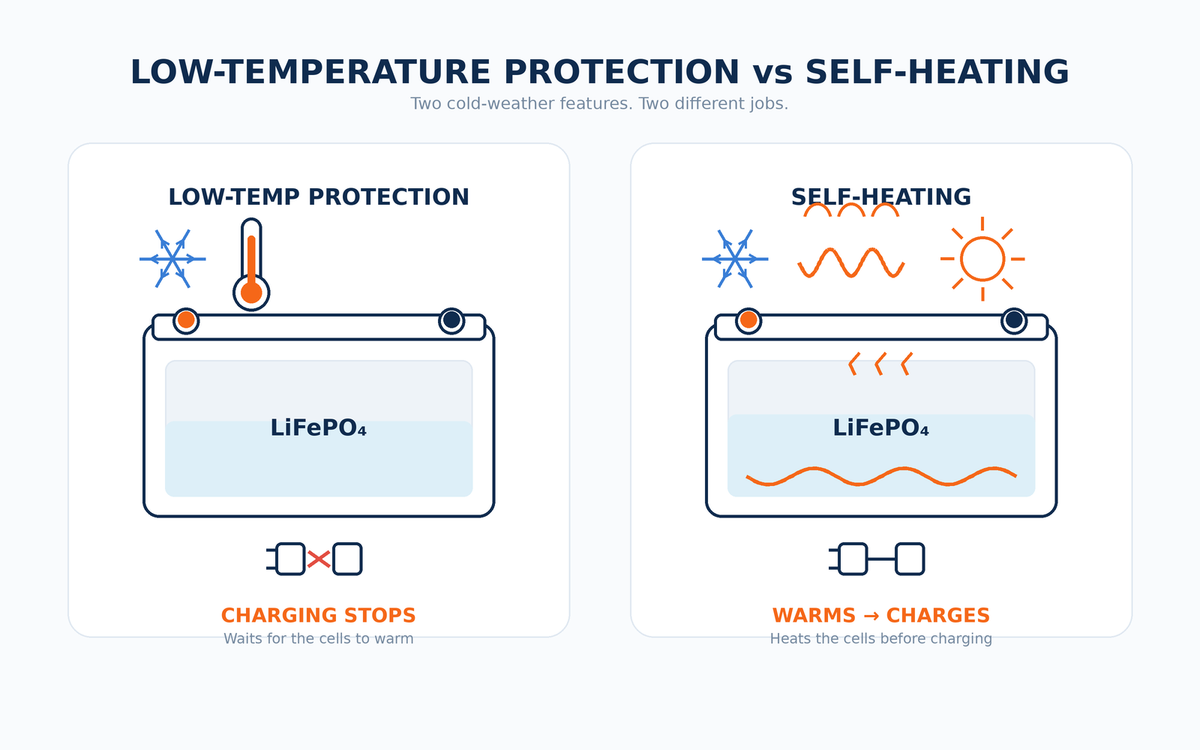
What each cold-weather feature does, when charging stops, and when an internal heater is useful
Cold-weather battery specifications often place low-temperature protection and self-heating side by side. They solve related problems, but they do not do the same job. One pauses charging; the other warms the cells so charging can restart.
Why charging in the cold needs special care
LiFePO4 batteries can operate in cold weather, but charging becomes the main concern as cell temperature falls. Lithium-ion movement slows and internal resistance rises. Charging under unsuitable low-temperature conditions can cause lithium plating inside the cells.
Lithium plating can contribute to capacity loss, higher internal resistance, faster aging, and shorter battery life. That is why a battery may block charging even when it can still power connected equipment.
How low-temperature protection works
Low-temperature protection is a BMS safety function. A temperature sensor monitors the battery, and the BMS stops charging when the cells become too cold. Charging remains blocked until the battery warms to its recovery temperature.
Temperature sensor > BMS detects low temperature > charging stops
The important limitation is simple: this feature does not warm the battery. It prevents charging under unsuitable conditions and waits for the temperature to rise.

How self-heating works
A self-heating LiFePO4 battery contains internal heating elements. When the cells are too cold and the required charging conditions are present, the heater warms the battery before normal charging begins.
Low temperature > heating starts > safe temperature > normal charging
Self-heating normally runs only when the battery is cold and the system meets its heating or charging requirements. It is not a heater that operates continuously. Some designs use incoming charger power, while others may also draw from stored battery energy.

The two features compared
Both features prevent normal charging when the cells are too cold. Their response is different: low-temperature protection waits, while self-heating actively works to bring the battery back into its permitted charging range.
|
Feature |
Low-Temperature Protection |
Self-Heating |
|
Stops cold charging |
Yes |
Yes |
|
Actively warms battery |
No |
Yes |
|
Heating element |
No |
Yes |
|
Energy use |
Very low |
Higher |
|
Cost and complexity |
Lower |
Higher |
|
Best fit |
Occasional cold weather |
Frequent winter charging |
Can the battery still discharge below freezing?
Often, yes. Charging and discharging usually have different temperature limits. A battery may continue to run lights, appliances, or other equipment in conditions where the BMS will not allow charging.
Cold conditions can still reduce available capacity and power. Always use the operating limits published for the exact battery model, because a battery's ability to discharge in the cold does not mean it is ready to accept charge.

When self-heating is useful
Self-heating is most useful when a battery needs to recharge automatically while it is still below its permitted charging temperature. That situation is common in winter RV camping, off-grid cabins, cold-weather solar systems, marine installations, and outdoor battery enclosures.
For occasional cold weather, low-temperature protection may be enough if the battery can warm naturally before charging is needed. For frequent winter charging, self-heating can reduce the waiting and make the system easier to operate.

Protection does not automatically mean heating
Low-temperature protection and self-heating are separate features. A battery can include a BMS charging cutoff without containing any heating element.
Do not assume that a battery will warm itself simply because its specifications mention low-temperature protection. Confirm the exact BUKNUWO model and its published cold-weather functions before planning winter use.
Questions to check before winter use
Start with the battery's permitted charging and discharging temperature ranges. Then confirm whether the model provides a charging cutoff, an internal heater, or both.
If the battery is self-heating, check the conditions required to start the heater and where its energy comes from. If it only has low-temperature protection, plan for the battery to warm before charging can resume.
Choosing the feature that fits the application
Low-temperature protection is the essential safeguard: it stops charging when the cells are too cold. Self-heating adds convenience by warming the cells first so charging can begin once a permitted temperature is reached.
Choose based on how often the battery must charge in freezing conditions. Occasional exposure may only require reliable protection. Regular unattended winter charging is where self-heating offers the clearest practical benefit.
Frequently Asked Questions
Can LiFePO4 batteries charge below freezing?
Only if the battery manufacturer allows it or the battery has an approved heating system.
What happens when low-temperature protection activates?
The BMS stops charging until the battery warms to the recovery temperature.
Does self-heating work all the time?
No. It normally activates only when the battery is cold and the required charging or heating conditions are met.
Does self-heating use battery energy?
It can. Some systems use charger power, while others may also use stored battery energy.
Does every BUKNUWO battery have self-heating?
No. Low-temperature protection and self-heating are separate features and vary by model.