
Weekend Use vs Full-Time Off-Grid Use: How Battery Planning Changes
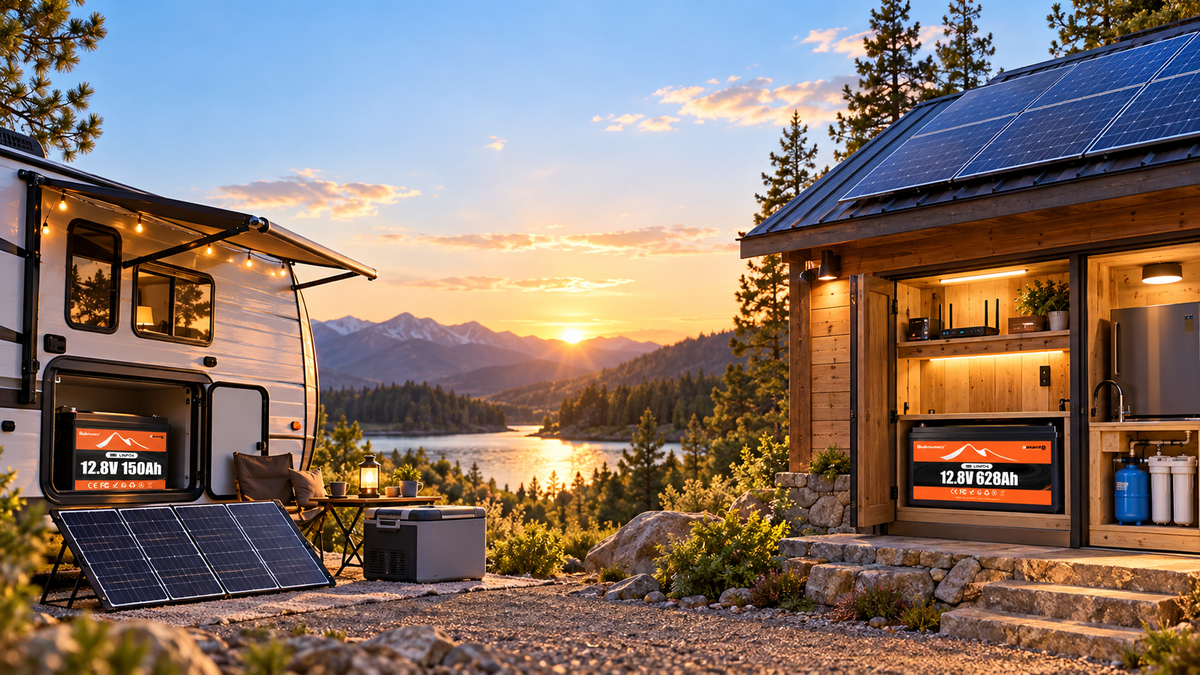
Quick answer: Weekend battery planning usually focuses on covering a known trip and recharging afterward. Full-time off-grid battery planning must repeatedly balance daily consumption, daily energy production, seasonal changes and several low-solar days. The difference is not simply buying a larger battery. A dependable full-time system also needs a charging source that can replace the energy used, a reserve policy, load priorities and a plan for unfavorable conditions.
Weekend use and full-time off-grid use solve different problems
A weekend system has a defined beginning and end. You may charge the battery at home, use it for one or two nights and recharge after returning. Temporary poor solar production may be inconvenient, but it does not always determine the success of the entire system.
A full-time off-grid system operates as a continuing energy cycle:
Generate energy → store energy → power loads → restore the energy used
If daily use repeatedly exceeds daily charging, even a large battery will eventually reach a low state of charge. For that reason, weekend vs full-time off-grid battery planning should compare energy flow—not battery capacity alone.
The main planning differences
| Planning factor | Weekend or occasional use | Full-time off-grid use |
|---|---|---|
| Primary goal | Cover a defined trip or activity | Maintain a repeatable daily energy balance |
| Starting condition | Battery can often begin fully charged | State of charge changes from one day to the next |
| Recharge timing | Recharging after the trip may be acceptable | Energy normally needs to be replenished while the system remains in use |
| Weather reserve | May only need limited contingency time | Often needs a plan for consecutive low-production days |
| Load flexibility | Optional equipment can often be left at home | Daily refrigeration, water, lighting and communication may be recurring loads |
| Monitoring | Periodic checks may be sufficient | Regular energy review and seasonal adjustment become more important |
| System design | Compactness and portability may lead | Serviceability, redundancy and recharge capacity carry more weight |
Start with daily energy, not the number of days alone
Two users can both say they need power for a weekend while having completely different requirements. One may run LED lights, phones and a small fan. Another may also operate refrigeration, a water pump, communications equipment and work devices.
List each device and estimate its daily energy:
Daily energy (Wh) = device watts × hours used per day
For cycling equipment such as refrigerators and pumps, use measured daily energy or manufacturer data when available. Do not assume the nameplate's maximum power runs continuously, and do not ignore motor startup current.
Create three groups:
- Essential loads: equipment that must remain available for the plan, such as selected refrigeration, water controls or communication.
- Flexible loads: equipment that can be delayed until good charging conditions return.
- Optional loads: convenience equipment that can be switched off first.
This classification has limited importance on a short trip with plenty of reserve. It becomes central when living off-grid full time.
How weekend battery planning works
A weekend plan normally starts with the expected trip energy. Add the daily watt-hours, multiply by the number of days and include a reasonable reserve for longer fan operation, colder refrigerator settings, additional device charging or delayed departure.
Then ask four questions:
- Can the battery cover the planned trip without depending on perfect solar conditions?
- Can the battery and BMS support continuous demand and brief startup current?
- Is the battery practical to mount or transport?
- Can it be recharged before the next trip?
For a short, light-use system, it can be reasonable to prioritize simplicity over a large permanent solar installation. Solar may reduce battery use during the day, but the system does not have to be described as energy-independent.

How full-time off-grid planning changes
Full-time planning starts with the same load list, but it must answer a harder question: can the system recover the energy used every day across changing seasons?
A larger battery can store more energy from productive days and extend the time before low state of charge. It cannot create energy. If the solar array, other charging source or available charging window is too small, increasing battery capacity may only delay the same energy deficit.
A full-time plan should consider:
- Average daily consumption and a demanding-day case
- Solar production during the weakest relevant season
- Consecutive cloudy or shaded days
- Charging-controller and charger limits
- How quickly the battery can recover after a low-production period
- Loads that must remain available at low state of charge
- Alternative charging or deliberate load reduction
- Routine inspection, monitoring and service access
The goal is not to make every day identical. It is to build operating rules that keep energy use within what the system can reasonably supply.
Battery reserve means something different in full-time use
For a weekend trip, reserve may mean enough energy for an extra evening or an unexpected increase in fan use. In a full-time system, reserve is also a bridge between periods of energy production.
Instead of assigning one universal reserve percentage, define operational action points. For example:
- At the first threshold, postpone flexible loads.
- At a lower threshold, operate only essential loads.
- If poor charging continues, use an appropriate alternative source or follow the site's contingency plan.
The exact thresholds should follow the battery, monitoring equipment and system design. A Bluetooth state-of-charge reading is useful, but it should be considered together with current, recent energy use, charging conditions and known system limits.

100Ah, 150Ah, 314Ah and 628Ah planning roles
The following table shows potential planning roles, not fixed recommendations. A small, efficient full-time system could use less energy than a heavily equipped weekend system.
| BUKNUWO model | Nominal energy | Potential planning role | Main tradeoff to check |
|---|---|---|---|
| 12.8V 100Ah | 1,280Wh | Light occasional use, short stays or a compact system with frequent charging | Limited reserve when refrigeration, pumps or longer fan use are added |
| 12.8V 150Ah | 1,920Wh | Weekend systems needing more reserve without moving immediately to a large fixed bank | Still requires a realistic load and recharge calculation |
| 12.8V 314Ah | About 4,019Wh | Longer stays, higher daily energy or focused off-grid essential loads | Greater weight, space and recharge time |
| 12.8V 628Ah | About 8,038Wh | Extended energy reserve or full-time systems with a verified higher daily requirement | Charging source, mounting, weight and recovery time become critical |
A 628Ah battery stores approximately twice the nominal energy of a 314Ah battery. That does not mean every system will run exactly twice as long, nor does it automatically mean twice the usable output power. Actual performance depends on load behavior, system efficiency, wiring, temperature, charging and the battery's documented current limits.

A larger battery does not fix an undersized charging system
Suppose a full-time system uses more energy each day than its solar equipment normally restores. Installing a larger battery can extend the time before the shortage becomes obvious, but the long-term imbalance remains.
When increasing battery capacity, review:
- Solar-array output in the actual installation
- MPPT controller input and output limits
- LiFePO4 charging profile and recommended battery charge current
- Cable and fuse ratings
- Available charging hours
- Time required to return from a low state of charge
Solar production varies with weather, shade, season, panel angle and temperature. Use the site's weaker-season conditions when planning a full-time system rather than relying only on ideal panel wattage. See the BUKNUWO solar connection guide for the basic panel-to-controller-to-battery path.
Startup current remains a separate requirement
Refrigerators, pumps, fans and other motor-driven equipment may briefly draw more current while starting. Increasing amp-hour capacity does not automatically prove that the battery, BMS, cables, protection and connectors can support the peak.
Check both:
- Energy requirement: how many watt-hours the system uses over time
- Current requirement: the combined running current and plausible simultaneous startup current
Use equipment-manufacturer startup data instead of applying one assumed multiplier to every motor. The 12V water-pump application guide provides a more focused example.
Full-time systems need seasonal planning
A setup that works comfortably during long summer days may become constrained when daylight hours decrease, panels are shaded or seasonal loads rise. Full-time users should review the energy plan before conditions change.
Seasonal review can include:
- Recent daily consumption from monitoring records
- Expected solar production in the coming season
- Changes in refrigeration, ventilation, water pumping and communications
- Battery and charger temperature limits
- Maintenance, connector inspection and panel cleaning
- The operating plan for several poor-production days
BUKNUWO smart batteries can provide local Bluetooth access to information such as state of charge, voltage and current. Bluetooth is short-range monitoring; it should not be presented as remote site management or as a replacement for an independent critical-system alarm.

Portability versus permanent installation
Weekend systems may benefit from compact equipment that can be removed, stored and charged elsewhere. Full-time systems are more likely to need permanent mounting, protected distribution, clear labeling and service access.
In either case:
- Mount the battery securely in a dry, protected and appropriately ventilated location.
- Cover terminals and protect cables from abrasion, movement and accidental contact.
- Use overcurrent protection selected for the conductor and equipment.
- Confirm structural support for high-capacity batteries.
- Follow battery, charger, controller and connected-equipment instructions.
BUKNUWO batteries discussed here are deep-cycle energy-storage batteries. They must not be used to start a vehicle, generator or other engine.
When a weekend system becomes a full-time system
A system should not be considered ready for full-time use simply because it completed several weekend trips. Weekend testing may not include the weakest solar season, consecutive cloudy days, long-term energy drift or sustained daily use.
Before changing the use pattern:
- Measure several days of real consumption.
- Separate essential, flexible and optional loads.
- Compare consumption with realistic weak-season charging.
- Choose the desired low-production reserve.
- Confirm current and startup compatibility.
- Check mounting, cable, fuse, controller and charger limits.
- Estimate recovery time after the reserve has been used.
- Write a low-energy operating and backup plan.
This review may show that more battery capacity is needed, but it may instead identify a charging shortfall, unnecessary continuous load or wiring limitation.
Common planning mistakes
- Choosing a battery only from the number of days away
- Treating average summer solar production as a year-round guarantee
- Increasing battery capacity without checking recharge time
- Ignoring loads that remain active overnight
- Assuming all appliances run at one constant wattage
- Ignoring motor startup current and voltage drop
- Using every load as “essential”
- Expecting Bluetooth monitoring to provide remote site control
- Planning full-time use from one successful weekend
Frequently asked questions
Is a 100Ah battery enough for weekend off-grid use?
It may be enough for a light, measured load plan with regular recharging. Refrigeration, pumps, fan runtime, weather and other shared loads can change the result, so capacity should be compared with total trip watt-hours.
Is 150Ah suitable for a two- or three-day trip?
A 150Ah battery provides 1,920Wh of nominal energy and may fit some weekend systems, but trip length alone cannot determine compatibility. Daily energy, startup current, reserve and charging access still need to be checked.
Does full-time off-grid living always require 314Ah or 628Ah?
No. An efficient full-time system with modest loads and dependable charging may require less energy than a high-consumption weekend setup. The higher-capacity models become relevant when the calculated daily energy and reserve goals justify them.
Is 628Ah automatically better than 314Ah?
The 628Ah model stores approximately twice the nominal energy, which can increase reserve under comparable loads. It also takes more space and can require more time or charging capacity to replenish. It is not automatically the better system choice.
Can solar make a system fully independent?
Solar can supply substantial energy, but production changes with real conditions. Full-time planning should include weak-season output, low-production days, load priorities and an appropriate contingency rather than promising complete independence.
What is the biggest difference between weekend and full-time planning?
Weekend planning primarily asks whether stored energy can cover a defined trip. Full-time planning asks whether the system can repeatedly replace the energy it consumes while maintaining reserve through changing conditions.
Final takeaway
Weekend and full-time off-grid systems begin with the same information—device demand, operating time and startup current—but use it differently. A weekend user may focus on total trip energy and recharging afterward. A full-time user must continuously balance consumption, charging, reserve and seasonal variability.
Compare the BUKNUWO 100Ah, 150Ah, 314Ah and 628Ah batteries only after defining that operating pattern. More capacity can extend stored-energy reserve, but charging capacity, load priorities and recovery time determine whether the complete system remains practical.
For related examples, see the camping battery capacity guide, home backup battery guide and 150Ah RV runtime guide.
Planning note: This article provides general information rather than a guarantee of autonomy or compatibility. Follow all equipment specifications and use a qualified installer when system design, protection or wiring is uncertain.