
How Long Will a 150Ah LiFePO4 Battery Last in an RV?
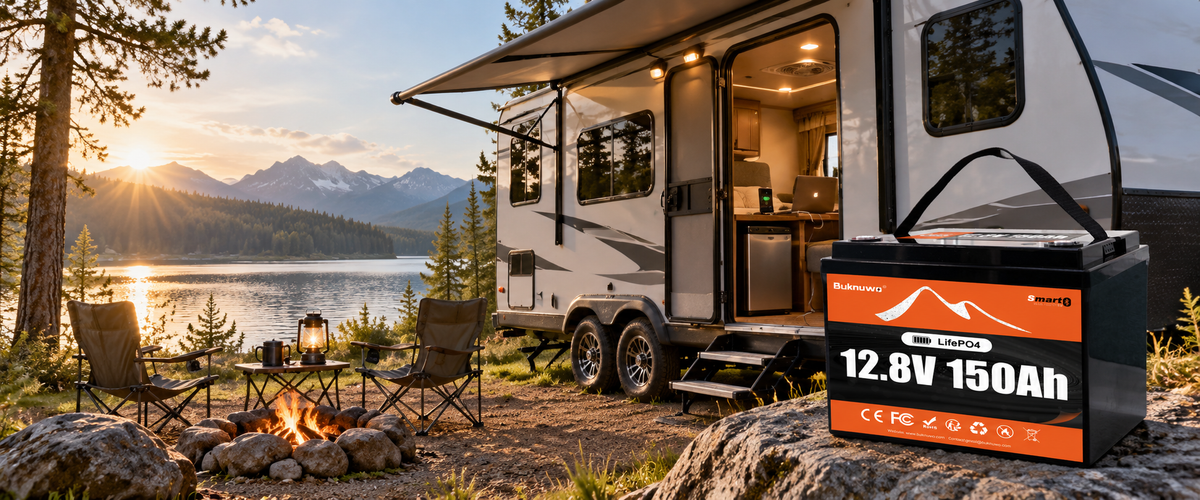
A 150Ah LiFePO4 battery can support common RV essentials for a weekend or longer, but there is no single runtime that applies to every RV. The result depends on the battery’s stored energy, the appliances you use, how long they run, whether they are powered by DC or through an inverter, and whether solar or another charging source is available.
The BUKNUWO 12.8V 150Ah Bluetooth LiFePO4 battery stores 1,920Wh of nominal energy. For the examples in this guide, we reserve 10% and use the remaining 90%—approximately 1,728Wh—as a planning value before any additional conversion losses.
Short answer: If an RV consumes about 800Wh per day, a 150Ah battery provides roughly two days of calculated runtime under the assumptions used in this guide. At approximately 1,130Wh per day, the result is about 1.5 days. These are planning examples, not guaranteed runtimes.

How Much Energy Is in a 150Ah LiFePO4 Battery?
Amp-hours alone do not tell you the battery’s total energy. To compare battery capacity with appliance consumption, convert amp-hours into watt-hours:
Nominal battery energy = Nominal voltage × Rated capacity
For the BUKNUWO 12.8V 150Ah battery:
12.8V × 150Ah = 1,920Wh
This means the battery stores 1.92kWh of nominal energy. Nominal energy should not be treated as a guaranteed amount delivered to every appliance. Battery protection settings, operating temperature, current, wiring, voltage drop, connected equipment and the reserve you choose to keep can reduce the energy available in actual use.
Use a Planning Energy Value
For the examples in this guide, we assume a 90% planning discharge window, meaning 10% of nominal energy is kept as a reserve:
1,920Wh × 90% = 1,728Wh
This is a calculation assumption—not a guaranteed usable-capacity specification and not a required depth of discharge. You may choose a larger reserve based on your trip, equipment and operating conditions.
Important: “90% planning energy” and “90% inverter efficiency” are two different assumptions. Do not combine or describe them as one product efficiency rating.
The Simple RV Battery Runtime Formula
For a relatively steady DC load:
Estimated runtime = Planning battery energy ÷ Load power
For example, a constant 100W DC load:
1,728Wh ÷ 100W = 17.28 hours
For appliances that cycle on and off, it is usually better to use measured daily energy in watt-hours:
Estimated days = Planning battery energy ÷ Daily appliance energy

How Long Can a 150Ah Battery Run Common RV Appliances?
The following illustrative RV appliance energy assumptions use 1,728Wh of planning energy. They assume each appliance is the only load connected and that it is powered directly by a compatible DC system. Real RVs normally operate several loads at the same time; use measured consumption whenever possible.
| Example load | Illustrative daily energy | Share of 1,728Wh per day | Equivalent runtime if this were the only load |
|---|---|---|---|
| 12V refrigerator | 480Wh | 27.8% | Approximately 3.6 days; temperature and duty cycle matter |
| LED lighting | 120Wh | 6.9% | Approximately 14.4 days; quantity and hours matter |
| Ventilation fan | 125Wh | 7.2% | Approximately 13.8 days; fan speed matters |
| Water pump | 30Wh | 1.7% | Approximately 57.6 days; normally intermittent |
| Phones and tablets | 60Wh | 3.5% | Approximately 28.8 days; charging losses excluded |
| Laptop | 195Wh | 11.3% | Approximately 8.9 days; adapter and use vary |
| Television | 120Wh | 6.9% | Approximately 14.4 days; size and brightness matter |
Do not interpret the single-appliance results as a promise that an RV will operate for that many days. The results show how much of the battery’s energy each example load would consume by itself.

Why Refrigerator Runtime Is Different
An RV refrigerator does not usually draw its rated power continuously for 24 hours. A compressor starts, runs for a period and stops after the target temperature is reached. The percentage of time it operates is called its duty cycle.
Refrigerator energy consumption changes with:
- Ambient temperature
- Thermostat setting
- Food temperature
- Door-opening frequency
- Ventilation around the refrigerator
- Compressor efficiency
- Whether the refrigerator is powered by DC or through an inverter
For better planning, use the refrigerator manufacturer’s daily energy value or measure consumption over at least 24 hours. If a refrigerator uses 480Wh per day:
1,728Wh ÷ 480Wh/day = 3.6 days
This result assumes the refrigerator is the only load and no charging energy enters the battery.
A More Realistic Weekend RV Example
A typical RV uses several appliances. Consider this illustrative daily energy plan:
| RV load | Example daily energy |
|---|---|
| 12V refrigerator | 480Wh |
| LED lights | 120Wh |
| Water pump | 30Wh |
| Ventilation fan | 125Wh |
| Phones and tablets | 60Wh |
| Laptop | 195Wh |
| Television | 120Wh |
| Total | 1,130Wh per day |
Using the 1,728Wh planning-energy value:
1,728Wh ÷ 1,130Wh/day ≈ 1.53 days
In this example, one 150Ah battery would not quite cover two full days without charging. Reducing nonessential loads, adding solar or charging while driving could extend the trip.
Essential-load version
If the laptop and television are removed, daily consumption falls to:
1,130Wh − 195Wh − 120Wh = 815Wh per day
The simplified result becomes:
1,728Wh ÷ 815Wh/day ≈ 2.12 days
This demonstrates why runtime is controlled by how the battery is used, not by capacity alone.

DC Loads vs. AC Loads
Compatible 12V appliances can be powered from a properly designed DC distribution system. Household-style AC appliances require an inverter, which introduces conversion loss and standby consumption.
For an AC load, a simplified planning equation is:
Estimated AC runtime = Planning battery energy × Inverter efficiency ÷ AC load
Using 1,728Wh of planning energy and an illustrative 90% inverter-efficiency assumption:
1,728Wh × 90% = approximately 1,555Wh delivered in this simplified AC example
| Constant AC load | Simplified runtime |
|---|---|
| 100W | Approximately 15.6 hours |
| 500W | Approximately 3.1 hours |
| 1000W | Approximately 1.6 hours |
Actual inverter efficiency is not fixed. It changes with inverter design and load level. The 90% value is an example assumption, not a guaranteed rating for an inverter or BUKNUWO battery.
Power-compatibility warning: A 1,000W AC load can require about 87A from a 12.8V battery at 90% inverter efficiency, and approximately 101A if battery-side voltage falls to 11V. That can approach or exceed this battery’s 100A maximum continuous discharge rating. The runtime estimate above does not confirm that every 1,000W appliance or inverter setup is compatible.
Battery Runtime and Instantaneous Power Are Different
A battery can contain enough energy to run an appliance for the desired time but still be unable to supply the appliance’s required current. Runtime is an energy question. Starting and running an appliance is a power and current question.
The BUKNUWO 12.8V 150Ah battery has a 100A maximum continuous discharge rating. At nominal voltage:
12.8V × 100A = approximately 1,280W of DC power before conversion losses
High-power heating appliances, microwave ovens, air conditioners and motor-driven equipment require additional system checks. The battery BMS limit, appliance startup demand, inverter limits, wiring and circuit protection must all be compatible.
Safety note: Do not use a BMS over-current protection threshold as a target operating current or as a guaranteed surge-power rating.
What Reduces Actual Battery Runtime?
- Several appliances running at the same time
- Inverter conversion and standby losses
- Voltage drop in cables and connections
- Hot or cold battery temperatures
- High discharge current
- Battery age and condition
- BMS or inverter low-voltage cutoff
- Hidden standby loads
- Leaving a larger reserve state of charge
Bluetooth monitoring can help the user observe battery state of charge, voltage, current and operating status. It does not replace an energy audit, but it can help identify higher-than-expected consumption during a trip.
How Solar Charging Changes Runtime
If solar energy enters the battery during the day, runtime is no longer determined by stored battery energy alone:
Daily battery energy change = Daily consumption − Daily charging energy
If the RV uses 1,130Wh per day and the solar system returns 800Wh to the battery, the net daily reduction is approximately:
1,130Wh − 800Wh = 330Wh per day
Actual solar production changes with location, season, peak sun hours, shading, temperature, panel orientation, wiring and controller limits. For solar-array and MPPT calculations, use the separate RV solar sizing guide rather than assuming panel nameplate wattage is produced all day.
Read: How Much Solar Power Do I Need for My RV Battery?
When Is One 150Ah Battery Enough?
One 150Ah battery may be a practical fit when:
- The trip is mainly a weekend or short stay.
- The RV uses efficient 12V refrigeration, lighting, fans and pumps.
- High-power electric heating and cooking loads are limited.
- Solar, shore power or vehicle charging is available.
- Daily energy consumption is measured and controlled.
A larger battery bank may be needed when:
- Daily energy use consistently approaches or exceeds available battery energy.
- The RV must operate for several days without charging.
- Cold or cloudy conditions reduce solar production.
- Several occupants use electronics and appliances heavily.
- High-current AC loads are part of the system design.
When adding batteries, use matching batteries with the same model, voltage, capacity and similar state of charge, and follow the product instructions for series and parallel connections.
View the BUKNUWO 12.8V 150Ah Bluetooth LiFePO4 Battery
Common Battery Runtime Calculation Mistakes
- Using Ah without converting to Wh.
- Assuming every appliance runs at full power all day.
- Ignoring refrigerator and air-conditioner duty cycles.
- Ignoring inverter conversion and standby losses.
- Calculating one appliance while forgetting other RV loads.
- Treating a calculated runtime as guaranteed performance.
- Ignoring solar, alternator or shore-power charging.
- Confusing stored energy with maximum output current.
- Using appliance output power instead of electrical input power.
- Running the battery to the protection cutoff on every trip.
Frequently Asked Questions
How long will a 150Ah LiFePO4 battery last in an RV?
It depends on daily energy use. With 1,728Wh of planning energy, an RV using 800Wh per day has a simplified runtime of approximately 2.16 days. At 1,130Wh per day, the result is approximately 1.53 days before charging.
How many watt-hours are in a 12.8V 150Ah battery?
A 12.8V 150Ah battery has 1,920Wh, or 1.92kWh, of nominal energy.
How long will a 150Ah battery run a 12V refrigerator?
If the refrigerator consumes 480Wh per day and it is the only load, 1,728Wh of planning energy gives a simplified result of approximately 3.6 days. Actual runtime varies with temperature, duty cycle, door openings and other connected loads.
Is a 150Ah LiFePO4 battery enough for weekend camping?
It can be. In the essential-load example in this guide, daily consumption is 815Wh and the simplified runtime is approximately 2.12 days. Calculate your own loads before relying on this result.
Can solar make a 150Ah RV battery last longer?
Yes. Solar charging reduces the amount of stored battery energy used each day. The result depends on actual solar production and daily consumption, not panel wattage alone.
Can I connect two 150Ah batteries in parallel?
Matching BUKNUWO 12.8V 150Ah batteries can be connected in parallel according to the product instructions to increase capacity while maintaining the same nominal voltage. Use matching batteries at similar states of charge and a properly designed balanced connection.
Does Bluetooth make the battery last longer?
No. Bluetooth monitoring does not add energy. It helps the user observe state of charge, voltage, current and battery status so energy use can be managed more effectively.
Calculate Runtime from Your Own RV
Start with 1,920Wh of nominal battery energy, choose a transparent reserve or planning factor, and record the actual watt-hours used by every appliance each day. Include conversion losses for AC appliances and subtract energy returned by solar or other charging sources.
Your result will be more useful when it is based on measured daily energy rather than generic appliance wattage.
Read: What Size Lithium Battery Do I Need for My RV?
Read: How Much Solar Power Do I Need for My RV Battery?
Explore BUKNUWO LiFePO4 Batteries for RV Applications
Methodology and Product Reference
The calculations use the confirmed BUKNUWO 12.8V 150Ah specifications: 12.8V nominal voltage, 150Ah rated capacity, 1,920Wh nominal energy and a 100A maximum continuous discharge rating. Examples use 90% of nominal energy as a planning value. AC examples separately use a 90% inverter-efficiency assumption. Neither percentage is a guaranteed performance specification.
Last updated: September 2026.
This article provides general planning information. Actual runtime depends on the battery, connected equipment, operating conditions, wiring, protection settings and charging sources. Follow all product manuals and installation requirements.