
Ah vs Wh: Battery Capacity & Energy Explained?
BATTERY BASICS
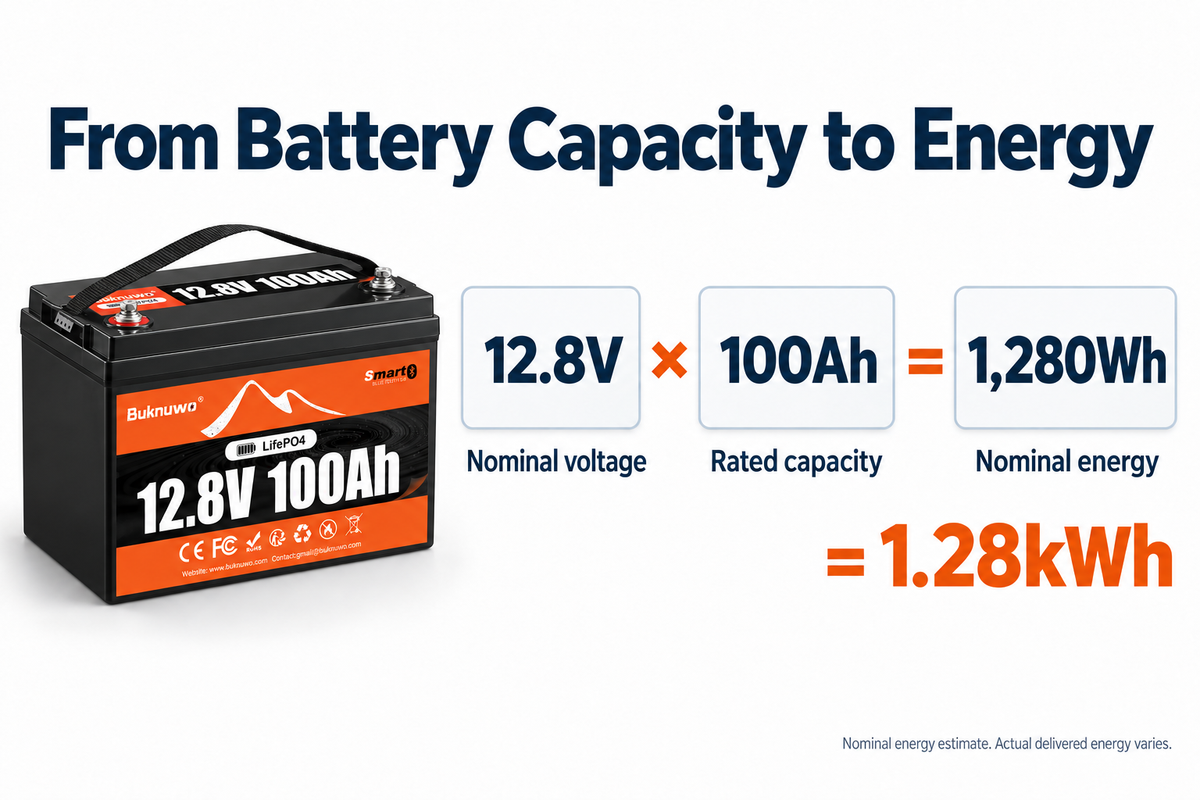
Amp-hours (Ah) measure a battery's charge capacity. Watt-hours (Wh) measure energy. To estimate a battery's nominal energy, multiply its nominal voltage by its rated amp-hours: 12.8V × 100Ah = 1,280Wh = 1.28kWh. State of charge (SOC) describes how much charge remains, while depth of discharge (DoD) describes how much has been removed relative to a defined capacity reference.
These numbers answer different questions. Voltage helps determine electrical compatibility. Ah describes charge capacity. Wh lets you compare energy across different battery voltages. SOC, your chosen discharge window, and system losses help estimate how much of that energy is available for use.
This guide connects those ideas using simple LiFePO4 examples for RV, solar, and backup power. The calculations are educational examples, not measured performance claims for a particular BUKNUWO model.
What Do V, Ah, Wh, and kWh Mean?
Battery capacity is often used as a general term, but its meaning depends on the unit beside the number. A rating in Ah describes charge; a rating in Wh or kWh describes energy.
| Term | Unit | What it describes | Example |
|---|---|---|---|
| Voltage | V | Electrical potential difference | 12.8V nominal |
| Current | A | Rate of electric charge flow | A 10A discharge |
| Charge capacity | Ah | Charge delivered over time under stated conditions | 100Ah rated capacity |
| Power | W | Rate of energy use or delivery | A 100W load |
| Energy | Wh | Power accumulated over time | 1,280Wh nominal energy |
| Energy in larger units | kWh | 1,000 watt-hours | 1.28kWh |
Voltage: the electrical level
Voltage matters because the battery must match the requirements of the charger, inverter, and other connected equipment. A battery with more stored energy is not automatically compatible with a device designed for a different voltage.
Nominal voltage is a reference value used to describe the battery. Its measured terminal voltage changes during charging and discharging. In common LiFePO4 configurations, a nominal 12.8V battery belongs to the 12V system class; that does not mean its terminal voltage stays at exactly 12.8V.
Amp-hours: charge over time
For a constant current, the basic relationship is:
Charge (Ah) = current (A) × time (h)
A steady 10A current flowing for 5 hours transfers 50Ah of charge. That calculation describes the charge transferred; it does not specify the energy without voltage information.
A 100Ah rating also does not mean the battery is rated to supply 100A. Permitted continuous and peak current are separate specifications. Actual delivered capacity depends on the manufacturer's rating conditions and the conditions in use.
Watt-hours and kilowatt-hours: energy
For a constant load, energy use is:
Energy (Wh) = power (W) × time (h)
A 100W appliance operating continuously for 5 hours uses 500Wh at the appliance. If an inverter supplies that appliance from a battery, the battery must provide additional energy to cover conversion losses.
1kWh = 1,000Wh
The difference between W and Wh is essential: watts tell you how quickly energy is being used; watt-hours tell you how much is used over time.
How Do You Convert Ah to Wh?
To compare battery nameplate ratings, use nominal voltage and rated capacity:
Nominal energy (Wh) = nominal voltage (V) × rated capacity (Ah)
For a battery rated at 12.8V and 100Ah:
12.8V × 100Ah = 1,280Wh = 1.28kWh

You can reverse the same relationship when voltage is known:
Capacity (Ah) = nominal energy (Wh) ÷ nominal voltage (V)
For example, 1,280Wh ÷ 12.8V = 100Ah. Dividing the same 1,280Wh by 25.6V gives 50Ah. There is no single Ah-to-Wh conversion factor that works at every voltage.
Nominal energy is a reference, not a runtime guarantee
Actual battery energy is determined by the voltage and current delivered throughout the discharge. Voltage is not constant, and the endpoint depends on the battery and connected equipment. Temperature, load, aging, and protection limits also affect the result.
Use the manufacturer's stated energy rating when available. Do not multiply a temporary charging-voltage reading by rated Ah and present the result as extra stored energy.
Why Ah Alone Cannot Compare Different Voltages
Two batteries can have the same Ah rating and different nominal energy. They can also have different voltage and Ah ratings but the same nominal energy.
| Illustrative battery rating | Calculation | Nominal energy |
|---|---|---|
| 12.8V 100Ah | 12.8 × 100 | 1,280Wh / 1.28kWh |
| 25.6V 100Ah | 25.6 × 100 | 2,560Wh / 2.56kWh |
| 12.8V 200Ah | 12.8 × 200 | 2,560Wh / 2.56kWh |
The first two examples both have 100Ah, but the 25.6V example has twice the nominal energy. The second and third examples have equal nominal energy even though their Ah ratings differ.

At the same voltage, a larger Ah rating generally means more nominal energy. Across different voltages, convert to Wh first. For the battery chemistry behind these ratings, see What Is a LiFePO4 Battery?.
What Does State of Charge (SOC) Mean?
State of charge estimates the charge remaining as a percentage of a defined full-charge capacity. Using a simplified 100Ah reference, 80% SOC corresponds to approximately 80Ah remaining relative to that reference.
SOC (%) = remaining charge (Ah) ÷ reference capacity (Ah) × 100
That percentage does not tell you the battery's size by itself. A 200Ah battery and a 100Ah battery can both show 80% SOC while containing different amounts of charge. An aging battery can also report 100% SOC relative to a reduced full-charge capacity.
SOC is an estimate, not a direct energy measurement
A battery monitor or suitably equipped BMS may track current over time and use voltage, temperature, and calibration information to estimate SOC. LiFePO4 voltage changes relatively little across much of its operating range, so voltage alone is not a precise percentage indicator under all conditions.
Because SOC is charge-based here, 80% SOC should not be treated as exactly 80% of the nameplate Wh available to a load. Battery voltage, the chosen stopping point, and system losses still matter.
How Are SOC and Depth of Discharge Related?
Depth of discharge describes the fraction of the reference capacity that has been removed. If DoD is measured from full charge and uses the same reference capacity as SOC:
DoD (%) = 100% − SOC (%)
| Remaining charge: SOC | Charge removed from full: DoD |
|---|---|
| 100% | 0% |
| 80% | 20% |
| 50% | 50% |
| 20% | 80% |

The size of a particular discharge cycle is a related but different quantity. Going from 90% SOC to 30% SOC uses a 60-percentage-point SOC window. At the end, the full-reference DoD is 70%, because the battery is at 30% SOC.
This distinction prevents a common mistake: the final DoD and the amount used during the latest operating period are not always the same. Always check which meaning a specification, monitor, or calculation uses.
What Is Usable Battery Capacity?
Usable capacity is the portion available within the operating limits being considered. Be clear whether it is expressed as battery-side Ah, battery-side Wh, or energy delivered to an appliance after conversion.
Start with the selected SOC window
For a simplified charge-based calculation:
Usable charge (Ah) ≈ reference capacity (Ah) × (starting SOC − stopping SOC)
Use SOC as a decimal in that formula. For a hypothetical 100Ah reference, starting at 100% and stopping at 20% gives:
100Ah × (1.00 − 0.20) = 80Ah
This is an example of choosing an 80% operating window. It is not a universal recommendation for LiFePO4 batteries. Use the operating guidance for the specific battery and system.
Estimate the energy within that window
Using nominal voltage as an approximation:
12.8V × 80Ah ≈ 1,024Wh of battery-side energy
Equivalently, 1,280Wh × 0.80 ≈ 1,024Wh. This approximation assumes the chosen charge window maps proportionally to nominal energy; actual delivered Wh can differ because the voltage and available capacity vary.
If the same battery starts at 80% SOC and stops at 20%, the available window is 60 percentage points. Under the same simplified assumptions, that gives 60Ah and approximately 768Wh, not 1,024Wh.
Account for conversion losses separately
An AC appliance connected through an inverter receives less energy than the battery supplies. With an assumed 90% inverter efficiency:
Estimated AC energy ≈ 1,024Wh × 0.90 = 921.6Wh
The 90% figure is an example assumption, not a fixed efficiency for every inverter. Efficiency varies with load and equipment. Battery condition, wiring losses, and standby consumption may require additional allowances; this simplified calculation does not model them individually.

Avoid applying the same allowance twice. If a specification already states usable energy within an operating window, do not automatically multiply by that window again. Also check whether an energy rating describes battery DC output or AC output after an inverter.
How Do You Estimate Battery Runtime?
Once the energy available at the load is estimated, divide it by the load's average power:
Runtime (h) ≈ energy available at the load (Wh) ÷ average load power (W)
Using the preceding example with a steady 100W AC load:
921.6Wh ÷ 100W ≈ 9.2 hours
For a steady 200W load, the same assumed usable AC energy would give about 4.6 hours. In practice, changing the load can also change inverter efficiency and battery behavior, so treat these as planning estimates.
A refrigerator or pump may cycle on and off. Use measured energy over a representative period or a realistic average-power estimate rather than assuming its maximum label wattage runs continuously. Include other loads sharing the battery.
Energy and power limits must both work. A battery can contain enough Wh for a planned duration yet be unable to supply the required current or startup surge. The battery management system (BMS) can interrupt output when a protection limit is reached; it does not add stored energy.
Common Capacity and Energy Mistakes
- Comparing Ah without checking voltage. Equal amp-hours do not imply equal energy at different voltages.
- Treating Ah as a current rating. A 100Ah capacity label does not establish a 100A continuous discharge limit.
- Confusing W with Wh. A 1,000W appliance uses 1,000Wh only if it runs at that power for one hour.
- Assuming SOC equals usable AC energy. The reserve, capacity reference, voltage behavior, and conversion losses affect what reaches the appliance.
- Using a protection cutoff as the daily target. The selected operating window should follow the battery's documented use guidance.
- Counting losses or reserves twice. Identify what is already included in a usable-energy rating before adding another allowance.
Frequently Asked Questions
How many watt-hours is a 100Ah battery?
It depends on nominal voltage. At 12.8V, 100Ah corresponds to 1,280Wh of nominal energy. At 25.6V, the same 100Ah corresponds to 2,560Wh. Voltage is necessary to convert Ah to Wh.
Is 1kWh the same as 1,000W?
No. A kilowatt-hour is energy; a watt is power. A constant 1,000W load uses 1kWh in one hour. A constant 100W load uses the same 1kWh over ten hours, measured at the load.
Does a higher Ah rating always mean longer runtime?
At the same voltage and under comparable conditions, more Ah generally provides more nominal energy. Across different voltages or operating conditions, compare usable Wh and the actual load instead of relying on Ah alone.
Does 80% SOC mean 80% of the energy is available to use?
Not exactly. It describes remaining charge relative to a capacity reference. A stopping reserve may leave only part of that charge available, and voltage behavior plus conversion losses affect the energy delivered to the load.
Can I determine exact SOC from battery voltage?
Not under all conditions. LiFePO4 voltage depends on current, temperature, and rest time, and much of its voltage curve is relatively flat. A properly configured monitor can provide a more useful estimate than a single voltage reading.
Does a higher BMS amp rating increase battery capacity?
No. A BMS current rating concerns the current the design can handle under specified conditions. It does not change the cells' Ah capacity or add nominal Wh. The complete battery's documented limits remain the relevant specifications.
Continue Learning
Use this sequence when reading a battery specification: V establishes the voltage level; Ah describes charge capacity; V × Ah gives nominal Wh; SOC and DoD describe charge remaining and removed; the operating window and losses help estimate usable energy.
Continue with What Is a LiFePO4 Battery? for the chemistry overview and What Is a Battery Management System (BMS)? for protection and current-limit fundamentals.
When comparing BUKNUWO models, start with the documented nominal voltage and capacity, then check energy, current limits, and operating conditions against your system's needs.