
What Is a LiFePO4 Battery?-BUKNUWO
BATTERY BASICS
A LiFePO4 battery is a rechargeable lithium-ion battery that uses lithium iron phosphate as its positive electrode material. Also called an LFP battery, it is used in RV house power, solar energy storage, off-grid systems, and backup power.
For someone learning about batteries, understanding the chemistry is only the beginning. Voltage determines electrical compatibility, capacity helps describe how much charge a battery holds, and the battery management system helps keep operation within defined limits.
This guide explains how LiFePO4 batteries work, what their specifications mean, and how charging, temperature, and everyday use affect performance.
What Does LiFePO4 Mean?
LiFePO4 is the chemical formula for lithium iron phosphate: Li represents lithium, Fe represents iron, P represents phosphorus, and O4 represents four oxygen atoms.
The name identifies the battery’s positive electrode material, commonly called the cathode in battery specifications. LiFePO4 is one type of lithium-ion battery. Other lithium-ion chemistries include nickel manganese cobalt oxide, or NMC.
How Does a LiFePO4 Battery Work?
Inside a cell
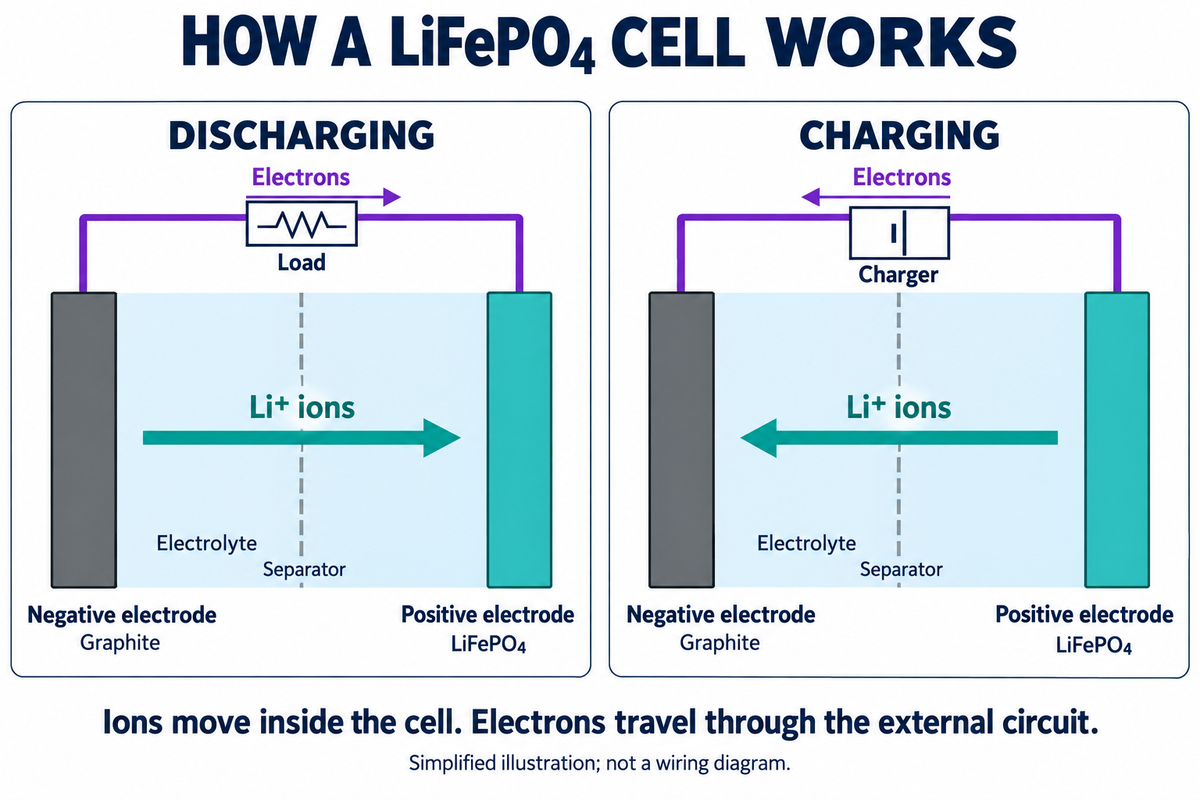
A typical LiFePO4 cell contains these functional components:
| Component | Main function |
|---|---|
| Positive electrode | Uses lithium iron phosphate to accept and release lithium ions |
| Negative electrode | Usually uses graphite to hold lithium ions during charging |
| Electrolyte | Allows lithium ions to move inside the cell |
| Separator | Keeps the electrodes apart while allowing ions to pass |
| Current collectors | Carry electrons between the electrodes and cell terminals |
These components work together; the electrolyte is not the path that electrons take through the external circuit.
Charging and discharging
During discharge, lithium ions move from the negative electrode toward the positive electrode. Electrons flow through the external circuit, supplying energy to connected equipment.
During charging, an external power source drives the process in the opposite direction, restoring stored chemical energy. This reversible process allows a rechargeable battery to be used repeatedly.

From cells to a battery pack
A finished battery combines cells, electrical connections, an enclosure, terminals, and protection electronics. Some designs contain the complete BMS inside the battery; others require an external management system. Check whether a product is a complete battery, a module, or an individual cell.

What Do Voltage, Ah, and Wh Tell You?
These specifications answer different questions. Reading them together gives you a more useful picture of the battery.
Nominal voltage: the battery’s voltage class
A typical LiFePO4 cell has a nominal voltage of approximately 3.2V. Four connected in series produce:
4 × 3.2V = 12.8V nominal
This is why a battery sold for a “12V” system may list 12.8V on its specifications.
Nominal voltage is a reference value. Actual voltage changes during charging and discharging, and the required charging voltage is higher than the nominal rating. For compatibility, compare the battery’s full operating voltage range with the equipment’s input requirements.
Capacity and energy: Ah versus Wh
Amp-hours (Ah) describe charge capacity. Watt-hours (Wh) describe energy.
To calculate a battery’s nominal energy from its label:
Nominal energy (Wh) = Nominal voltage (V) × Rated capacity (Ah)
For a 12.8V 100Ah battery:
12.8V × 100Ah = 1,280Wh = 1.28kWh
BUKNUWO lists its 12V 100Ah Bluetooth LiFePO4 battery at 12.8V, 100Ah, and 1,280Wh. These are published product specifications, not an independent capacity test. BUKNUWO product specifications
| Example specification | Nominal energy |
|---|---|
| 12.8V 100Ah | 1,280Wh |
| 25.6V 100Ah | 2,560Wh |
Both examples have the same Ah rating, but the second has twice the nominal energy. Actual energy delivered in a discharge also depends on voltage throughout the discharge, load, temperature, battery condition, and cutoff settings.
Usable energy and runtime
For a simple AC-powered example, assume a fully charged 12.8V 100Ah battery, use of 80% of its nominal energy, 90% inverter efficiency, and a constant 100W AC load. Ignore additional standby and wiring losses for this calculation.
Estimated AC energy = 1,280Wh × 0.80 × 0.90 = 921.6Wh
Estimated runtime = 921.6Wh ÷ 100W ≈ 9.2 hours
The 80% energy allowance and 90% inverter efficiency are teaching assumptions. They are not a recommended operating limit, a guaranteed efficiency, or a measured BUKNUWO runtime. The energy allowance is also not an exact conversion from DoD, which is defined using charge capacity.

State of charge (SOC) describes the proportion of charge remaining. Depth of discharge (DoD) describes the proportion removed relative to a full-charge reference. When both use the same capacity reference and DoD is measured from that full-charge point:
SOC + DoD ≈ 100%
For example, 80% SOC corresponds to approximately 20% DoD under that convention. A discharge from 80% SOC to 30% SOC uses a 50-percentage-point SOC window; it should not be confused with the final 70% DoD measured from full charge.
LFP voltage changes relatively little across much of its operating range, limiting precise SOC estimates from voltage alone.
What Does the BMS Do?
A battery management system (BMS) monitors battery conditions and helps prevent operation outside configured limits. Depending on the design, it can monitor cell voltages, current, and temperature; help balance cells; and interrupt charging or discharging when a protection threshold is reached.
Protection may address overcharge, over-discharge, overcurrent, short circuits, and temperature limits. Features and thresholds differ between batteries.
100Ah and 100A describe different things. The first is charge capacity; the second is current. A 100Ah rating does not automatically establish a 100A continuous discharge capability. A BMS current label also does not, by itself, establish the capability of the entire battery and installation.
Use the finished battery’s continuous and surge ratings. A BMS does not replace a compatible charger, suitable cables, or correctly rated fuses or circuit breakers. Protection cutoff thresholds are not routine operating targets.
How Are LiFePO4 Batteries Charged?
LiFePO4 batteries commonly use constant-current/constant-voltage (CC/CV) charging. Current is controlled while voltage rises; once the target voltage is reached, voltage is held while current decreases. Charge termination and any later maintenance stage depend on the specified charging profile.
Follow the charging voltage and current specified for your model. A “12V” label alone does not establish charger compatibility.
Charging current may be expressed as a C-rate, which relates current to rated capacity. For a 100Ah battery:
0.2C corresponds to 20A
This explains the notation; it does not establish a recommended current for every 100Ah battery.
A battery may be allowed to discharge at temperatures where charging is prohibited. Charging limits should be based on the battery or cell temperature specified by the manufacturer, rather than assuming surrounding air temperature is always equivalent. Limits vary: Victron’s Lithium Smart instructions, for example, specify a minimum charging temperature of 41°F (5°C). That is a model-specific example, not a BUKNUWO setting.
Low-temperature charging protection does not automatically include a heater.
How Long Do LiFePO4 Batteries Last?
LiFePO4 batteries can support thousands of charge and discharge cycles. A useful cycle-life rating also states the DoD, charging and discharging current, temperature, and remaining-capacity threshold used for the test. Victron, for example, publishes different cycle counts at different DoD values for the same battery family.
A figure such as “4,000 cycles” is therefore not a fixed lifetime in years or a countdown to immediate failure. Also check whether the rating refers to a cell or a complete battery. Cycle-counting methods matter: a test cycle and an equivalent full cycle are not necessarily the same unit.
Sandia research found that discharge rate, DoD, and temperature significantly affected degradation, even within manufacturer operating limits. Charging practices and storage conditions also deserve attention.
Calendar aging is deterioration over time, including periods when the battery is not cycling. Follow the manufacturer’s storage SOC, temperature, inspection, and disconnection guidance.
Are LiFePO4 Batteries Safe?
LiFePO4 generally offers greater thermal stability than common nickel-rich lithium-ion chemistries. That advantage does not establish the safety of a complete battery by itself.
LFP batteries can still overheat, vent, or catch fire under fault or abuse conditions.
Safe operation also depends on cell quality, protection electronics, charging settings, connections, protective devices, and installation conditions. Follow the battery’s documented limits and installation instructions.
Where Are LiFePO4 Batteries Used?
| Application | Typical role |
|---|---|
| RV and camper house power | Supplying lights, fans, refrigerators, and other onboard loads |
| Solar energy storage | Storing energy for times when solar production is insufficient |
| Off-grid cabins | Supplying loads through a compatible charging and power system |
| Marine house power | Running compatible electronics and living-area equipment |
| Backup power | Supporting selected loads through an appropriately designed system |
BUKNUWO describes these energy-storage uses in its battery help center. The chemistry alone does not establish suitability. Voltage, energy needs, continuous current, startup surges, and operating conditions all matter.
Can LiFePO4 Batteries Be Connected Together?
Compatible batteries can form a larger bank when the manufacturer permits the proposed configuration. For two identical 12.8V 100Ah batteries:
| Configuration | Nominal voltage | Rated capacity | Total nominal energy |
|---|---|---|---|
| One battery | 12.8V | 100Ah | 1,280Wh |
| Two in series | 25.6V | 100Ah | 2,560Wh |
| Two in parallel | 12.8V | 200Ah | 2,560Wh |
Series increases voltage. Parallel increases Ah capacity. Adding batteries increases total stored energy in either arrangement.
These are idealized calculations, not wiring instructions. Confirm permitted configurations, battery matching, charge-state preparation, charging equipment, and system protection before connecting batteries. Do not assume that every battery with a BMS supports series operation.
Common Misunderstandings
- “100Ah tells me exact runtime.” Runtime also depends on voltage, usable energy, losses, and load.
- “A 12V battery should charge at 12V.” Nominal and charging voltage serve different purposes.
- “Voltage tells me exact SOC.” LFP’s relatively flat voltage curve limits this approach.
- “A BMS makes every charger or load compatible.” Protection operates within specific capabilities and limits.
Frequently Asked Questions
Are LFP and LiFePO4 the same thing?
Yes. LFP is the abbreviation for lithium iron phosphate, whose chemical formula is LiFePO4.
Can a LiFePO4 battery replace a lead-acid battery?
It can in a compatible system. Check more than physical size and nominal voltage: review the charger, alternator charging arrangement, equipment voltage range, mounting, and protection. The charger needs a suitable profile or adjustable settings that match the battery.
Can a 100Ah LiFePO4 battery run a refrigerator?
Possibly. Check daily energy consumption and startup demand, together with battery voltage and discharge ratings. An AC refrigerator also needs a suitable inverter. Use average energy consumption for runtime estimates; do not assume the compressor operates continuously at its nameplate power.
Does low-temperature protection mean the battery is self-heating?
No. Protection restricts charging when conditions are unsuitable. Self-heating requires additional hardware and controls. Confirm each feature separately.
Can a deep-cycle LiFePO4 battery start an engine?
Only if it is explicitly rated for that purpose. Deep-cycle capacity does not establish starting capability. BUKNUWO’s 12V 100Ah Bluetooth model is identified as an energy-storage battery, not an engine-starting battery. BUKNUWO product specifications