
Planning a LiFePO4 Battery System for a Small Farm
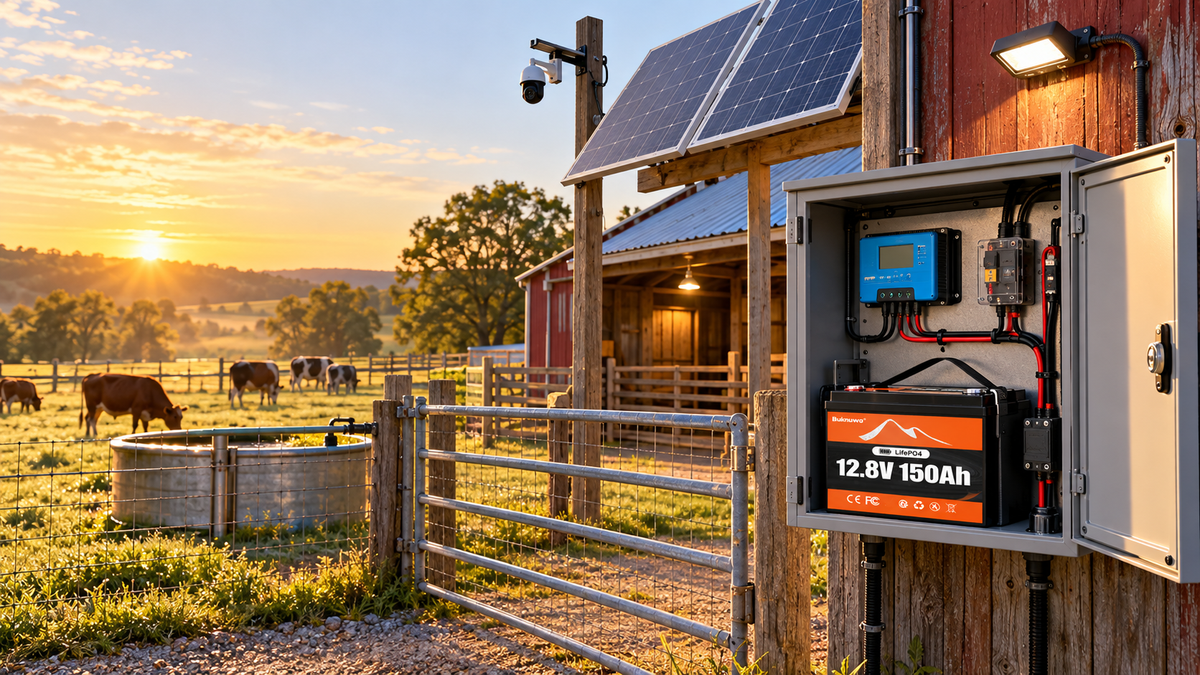
A small farm may have modest electrical loads spread across a surprisingly large area. A livestock water pump may be near a distant pasture, cameras and a gate controller may operate at the property entrance, while barn lights, sensors and a network gateway remain closer to the main buildings. Planning a reliable LiFePO4 battery system for a small farm therefore involves more than choosing an amp-hour rating.
The system must match each load’s voltage, daily energy use and short-duration current demand. It must also account for long cable runs, seasonal solar production, outdoor exposure, livestock, water, dust and unauthorized access. This guide explains how to organize those decisions and compare 100Ah, 150Ah and 314Ah battery options without promising a fixed runtime.
This article is a general planning guide. It is not an engineering drawing or a substitute for the manuals, local requirements and qualified installation support applicable to your farm.
Quick answer: divide the farm into power zones first
Before selecting a battery, mark each place where electricity is needed. Typical zones may include:
- the entrance gate and driveway;
- a barn, shed or feed-storage area;
- a livestock watering point;
- a remote pasture or electric-fence section;
- a greenhouse or irrigation-control area;
- a communications or security location.
For every zone, list its devices, operating schedule, voltage, maximum current and importance. Then decide whether it is more practical to run power from one central system or place a smaller battery-and-solar station near the load.
A 100Ah battery may be considered for a light remote zone such as sensors, a gate camera, communication equipment or a compatible fence energizer. A 150Ah battery offers more nominal energy for a pump-and-monitoring combination or longer operation. A 314Ah battery may suit a verified barn-side system with several auxiliary loads or a deliberately planned longer weather reserve. Farm acreage alone does not determine the correct capacity.
1. Identify suitable farm loads—and the loads to exclude
Small 12V energy-storage systems are most practical when they support defined, moderate loads. Possible applications include:
- electric-fence energizers with compatible input requirements;
- livestock water-level sensors and small compatible water pumps;
- gate controllers, access keypads and marker lights;
- security cameras, cellular routers and Wi-Fi bridges;
- barn or path LED lighting;
- weather stations and environmental sensors;
- automation controllers and selected feeding-system controls;
- radios, phones and other low-power communication equipment.
Do not treat a deep-cycle battery as a universal source for agricultural machinery. The BUKNUWO batteries discussed here are intended for energy storage and are not designed to start tractors, vehicles, generators or engine-driven pumps. Large irrigation pumps, electric heaters, welders, grain dryers and other high-power equipment require a separate, verified system design and may be outside the practical scope of a small 12V installation.
2. Build a load list for each zone
For every device, record four items:
- required input voltage;
- normal operating power or current;
- expected daily operating time;
- maximum or startup current, when applicable.
The basic daily-energy calculation is intentionally simple:
Daily energy (Wh) = Power (W) × Operating time (hours)
Add the daily watt-hours for all equipment in that zone. A camera or router that operates continuously should be counted for 24 hours. A trough pump that runs in several short cycles should be counted using its total estimated daily runtime. If usage changes with animal count, weather or season, calculate both a normal day and a demanding day.
Do not forget controllers, converters, communication gateways and equipment that remains active in standby. These small loads can become meaningful when they run continuously.

3. Check pump, gate and motor startup demand
Water pumps, gate motors and ventilation equipment can briefly draw more current while starting than during normal operation. The battery BMS, wiring, fuse or breaker, controller, converter and any other power electronics must all be able to support the highest expected event.
Running watts alone do not establish startup compatibility. Review the equipment documentation for starting current, surge current or locked-rotor current. If two motor loads could start together, assess that combined demand. A reliable control sequence may stagger their starts, but do not assume the sequence will occur unless the automation system enforces it.
Pipe pressure, vertical lift, filter restriction and long plumbing runs can also change pump behavior. For a closer look at pump-specific planning, see How to Choose a LiFePO4 Battery for a 12V Water Pump.

4. Centralized or distributed farm power?
A farm can use one larger battery system near a building, several smaller systems near individual loads, or a combination of both. The better approach depends on distance, maintenance, security and the type of equipment.
Centralized system
A centralized system places the main battery, charging equipment and distribution close together. It can simplify monitoring and maintenance, but long low-voltage cable runs may require large conductors and careful voltage-drop control. One system fault may also affect several farm functions.
Distributed systems
A distributed arrangement places a smaller battery and solar panel near a remote gate, trough or camera location. Shorter load-side cable runs may reduce voltage drop, and each zone can be sized around its own purpose. The tradeoff is that the farm has more batteries, panels, enclosures and maintenance points to inspect.
Hybrid arrangement
A hybrid plan might use a larger barn-side system for lighting, communications and nearby controls while using a separate small solar station at a remote gate or pasture. This can avoid an impractical low-voltage cable run without duplicating every function.

Do not choose between centralized and distributed power only from the purchase price of the batteries. Include cable cost, trenching, voltage drop, enclosure security, solar exposure and the time required to inspect multiple locations.
5. Control voltage drop across farm distances
At the same wattage, a 12V-class circuit carries more current than a higher-voltage circuit. Over a long distance, undersized cable can create voltage drop, heat and unreliable operation. A pump may fail to start or a camera may reboot even though the battery still contains energy.
Cable selection should consider:
- maximum continuous and startup current;
- total round-trip cable length;
- acceptable voltage drop for the equipment;
- installation method and ambient temperature;
- mechanical protection, burial and local code requirements.
For widely separated loads, placing regulated conversion closer to the equipment or using independently designed distributed stations may be more practical than extending a 12V circuit across the property. Have a qualified installer assess long buried runs and higher-voltage distribution.
6. Plan solar around the farm’s least favorable season
Solar panel nameplate wattage is not guaranteed daily energy. Real production changes with latitude, season, cloud cover, temperature, panel angle, dirt, snow and shade. Barns, trees, silos and fencing can create shadows that move throughout the day.
The array should normally replace the energy consumed by the zone and provide a realistic route to recovery after poor weather. A large battery paired with insufficient solar may remain partly charged for long periods instead of providing dependable reserve.
Use a compatible MPPT solar charge controller between the panels and battery. Confirm the controller’s PV voltage limit, output current, LiFePO4 charging profile and the battery’s charging requirements. Do not connect a solar array directly to the battery. Review How to Connect a BUKNUWO LiFePO4 Battery to a Solar System for the basic system relationship.
7. Choose the required low-sun reserve
Reserve capacity allows essential equipment to operate through nights and periods of low solar production. A useful starting relationship is:
Reserve energy = daily essential-load energy × desired low-sun days
Then account for system losses, temperature, battery aging and an operating margin. There is no universal number of reserve days. A gate camera that can be checked daily may need a different plan from a livestock watering alarm at a remote pasture.
Define load priorities before energy becomes limited:
- maintain animal-water monitoring and critical controls;
- retain communications and security alerts;
- support essential access and safety lighting;
- reduce decorative lighting or other deferrable loads.
Use a suitable control strategy to disconnect nonessential loads before the battery reaches protective shutdown. The BMS should remain a protection layer rather than routine daily load management.
8. Compare 100Ah, 150Ah and 314Ah options
The following figures are nominal energy ratings, not guaranteed available energy or runtime in a finished farm installation.
| Battery option | Nominal energy | Possible farm role | What to confirm |
|---|---|---|---|
| BUKNUWO 12.8V 100Ah | 1,280Wh | Light remote zone with sensors, camera, communications, compatible fence equipment or limited lighting | 24-hour background load, seasonal solar and required reserve |
| BUKNUWO 12.8V 150Ah | 1,920Wh | Pump-and-monitoring zone, longer light use or several moderate auxiliary loads | Motor startup demand, daily pump runtime and solar recovery |
| BUKNUWO 12.8V 314Ah | About 4,019Wh | Verified barn-side system with more equipment or deliberately extended low-sun reserve | Charging current, array size, enclosure capacity, cable protection and recharge time |
A larger capacity may provide more stored energy, but it does not increase solar production, eliminate cable voltage drop or guarantee compatibility with a motor. Select the model after the load, startup demand, charging source and environmental design have been checked.

9. Protect outdoor equipment from water, animals and impact
Farm electrical equipment may be exposed to rain, dust, mud, insects, fertilizer, rodents, livestock and machinery. A component’s individual water-resistance rating does not make the whole installation weatherproof.
- Mount the battery upright, dry and mechanically secured above likely standing water.
- Use a suitable lockable enclosure with protected cable entries and service access.
- Install terminal covers, correctly crimped lugs and strain relief.
- Use a correctly rated fuse or DC breaker close to the battery positive terminal.
- Use separate branch protection where several circuits leave a distribution point.
- Keep equipment beyond livestock reach and away from gates or paths where machinery can strike it.
- Separate electrical equipment from trough overflow, irrigation spray and chemical storage.
- Use drip loops and environmental protection appropriate to the site.
A completely sealed cabinet may still trap condensation or heat. Follow the ventilation and temperature requirements of the battery, controller and communications equipment. Security may also matter at a remote roadside installation, so consider tamper-resistant fasteners, locks and discreet equipment placement.
10. Consider both winter charging and summer enclosure heat
Charging and discharging have different temperature limits. Low-temperature charging protection may stop charging when the battery is outside its permitted range, but that protection is not the same as built-in battery heating. Confirm the manual for the exact model and design around the battery temperature—not only the outdoor air forecast.
In summer, a dark enclosure in direct sunlight can become substantially hotter than ambient conditions. Shade, cabinet color, component spacing and appropriate ventilation can influence equipment temperature. In winter, the system may face lower solar harvest at the same time that monitoring, lighting or freeze-related controls need more energy.
11. Understand the role of Bluetooth monitoring
Bluetooth monitoring can help during on-site inspection by displaying supported battery information such as state of charge, voltage, current and status. It does not automatically provide farm-wide Internet monitoring or remote alarms.
Remote status requires compatible gateways, controllers or telemetry equipment, and those devices add their own continuous load. Include routers, cellular modems and communication bridges in the energy calculation. For a camera-focused remote zone, see Off-Grid Security Camera Power: LiFePO4 Battery and Solar Setup Guide.
Common small-farm battery-system mistakes
- Sizing by acreage: energy use depends on equipment and runtime, not the number of acres.
- Ignoring motor startup: a pump can fail to start even when its running power appears acceptable.
- Extending undersized 12V cable: long runs can cause voltage drop and unreliable operation.
- Using one system for every distant load: trenching and conductor size may make distributed stations more practical.
- Buying more battery without adding charging capacity: the system still needs sufficient energy to recover.
- Mounting equipment near animals or water: impact, chewing, overflow and contamination introduce avoidable risks.
- Assuming Bluetooth means remote access: local app monitoring is not the same as Internet telemetry.
- Using an energy-storage battery for starting: tractors, generators and engine-driven pumps need purpose-built starting equipment.
Small-farm planning checklist
- Map every load location and divide the property into practical zones.
- Separate essential equipment from optional equipment.
- Record voltage, daily runtime, normal power and startup current.
- Calculate normal-day and demanding-day energy for each zone.
- Compare centralized, distributed and hybrid installation approaches.
- Choose a realistic low-sun reserve and load-priority plan.
- Size panels and MPPT controllers using seasonal site conditions.
- Verify BMS current, conversion equipment, protective devices and voltage drop.
- Design secure enclosures around water, livestock, dust, temperature and machinery.
- Commission the system by testing motor starts, nighttime operation, alarms and low-sun behavior.
If one farm zone includes a greenhouse, use the more specific moisture, fan and seasonal-load guidance in Planning a LiFePO4 Battery System for a Small Greenhouse.
Frequently asked questions
What size LiFePO4 battery is suitable for a small farm?
The appropriate size depends on the equipment in each farm zone, its daily watt-hours, motor startup demand, desired low-sun reserve and solar recovery. A 100Ah battery may suit a light remote zone, while 150Ah or 314Ah may be considered as energy use or reserve requirements increase.
Can a LiFePO4 battery run a livestock water pump?
It may run a compatible pump when the battery, BMS, cable, fuse, controller and conversion equipment can supply both normal current and startup demand. Pump voltage, pressure, lift, restriction and daily runtime must be checked.
Is one large farm battery better than several small batteries?
Not automatically. A central battery can simplify maintenance, but long low-voltage runs may increase cable cost and voltage drop. Distributed systems shorten load-side wiring but add more equipment locations. Compare distance, loads, solar access, security and maintenance.
Can a 100Ah battery support an electric fence?
It may be more capacity than some fence energizers require, but compatibility depends on the energizer’s input voltage, consumption, grounding design, fence condition and required reserve. Follow the fence-equipment manufacturer’s instructions.
How should solar panels be sized for a farm battery?
Start with the zone’s daily watt-hours, then use realistic seasonal peak-sun-hours and allow for weather, shading, orientation and system losses. The array should support daily use and a practical recovery plan after low-sun periods.
Where should a farm battery be installed?
Use a dry, secured and serviceable location protected from water, livestock, rodents, chemicals, impact, theft and temperatures outside the battery’s permitted limits. Provide suitable circuit protection, cable entry and thermal management.
Can these batteries start a tractor, generator or engine-driven pump?
No. The batteries discussed in this article are intended for deep-cycle energy storage, not engine starting. Use purpose-built starting batteries or equipment specified by the machinery manufacturer.
Before installation, verify current product manuals, equipment specifications and applicable electrical requirements. Use a qualified professional for long underground runs, AC circuits, significant motor loads or installations subject to local agricultural and electrical codes.