
Off-Grid Security Camera Power: LiFePO4 Battery and Solar Setup Guide
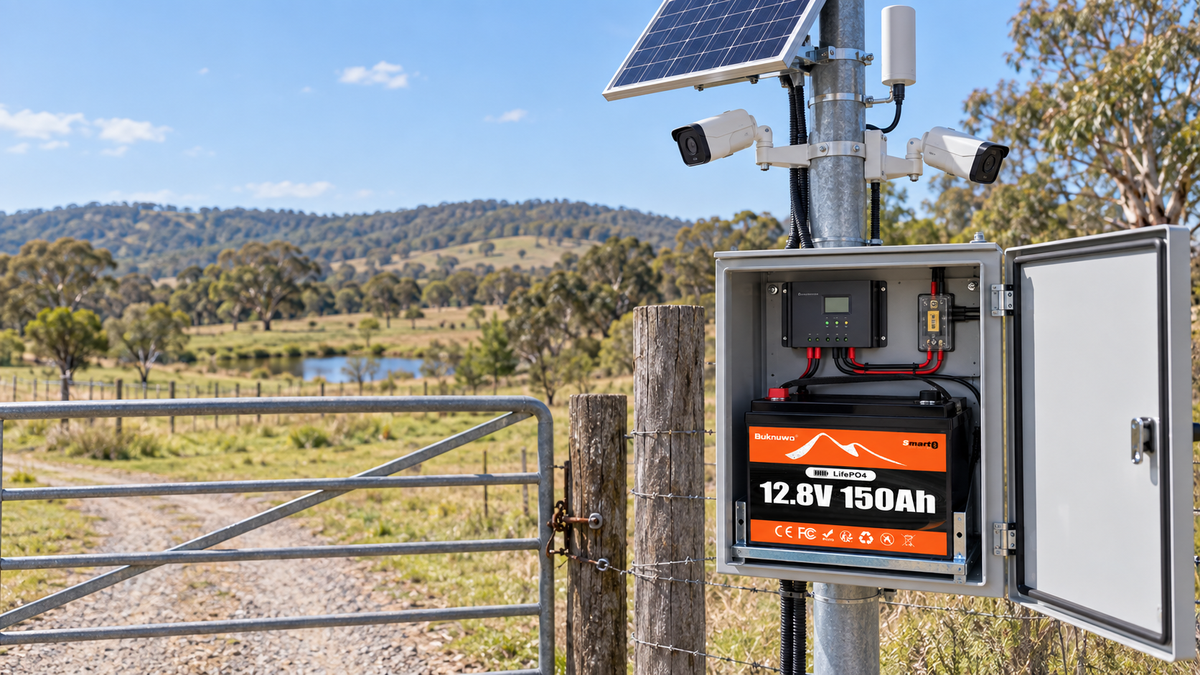
An off-grid security camera power system has to do more than turn a camera on during sunny weather. It may need to run cameras, infrared illumination, a recorder, a router, a PoE switch and voltage converters through long nights and several cloudy days. A reliable design therefore starts with the complete load, then sizes the battery, solar array, charge controller, wiring and enclosure as one system.
This guide explains that planning process for gates, farms, construction sites, cabins and other remote locations. It is a general design guide, not a substitute for the manuals or electrical requirements of your specific cameras, networking equipment, controller and battery.
Quick answer: size the system, not only the battery
For a remote surveillance power system, work through these five questions:
- What equipment must run, and how much energy does the entire system use in 24 hours?
- Does power use increase at night or during camera movement, recording, transmission or reboot?
- How many low-sun days should the battery cover?
- Can the solar array replace the energy used each day under local seasonal conditions?
- Are the voltage conversion, fusing, cable size and enclosure suitable for the site?
A 100Ah battery may suit a small, efficient camera site. A 150Ah battery provides more stored energy for added equipment or a longer weather reserve. A 314Ah battery may be considered for a larger, verified multi-camera installation. Capacity alone does not confirm compatibility or runtime.
1. List every device that uses power
Do not calculate from the camera count alone. Include every continuous and intermittent load:
- fixed, PTZ or cellular cameras;
- NVR, DVR or edge recorder;
- hard drive or other storage device;
- 4G/5G modem, Wi-Fi bridge or router;
- PoE switch, regulated DC converter or injector;
- environmental sensors, relays or site lighting, if fitted;
- enclosure fans or approved heaters, if the equipment specifications require them.

Use the manufacturer’s input specification for initial planning, then measure the assembled system when possible. A plug-in meter, DC power meter or monitored bench supply can reveal loads that a simple camera wattage estimate misses.
Daytime power may differ from nighttime power
Infrared LEDs often switch on after dark, and some cameras activate additional processing or illumination. PTZ movement, storage drive activity, cellular transmission and equipment reboot can also change current briefly. These changes are not the same as a motor’s large starting surge, but the power supply, converter and protective devices still need enough headroom for the highest expected simultaneous demand.
If the camera documentation lists both typical and maximum consumption, do not use the typical number as a guaranteed upper limit. Test night mode and the most demanding operating state before finalizing the system.
2. Convert the equipment list into daily energy
Battery capacity is energy, while each device’s watt rating describes power at a moment in time. For a DC device:
Power (W) = Voltage (V) × Current (A)
For a load that truly runs continuously:
Daily energy (Wh) = Power (W) × 24 hours
Add intermittent loads according to the hours or duty cycle they actually operate. Also allow for conversion and wiring losses. For example, a regulated DC-DC converter cannot deliver its full output energy without drawing somewhat more energy from the battery.
A useful site worksheet should record daytime watts, nighttime watts, hours in each state and any intermittent loads. This produces a more defensible estimate than multiplying the number of cameras by a generic value.
3. Decide how much cloudy-day reserve you need
Solar production changes with season, latitude, shade, panel angle, dirt, snow and weather. The battery must bridge the periods when the array produces less energy than the system consumes.
Begin with:
Required reserve energy = expected daily load × desired low-sun days
Then allow for conversion losses, temperature effects, aging and a practical operating reserve. There is no universal reserve percentage or correct number of autonomy days. A gate that can tolerate a maintenance visit has a different requirement from an unattended site where loss of recording is consequential.
For critical monitoring, validate the result through seasonal measurements and consider a low-voltage alert or controlled load-shedding plan. Do not depend on the BMS as the normal daily on/off control.
4. Size the solar side for energy replacement
A panel’s nameplate wattage is a laboratory rating, not a promise of daily output. Solar planning should use realistic peak-sun-hours for the site and the least favorable operating season. Allow for temperature, controller conversion, cable losses, panel orientation and partial shading.
The daily solar harvest needs to cover the daily camera-system use and, when practical, provide additional energy to recover after cloudy weather. An oversized battery with too little solar may simply take longer to return to a healthy state of charge.
Use a compatible MPPT solar charge controller between the array and the LiFePO4 battery. Do not connect a solar panel directly to the battery. Confirm that the controller’s PV input limits, output current and LiFePO4 charging settings match the panel arrangement and battery manual. For a broader connection overview, see How to Connect a BUKNUWO LiFePO4 Battery to a Solar System.

5. Compare 100Ah, 150Ah and 314Ah LiFePO4 options
The following values are nominal energy figures. They are useful for comparison, but they are not guaranteed usable runtime in a finished installation.
| Battery | Nominal energy | Where it may fit | Check before selecting |
|---|---|---|---|
| BUKNUWO 12.8V 100Ah | 1,280Wh | A compact, efficient site with a limited camera and network load | Measured night load, desired autonomy and available solar recovery |
| BUKNUWO 12.8V 150Ah | 1,920Wh | A site needing more reserve, additional network equipment or longer low-sun coverage | Total daily watt-hours, enclosure space, controller output and recharge time |
| BUKNUWO 12.8V 314Ah | About 4,019Wh | A larger, verified multi-camera system or a site designed for extended autonomy | Whether the solar array can recover the larger energy reserve in the available sun |

These are planning directions, not fixed camera-count recommendations. Two systems with the same number of cameras can have very different recorder, router, night-vision and conversion loads. Use the linked product pages to confirm current dimensions, charging requirements and BMS specifications before installation.
6. Plan the DC and PoE voltage path correctly
A 12.8V LiFePO4 battery is not automatically a direct power source for every 12V-labeled device, and it is not a direct PoE supply. Battery voltage changes through the charge and discharge cycle. Cameras, routers and recorders may require regulated 5V, 12V, 24V or a standards-compliant PoE voltage.
Use a correctly rated regulated DC-DC converter, PoE switch or injector that matches the equipment specification. Verify input range, output voltage, current capacity, conversion efficiency and environmental rating. Never connect a 12.8V battery directly to PoE cabling unless the equipment manufacturer explicitly designed the system for that arrangement.
Avoid adding an AC inverter simply by habit. A well-designed DC system may reduce conversion stages when every device has a compatible regulated DC path. However, equipment manuals and electrical requirements should determine the architecture.
7. Protect the wiring and control voltage drop
- Install a correctly sized fuse or DC-rated circuit breaker near the battery positive terminal.
- Choose cable size from maximum current, cable length, installation method and acceptable voltage drop—not from current alone.
- Use protected terminals, proper lugs and strain relief; keep conductive tools and loose hardware away from the battery.
- Use weather-rated cable glands and drip loops where conductors enter the cabinet.
- Follow equipment guidance for separating power, network and radio cables.
- Provide separate branch protection where multiple circuits leave a distribution point.
Long low-voltage cable runs can produce enough voltage drop to cause nighttime resets even when the battery still has energy. In many installations it is preferable to place regulated conversion close to the load or use an appropriately designed higher-voltage distribution method. Have a qualified installer review the design when local codes or site conditions require it.
8. Use an enclosure designed for the environment
A weather-resistant cabinet should keep out rain and pests while managing heat and condensation. Mount it above likely standing water, protect it from direct impact and use a lock where unauthorized access is possible. A completely sealed box can still collect condensation or trap heat, so follow the thermal and ventilation requirements of all installed components.
Keep the battery upright and mechanically secured on a suitable shelf. Do not let water drain onto terminals or electronics. Allow service access without exposing live conductors, and check that the combined battery and equipment weight is within the cabinet and mounting structure ratings.

9. Account for cold and hot weather
Charging and discharging have different temperature limits. A BMS with low-temperature charging protection may interrupt charging when conditions are outside its allowed range; that protection should not be interpreted as a heater. Confirm the current battery manual and provide an appropriate thermal strategy for the actual climate.
High enclosure temperature can also affect electronics, battery behavior and service life. Shade, cabinet color, ventilation and component spacing may matter as much as the ambient forecast. See How to Care for a LiFePO4 Battery in Everyday Use and Storage for additional maintenance guidance.
10. Understand what Bluetooth monitoring can—and cannot—do
Bluetooth battery monitoring can help during installation and on-site service by showing available data within local wireless range. It does not by itself provide Internet-based monitoring from another location. Remote battery status requires a separate compatible gateway, site controller or telemetry system. Confirm what data each component exposes before promising remote alerts.
Common off-grid camera power mistakes
- Sizing from camera watts only: the recorder, router, PoE equipment and converters may be a meaningful part of the daily load.
- Ignoring night mode: infrared lighting and other nighttime functions can change consumption.
- Using panel watts as daily watt-hours: real solar harvest depends on time and conditions.
- Choosing a large battery with inadequate solar: stored energy cannot recover quickly if the array is undersized.
- Directly powering incompatible equipment: nominal labels do not replace voltage-range and PoE checks.
- Using the BMS as routine control: BMS cutoff is protective, not a substitute for sound energy management.
- Overlooking voltage drop: long cables can trigger resets at the far end.
- Confusing Bluetooth with remote telemetry: local app access does not guarantee cloud access.
A practical selection sequence
- List every device and its input specification.
- Measure daytime, nighttime and highest simultaneous load where possible.
- Calculate daily energy and choose the required low-sun reserve.
- Compare that energy requirement with the nominal battery options.
- Size the solar array and MPPT controller using local seasonal conditions.
- Verify every voltage conversion and PoE interface.
- Select cable, branch protection and enclosure features for the actual site.
- Commission the system through night mode and poor-weather simulations before relying on it unattended.
If the installation also supports a cellular modem or emergency radio, the load-planning approach in How to Choose a LiFePO4 Battery for Emergency Communication Equipment may provide useful additional context.
Frequently asked questions
What size battery does an off-grid security camera system need?
It depends on total daily energy, conversion losses, temperature and the number of low-sun days the site needs to cover. Calculate watt-hours for the complete camera, recording and network system before comparing 100Ah, 150Ah or larger batteries.
Is a 100Ah LiFePO4 battery enough for security cameras?
It can be suitable for some small, efficient systems, but camera count alone is not enough to decide. Confirm the night load, recorder and router use, desired autonomy and solar recovery capacity.
Does night vision increase security camera power use?
It may. Infrared LEDs and other night functions can increase consumption on some models. Use the camera specification and measure the assembled system after dark when possible.
Can a LiFePO4 battery power PoE cameras?
Yes, as part of a properly designed system using compatible regulated conversion and standards-compliant PoE equipment. A 12.8V battery should not be connected directly to PoE wiring unless the equipment is specifically designed for that input.
How do I size solar panels for an off-grid camera?
Start with the system’s daily watt-hours, then use realistic local peak-sun-hours and allow for seasonal weather, temperature, orientation, shading and system losses. The array should support normal daily use and a reasonable recovery plan after low-sun periods.
Can the battery start a vehicle or generator at the site?
No. The batteries discussed here are intended for energy-storage applications, not engine starting. Use purpose-built starting equipment for engines.
Are cameras allowed anywhere on private property?
Camera placement, audio recording, public-area coverage and data retention may be regulated. Point cameras only where permitted and follow applicable privacy, notice and security requirements in the installation location.
Before installation, verify current product manuals, local electrical rules and the specifications of every camera, network device, converter, controller and protective component. For critical sites, consult a qualified installer.