
How to care for a LiFePO4 battery in everyday use and storage
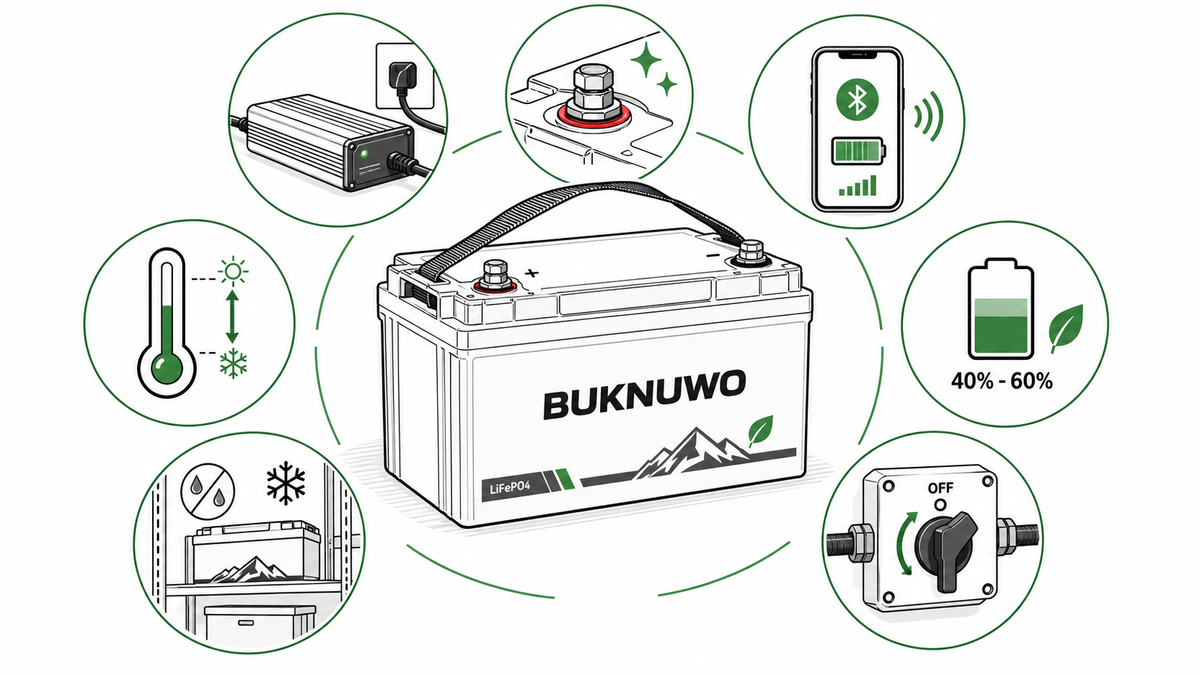
A LiFePO4 battery needs relatively little routine maintenance. There is no water to top up or electrolyte level to check, as there is with a flooded lead-acid battery. Most of the work involves checking the charger settings, keeping connections in good condition, and paying attention to how the battery is used and stored.
These habits apply whether your battery powers an RV, a boat, a trolling motor, a camping setup, or a solar or backup system. The details vary by model, especially charging limits and temperature ranges. For BUKNUWO batteries, use the manual for your exact model as the reference.
Start with the charger settings
Use a charger or charging profile designed for LiFePO4 batteries. Check that it matches the battery voltage, specified charging voltage and current, and the way your battery bank is configured.
Many 12.8V LiFePO4 batteries have a maximum charging voltage of around 14.6V. Treat that as an example, not a setting to copy without checking the manual. Avoid lead-acid equalization and desulfation modes unless the battery manufacturer specifically approves them.
It is usually unnecessary to keep a battery at 100% state of charge (SOC) continuously. Follow the charging strategy recommended for your model, and avoid repeatedly pushing it to its extreme charge or discharge limits when you do not need to.
Most modern LiFePO4 batteries have a battery management system (BMS) that helps protect against high or low voltage, excessive current, and abnormal temperatures. Set up normal charging and use so that protection does not have to activate on every cycle.

Keep heat and cold in mind
Where you install the battery matters. Keep it away from engines, exhaust systems, and other heat sources, because excessive heat can accelerate aging.
Cold-weather charging needs a separate check. Many LiFePO4 batteries restrict charging at or below freezing. If low-temperature protection activates, let the battery warm up enough to meet its permitted charging conditions before trying again. Follow the charging and discharging temperature limits in the product manual.

Put the battery away with storage in mind
If your RV, boat, or camping equipment will sit unused for an extended period, prepare the battery before putting it away. Avoid leaving it completely discharged or continuously at maximum charge.
For many LiFePO4 batteries, approximately 40% to 60% SOC is a practical storage target, unless the manufacturer specifies otherwise. Once the charge level is appropriate:
1. Disconnect unnecessary loads and turn off inverters or standby devices.
2. Store the battery in a cool, dry place.
3. Check voltage and SOC periodically during storage.
Standby loads are easy to overlook when equipment is parked for the season. Disconnecting them is part of preparing the system for storage.

Inspect the connections and cables
Periodically check the positive and negative terminals, battery cables, cable lugs, busbars, fuses, and circuit breakers. Look for loose connections, corrosion, damaged insulation, discoloration, or other signs of overheating.
A loose connection can add resistance, cause a voltage drop, and generate unwanted heat. Tighten battery terminals to the manufacturer's recommended torque.
Cable size also affects performance. Undersized cables can cause voltage drop, heat, and power loss, as well as poor inverter performance or charging problems. Choose cable size according to maximum current, cable length, system voltage, and inverter power.

Give battery banks the same attention
For a series or parallel bank, use batteries with matching voltage, capacity, model, and chemistry, and with similar age and condition. Confirm that both the battery model and its BMS support the intended arrangement.
Before connecting batteries in parallel, make sure their voltage and SOC are reasonably close. Similar cable lengths and sizes help the batteries share current. In larger parallel banks, balanced wiring or dedicated positive and negative busbars can improve current distribution.

Use the app to notice changes early
If your battery has Bluetooth, checking the app can be a useful part of routine maintenance. Depending on the battery and app, you may be able to see SOC, voltage, current, power, temperature, charging and discharging status, and protection status.
Pay attention if runtime suddenly drops, the battery becomes unusually hot, or protection activates repeatedly. Inspect the system before continuing normal use. Repeated BMS shutdowns should not be treated as part of the usual operating cycle.

Checks for RVs and solar or marine systems
Before an RV trip
Check SOC, terminal tightness, inverter operation, solar charging, and BMS status before setting off. When the RV goes back into long-term storage, disconnect unnecessary standby loads.
In a solar installation
Review the MPPT controller settings, charging voltage and current, and inverter settings. Inspect cable connections, fuses, and breakers too. A healthy battery can still perform poorly if the controller or inverter is configured incorrectly.
On a boat
Moisture makes electrical connections worth checking regularly. Inspect terminals, cable lugs, busbars, fuse holders, and disconnect switches. Keep the installation dry and protected within the battery's stated environmental rating.

A maintenance schedule you can keep
Use this schedule to organize routine checks alongside the instructions for your battery model.
|
Interval |
Recommended Check |
|
Before use |
Check SOC, voltage, and BMS status |
|
Monthly |
Inspect terminals, cables, and connectors |
|
Before long storage |
Adjust SOC and disconnect unnecessary loads |
|
During storage |
Periodically check battery SOC |
|
Before winter |
Confirm low-temperature protection |
|
After storage |
Inspect connections before normal use |
Claim Your BUKNUWO 12.8V 314AH Battery Discount