
LiFePO4 Battery Power for a Portable Refrigerator and Freezer: Runtime, Startup Current and Solar Charging
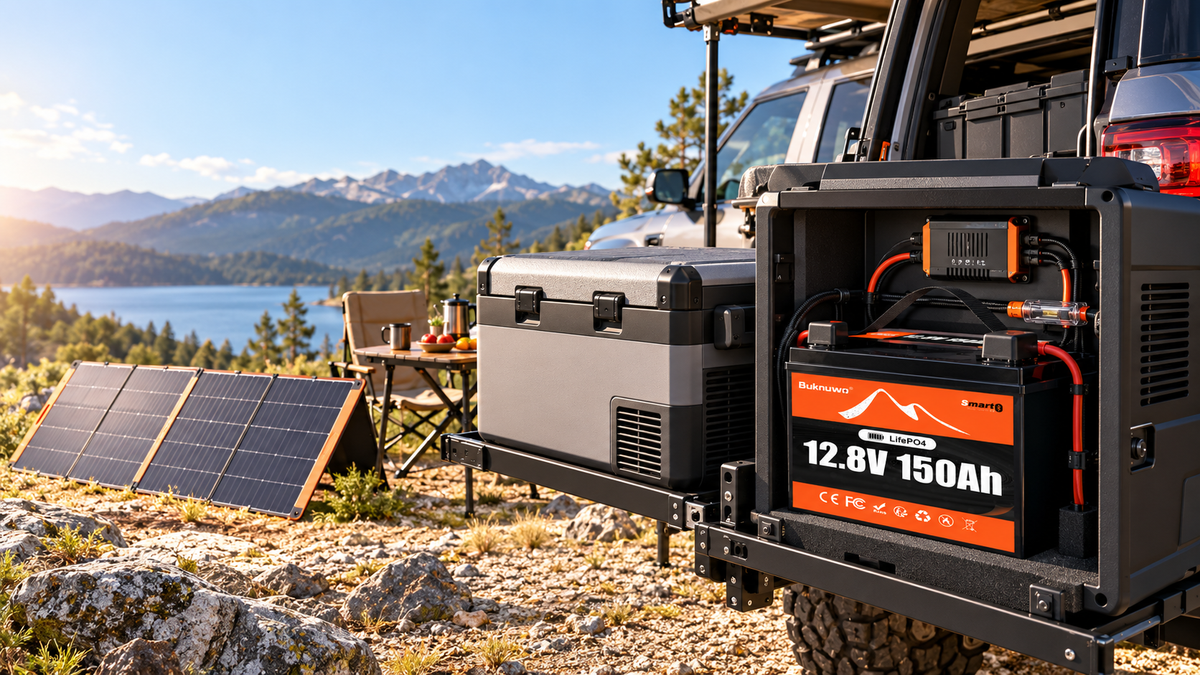
Quick answer: To plan LiFePO4 battery power for a portable refrigerator or freezer, start with the appliance's measured daily energy use—not only its maximum wattage. Then account for compressor startup current, ambient temperature, cooling setting, ventilation, other connected loads and the energy you can realistically replace through solar or another charger. A 100Ah battery may suit a light weekend setup, 150Ah provides more reserve for a larger or dual-zone cooler, and 314Ah may fit longer stays or multiple cooling units. The correct size still depends on the actual refrigerator and operating conditions.
Portable refrigerators do not use power at one constant rate
A compressor refrigerator normally cycles on and off to maintain its set temperature. Its label may list input voltage and a maximum or rated current, but that number does not necessarily describe the average energy used over an entire day. The compressor can run more often in hot weather, when the cabinet starts warm, when the lid is opened frequently or when the unit is set to freezer temperatures.
This is why a reliable LiFePO4 battery for a portable refrigerator should be selected from daily watt-hours whenever possible. Check the refrigerator manual for published energy data, or measure the complete unit with a suitable DC energy meter during conditions similar to your planned trip.
Do not assume every “electric cooler” behaves the same way. Compressor coolers, thermoelectric coolers and other cooling technologies can have different operating patterns. This guide focuses mainly on 12V/24V portable compressor refrigerators and freezers commonly used for camping, overlanding, fishing, tailgating and mobile outdoor work.
What changes portable fridge battery runtime?
| Factor | Why it matters | Practical planning step |
|---|---|---|
| Ambient temperature | Higher surrounding temperature can increase compressor runtime | Test or plan for the warmest expected conditions |
| Fridge vs. freezer setting | Lower setpoints generally require more cooling work | Use the temperature mode you will actually need |
| Starting temperature | Cooling warm food and the cabinet consumes additional energy | Pre-cool the unit and contents when shore power is available |
| Lid openings | Warm air enters whenever the lid is opened | Organize contents and limit unnecessary opening |
| Ventilation | Blocked condenser vents can reduce cooling performance | Follow the appliance manufacturer's clearance requirements |
| Sun exposure | Direct sunlight can increase cabinet temperature | Place the cooler in shade without blocking ventilation |
| Other loads | Lights, phones, cameras and pumps share the same stored energy | Include every load in the daily energy budget |
| Wiring voltage drop | Long or undersized cables may cause low-voltage shutdown | Size cable and protection for the run and appliance requirement |
Use daily watt-hours instead of guessing from battery amp-hours
The simplest useful calculation is:
Daily energy (Wh) = average power (W) × operating time (hours)
For a cycling compressor, “average power” should ideally come from a 24-hour measurement or the refrigerator manufacturer's energy-consumption data. If only maximum input power is available, multiplying it by 24 hours usually creates a conservative upper-bound rather than a realistic average estimate.
Battery nominal energy is:
Battery energy (Wh) = nominal voltage × capacity (Ah)
For example, a 12.8V 100Ah battery stores 1,280Wh of nominal energy. Do not divide 1,280Wh by a fridge's maximum wattage and treat the answer as guaranteed runtime. Actual available energy depends on battery state of charge, temperature, BMS limits, wiring, DC conversion losses and the refrigerator's real duty cycle.
Why startup current still matters
A refrigerator compressor may briefly draw more current while starting than it uses after it is running. The duration can be short, but the battery, BMS, fuse, switch, connector and cable path all need to support the appliance manufacturer's requirement without excessive voltage drop.
There is no single startup multiplier that applies to every portable refrigerator. Use the manual, specification sheet or manufacturer support information for the exact model. If two cooling units share one bank, also consider whether they could start at nearly the same time.
Battery capacity and current capability answer different questions:
- Watt-hours or amp-hours help describe how much energy is stored.
- Continuous and peak current ratings help determine whether the system can support operating and startup demand.

100Ah, 150Ah or 314Ah for a portable refrigerator?
The comparison below is a planning framework, not a promise of days or hours. Refrigerator efficiency, weather, setpoint and charging access can change the result substantially.
| BUKNUWO battery | Nominal energy | Potential use profile | Confirm before choosing |
|---|---|---|---|
| 12.8V 100Ah | 1,280Wh | One efficient portable fridge, lighter auxiliary loads and shorter trips with regular recharging | Measured daily Wh, compressor startup and recharge interval |
| 12.8V 150Ah | 1,920Wh | Larger or dual-zone cooler, freezer operation or additional reserve for changing weather | Total DC current, physical space and charging time |
| 12.8V 314Ah | About 4,019Wh | Longer stationary use, refrigerator plus freezer, or several supported auxiliary loads | Weight, mounting, solar/charger capacity and simultaneous startup |
The 100Ah and 150Ah models use a 100A smart BMS, while the 314Ah model uses a 200A smart BMS. These limits do not remove the need for correctly sized branch fuses and cables. Portable refrigerators usually use much less current than the full BMS rating, but every connected load must be counted.

When a 100Ah battery may be enough
The BUKNUWO 12.8V 100Ah LiFePO4 battery may be a practical starting point for one efficient 12V portable refrigerator on a weekend trip, especially when the cooler is pre-chilled and the battery can be recharged regularly. A freezer setting, very hot weather or extra equipment can shorten the interval between charges.
When 150Ah offers useful reserve
The BUKNUWO 12.8V 150Ah LiFePO4 battery stores 50% more nominal energy than the 100Ah model. It may better suit a larger or dual-zone portable fridge/freezer, variable conditions, or a system that also charges phones, cameras and modest lighting. This does not mean every dual-zone cooler requires 150Ah; measured consumption remains the deciding input.

When 314Ah may make sense
The BUKNUWO 12.8V 314Ah LiFePO4 battery may fit a longer base-camp stay, a refrigerator-plus-freezer arrangement or a system with several auxiliary loads. The tradeoffs are greater battery weight, more installation space and a longer recharge time unless charging capacity is increased appropriately.

Direct DC power is usually the simpler path
If the portable refrigerator accepts 12V or 24V DC input, an appropriately designed DC connection generally avoids the additional conversion stage required by an AC inverter. Confirm the appliance's acceptable voltage range and connector requirements before wiring it to a 12.8V LiFePO4 system.
Some refrigerators include an AC adapter for use at home. That does not automatically mean AC is the preferred method in a battery-powered campsite. When AC equipment must be used, include inverter efficiency, idle consumption and startup capability in the plan. The inverter is a system component; it is not included with the BUKNUWO batteries discussed here.
How to plan solar charging
A typical portable solar arrangement is:
Solar panels → compatible MPPT charge controller → LiFePO4 battery → protected DC refrigerator circuit
Do not connect an unregulated solar panel directly to the battery or refrigerator. Select the controller from panel voltage, panel current, battery voltage and the manufacturer's LiFePO4 charging requirements. The BUKNUWO solar connection guide explains the basic system path.
Solar should be treated as variable energy input. Actual production changes with location, season, weather, shade, panel angle, temperature and controller limits. For planning purposes:
- Compare expected daily solar energy with the refrigerator's measured daily use.
- Include system losses and other loads.
- Keep reserve for cloudy periods rather than assuming every day replaces the full battery use.
- Place panels in sunlight while keeping the refrigerator and battery installation within their allowed temperature and environmental conditions.
Protect against voltage drop and accidental shutdown
A portable fridge can stop even when the battery still contains energy if voltage at the refrigerator falls below its protection threshold. Long cable runs, small conductors, weak connectors and shared accessory sockets can contribute to voltage drop, especially during compressor startup.
Use cable and overcurrent protection selected for the appliance current, cable length and installation environment. Place the battery in a dry, secure and ventilated location, cover the terminals and protect wiring from abrasion, heat and movement. Do not bypass the refrigerator's low-voltage protection without manufacturer approval.
BUKNUWO batteries in this article are designed for deep-cycle energy storage, not engine starting. Do not use them to crank a vehicle or replace a starter battery.
Ways to reduce the cooling energy budget
- Pre-cool the refrigerator and contents before leaving when suitable power is available.
- Keep the unit shaded while maintaining the required airflow around its vents.
- Avoid placing hot food directly into the cooler when that can be done safely.
- Group frequently used items so the lid remains open for less time.
- Use the temperature setting appropriate for the contents instead of automatically choosing the coldest setting.
- Check door seals, vent clearance and dust buildup according to the refrigerator manual.
- Separate optional loads from the refrigerator circuit so they can be switched off first.
Always follow applicable food-storage guidance and the refrigerator manufacturer's instructions. A battery state-of-charge reading does not confirm that food has remained at a safe temperature; use an appropriate temperature monitor when that matters.
A practical sizing workflow
- Identify refrigerator type, input voltage and connector.
- Record measured or manufacturer-published 24-hour energy use under relevant conditions.
- Check compressor startup or peak-current requirements.
- Add the daily watt-hours of lights, cameras, phones and other shared loads.
- Choose a reserve for heat, freezer operation, extra openings and poor charging days.
- Compare the total with 1,280Wh, 1,920Wh and about 4,019Wh battery options.
- Confirm BMS current, cable, fuse, connector and voltage-drop compatibility.
- Estimate how much energy shore power, vehicle charging or solar can realistically replace.
- Test the complete system before relying on it for a trip or temperature-sensitive contents.
Common mistakes to avoid
- Using maximum watts as if the compressor runs continuously all day
- Using an advertised low average without considering hot-weather operation
- Ignoring compressor startup current or simultaneous starts
- Choosing from amp-hours alone without converting the load plan to watt-hours
- Running through a long, undersized accessory cable
- Blocking the refrigerator's ventilation openings
- Treating solar panel wattage as guaranteed daily energy
- Adding a larger battery without increasing recharge capacity
- Assuming Bluetooth battery monitoring also monitors food temperature
Frequently asked questions
How long will a 100Ah LiFePO4 battery run a portable refrigerator?
There is no universal runtime. Start with the refrigerator's measured daily watt-hours, then account for other loads, reserve and system losses. Ambient temperature, setpoint, ventilation and lid openings can change consumption considerably.
Is 150Ah better for a portable freezer?
A 150Ah battery provides more stored energy than 100Ah and may offer useful reserve for freezer temperatures or a larger dual-zone unit. It is not automatically required; compare both capacities with the actual daily energy measurement.
Can I run a 12V fridge directly from a LiFePO4 battery?
Potentially, if the refrigerator's permitted input-voltage range, connector, low-voltage protection and current requirements are compatible with the battery system. Use correctly sized cable and circuit protection rather than assuming every 12V appliance can be connected the same way.
Can solar panels keep the refrigerator running indefinitely?
No fixed claim can be made because solar production and refrigerator demand both vary. A well-planned solar system may replace part or all of the daily use in favorable conditions, but reserve and an alternative charging plan are sensible for poor weather or shade.
Does a portable refrigerator have startup current?
Many compressor-based units have a short starting demand above their running demand. Use the exact refrigerator manufacturer's data because the amount and duration differ by model.
Should I choose 314Ah simply for the longest runtime?
Not necessarily. A 314Ah battery stores more energy, but it also adds weight, space and recharge time. For a single efficient fridge with frequent charging, a smaller battery may be more practical.
Final takeaway
The best portable refrigerator battery plan is based on measured daily energy, compressor startup requirements, operating conditions and realistic charging—not a generic runtime promise. Compare the BUKNUWO 100Ah, 150Ah and 314Ah batteries only after building that load profile. For related planning, see how long a 150Ah LiFePO4 battery may last in an RV and the emergency communication battery guide.
Planning note: This article provides general information. Follow the battery, refrigerator, charge-controller and vehicle manufacturers' specifications, and use a qualified installer when wiring requirements are uncertain.