
Portable Power for Farmers Markets and Outdoor Vendor Booths
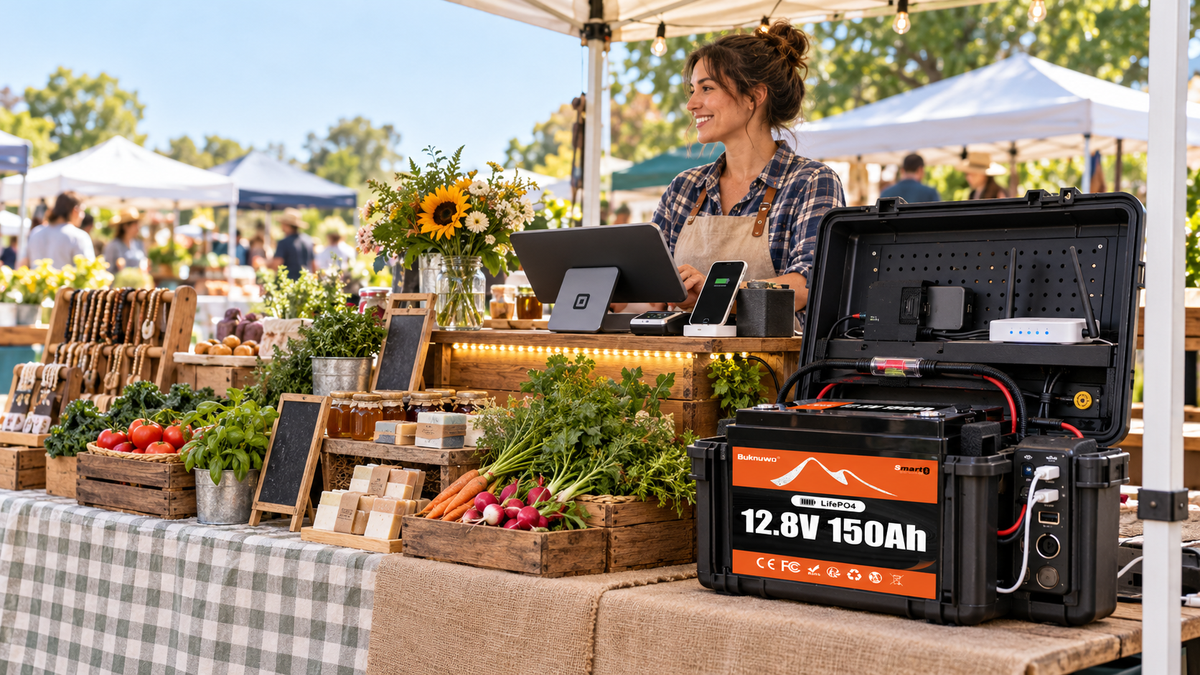
A reliable checkout can matter as much as an attractive display at a farmers market. Tablets, card readers, receipt printers, mobile hotspots, LED lights, phones, and compact cooling equipment all need electricity—often in a location where a wall outlet is unavailable or inconvenient. A properly planned portable power system for farmers markets can keep these devices available without assuming that every vendor has the same equipment or operating schedule.
This guide explains how to evaluate a LiFePO4 battery for an outdoor vendor booth, compare 100Ah, 150Ah, and 314Ah options, account for startup current, and arrange equipment more safely around customers, merchandise, and food. The examples are planning references rather than guaranteed runtime figures.
Quick answer: what battery size does a market booth need?
A small booth using a POS tablet, card reader, phone charger, router, and LED lights may be able to work with a 100Ah battery when its actual daily consumption is modest. A 150Ah battery can provide additional energy for longer event days or more mixed loads. A 314Ah battery may be considered for multiple checkout stations, extended operating periods, or compatible cooling equipment.
These are not automatic recommendations. Battery capacity must be checked against:
- Each device's voltage and power requirement
- Daily operating time
- Conversion and wiring losses
- Startup or peak current
- Weather and temperature
- Available charging time between events
- The reserve needed for delayed closing or back-to-back market days
Start with an equipment list
Do not select a battery only because another vendor uses the same capacity. Two stalls of the same size can have very different electrical demand. A craft booth with one tablet and two lamps is not equivalent to a produce stand with refrigeration, multiple terminals, and a printer.
| Booth equipment | Operating pattern | What to verify |
|---|---|---|
| POS tablet and card reader | Used throughout the event | Charger voltage, watts, and charging time |
| Mobile hotspot or router | Often continuous | Daily energy and signal-related behavior |
| Receipt or label printer | Intermittent | Short peak demand while printing |
| LED display lights | Several hours | Total wattage of all fixtures |
| Phones and scanners | Periodic charging | Number of devices and charger losses |
| Compact refrigerator or cooler | Cycles on and off | Measured daily energy and compressor startup current |
| Small pump | Intermittent | Running and startup current |
| Coffee maker, kettle, hot plate, or heater | High-power heating cycles | Separate system assessment is usually needed |
A simple first estimate is:
Daily energy (Wh) = device power (W) × operating time (hours)
Add the watt-hours for all devices, then allow a reasonable margin for conversion losses and unexpected operating time. For refrigerators, printers, pumps, and other cycling equipment, measured energy over a representative event day is more useful than guessing from the maximum nameplate wattage.
Choosing between 100Ah, 150Ah, and 314Ah
12.8V 100Ah for a compact sales setup
The BUKNUWO 12.8V 100Ah Bluetooth LiFePO4 battery provides 1,280Wh of nominal stored energy. It may suit a carefully measured setup built around a tablet POS system, card reader, mobile hotspot, phone charging, and efficient LED lighting.
This option is most appropriate when loads are modest, the event duration is known, and the battery can be fully recharged before the next market. It should not be selected for refrigeration or heating equipment without checking the actual energy and current requirements.

12.8V 150Ah for longer days and mixed small loads
The BUKNUWO 12.8V 150Ah Bluetooth LiFePO4 battery stores 1,920Wh nominally. The additional capacity may be useful for a longer sales day, more lighting, a printer, several charging devices, or a compatible compact cooler alongside the checkout equipment.
A 150Ah battery does not automatically make every cooler suitable. Compressor startup current, ambient temperature, lid openings, thermostat setting, and the condition of the cooler can all affect the result.

12.8V 314Ah for larger or longer-running booths
The BUKNUWO 12.8V 314Ah Bluetooth LiFePO4 battery provides 4,019.2Wh of nominal energy. It may be considered when a booth operates multiple checkout stations, more extensive display lighting, communications equipment, or compatible recurring cooling loads—or when more reserve is needed between charging opportunities.
Larger capacity does not solve an undersized cable, an incompatible BMS current limit, or excessive startup demand. Confirm every part of the system rather than relying on the amp-hour rating alone.

| Battery | Nominal energy | Possible planning role |
|---|---|---|
| 12.8V 100Ah | 1,280Wh | POS, router, device charging, and efficient booth lighting |
| 12.8V 150Ah | 1,920Wh | Longer operation or several mixed small loads |
| 12.8V 314Ah | 4,019.2Wh | Larger setups, recurring compatible loads, or additional reserve |

Startup current can matter as much as daily energy
Daily watt-hours help determine capacity, but they do not confirm that the battery system can start every device. A refrigerator compressor, water pump, fan, or other motor may briefly require more current when it starts than during normal operation. Some printers can also create short peaks.
Check the manufacturer's startup, surge, or locked-rotor information where applicable. The battery's BMS, fuse, cable, connector, switch, DC converter, and any other power equipment must all be able to support the intended current. A protective shutdown should not be treated as a normal way to test an unknown load.
DC equipment and AC equipment need different planning
Some booth equipment can operate from a compatible DC supply or USB converter. Other equipment requires AC power and therefore needs appropriately rated conversion equipment. BUKNUWO does not sell the inverter in this example, and the inverter or converter must be selected separately for the appliance, continuous load, startup demand, waveform requirement, and system voltage.
Every conversion stage consumes some energy. Use the equipment manufacturer's efficiency information when available rather than assuming all stored battery energy reaches the appliance. Keep DC and AC wiring organized and physically protected from customers.
Refrigeration requires additional caution
A battery system can supply compatible electrical refrigeration equipment, but electrical operation alone does not establish food safety. Vendors must follow the applicable market rules and food-handling requirements for temperature monitoring, storage, sanitation, and backup procedures.
Before relying on a cooler or refrigerator:
- Measure its energy use under realistic outdoor temperatures.
- Check compressor startup current.
- Confirm that required product temperatures can be maintained.
- Use an independent thermometer or approved temperature logger where required.
- Have a plan for equipment failure or unexpectedly long event hours.
Hot weather, frequent door openings, direct sunlight, and warm products placed inside can increase demand. Do not use a calculated runtime as the only food-safety control.
High-power heating appliances should be evaluated separately
Coffee makers, electric kettles, hot plates, warming trays, space heaters, and cooking appliances can draw far more power than a POS terminal or LED light. Some market operators may be able to build a suitable system, but battery capacity alone does not prove compatibility.
Check appliance wattage, operating time, simultaneous loads, current limits, conversion equipment, cables, and local event rules. If several heating appliances must operate together, a small portable 12V booth setup may not be the most practical architecture.
Safer placement at a public event
A farmers market is a public, busy environment. Place the battery in a stable, raised, shaded, dry, and ventilated protective enclosure. Prevent customer access to terminals, fuses, cables, and switches. Keep the system away from food preparation surfaces, liquids, direct sun, vehicle paths, sharp table hardware, and areas where people may trip.
Use overcurrent protection close to the battery positive terminal and choose correctly rated cables and connectors. Secure cables against pulling and abrasion. Do not place fabric, paper packaging, or merchandise over the battery enclosure, and do not use an improvised sealed box that conflicts with the product's installation requirements.
Rain, heat, and seasonal conditions
A canopy reduces direct exposure but is not the same as a weather-rated electrical enclosure. Wind-driven rain can enter from the sides, and water can run along cables. Plan splash protection, cable entry direction, drainage, and a shutdown procedure before the event begins.
Summer heat can raise battery and electronics temperatures, especially inside dark boxes or parked vehicles. In cold weather, follow the battery's specified charging-temperature limits. For more seasonal considerations, see the seasonal LiFePO4 power planning guide.
Charging between market days
Calculate whether the available charger can restore the energy used before the next event. Back-to-back markets may require more charging time than expected. If solar charging is used, output will vary with location, weather, shade, panel angle, and season. Use a compatible MPPT charge controller and suitable settings.
The BUKNUWO solar connection guide provides an overview, but the final solar array and controller should be matched to the battery and local conditions.
Bluetooth monitoring: useful, but not a substitute for planning
Bluetooth can help the operator review available battery information while near the booth. It should not be used as the only indicator for food temperature, nor should it replace load measurements, correct protection, or a pre-event charging routine. Bluetooth is local wireless access and does not automatically provide internet-based monitoring.
Common mistakes to avoid
- Choosing a battery from amp-hours without comparing watt-hours and voltage.
- Forgetting continuous router, hotspot, or lighting consumption.
- Ignoring compressor or pump startup current.
- Assuming a canopy provides complete rain protection.
- Placing the battery where customers can touch it or trip over cables.
- Treating a powered refrigerator as proof of food-safety compliance.
- Adding a heating appliance without recalculating the entire system.
- Assuming Bluetooth is remote internet monitoring.
- Using the battery to start a vehicle or generator. The batteries discussed here are intended for energy storage, not engine starting.
Pre-market power checklist
- Record every device's voltage, watts or amps, and operating time.
- Identify continuous, cycling, and short-duration loads.
- Check startup current for compressors, pumps, and motors.
- Confirm BMS, fuse, wire, connector, and converter ratings.
- Fully charge and test the system with realistic simultaneous loads.
- Use a stable enclosure protected from customers and weather.
- Confirm the event organizer's electrical and food-service requirements.
- Plan charging before the next market and an orderly shutdown if reserve becomes low.
Frequently asked questions
Is a 100Ah battery enough for a farmers market booth?
It may be enough for a measured low-power setup with POS equipment, communications, charging, and efficient lighting. It cannot be confirmed without the devices' daily watt-hours, event duration, and reserve requirement.
What size battery do I need for a POS system and lights?
Add the energy used by the tablet, card reader, printer, router, chargers, and all lights. Then include conversion losses and a practical reserve. A 100Ah battery may suit a compact setup, while 150Ah can provide more room for longer hours or additional loads.
Can a LiFePO4 battery run a market refrigerator?
It may run compatible equipment if daily energy, compressor startup current, voltage, and system current limits are properly matched. Test under realistic outdoor conditions and maintain separate food-temperature controls.
Should I select 314Ah for every food booth?
No. A 314Ah battery offers more nominal energy, but the right choice depends on measured demand, charging logistics, weight and space considerations, equipment current, and required reserve.
Can I leave the battery in direct sunlight?
Direct sun can raise enclosure temperature. Use a stable shaded installation that follows the battery manufacturer's environmental and clearance requirements, while protecting it from water and customer contact.
Can this battery start my market vehicle or generator?
No. The BUKNUWO batteries discussed in this guide are energy-storage batteries and are not intended for engine-starting applications.
Final recommendation
For a small craft or produce booth, begin by measuring the POS system, router, charging devices, and lights before considering a 100Ah battery. Consider 150Ah when the event lasts longer or several compatible small loads operate together. Evaluate 314Ah when measured demand, repeated market days, cooling equipment, or the required reserve justifies the additional capacity.
The best farmers market battery setup is not simply the largest battery. It is a complete system whose energy, current limits, wiring, weather protection, charging plan, and public placement all match the way the booth actually operates.