
LiFePO4 Power for a Remote Beekeeping Site
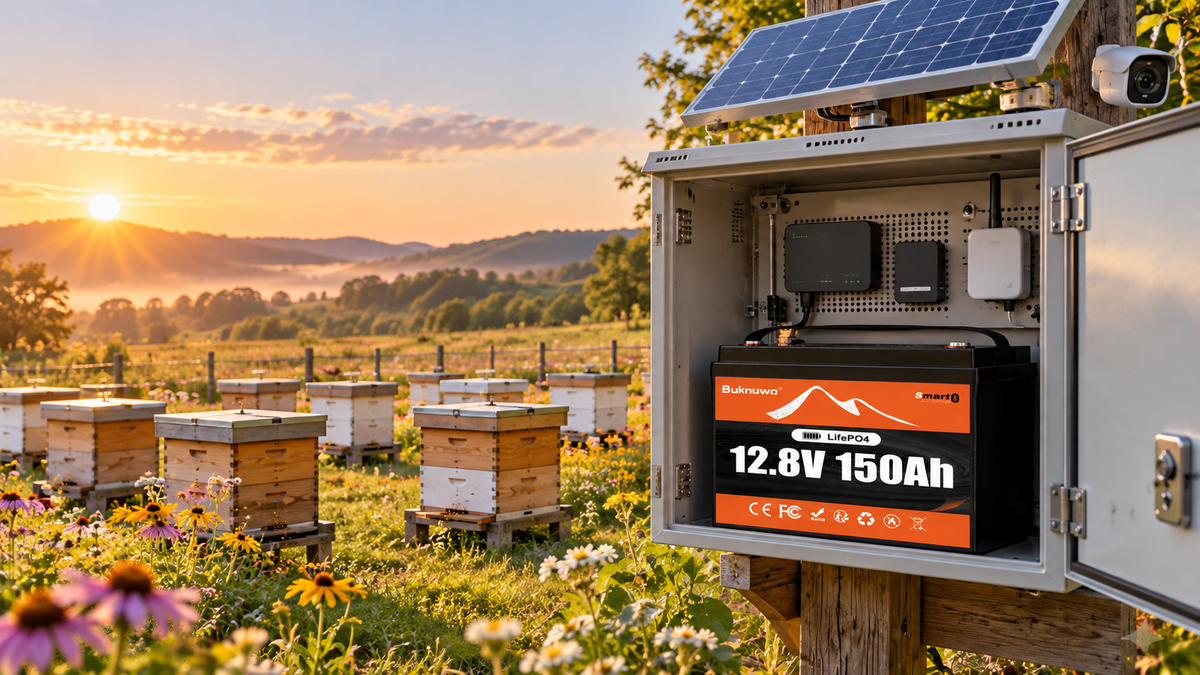
Running electrical equipment at a remote apiary is less about finding the largest battery and more about matching dependable storage to the equipment that actually operates each day. A well-planned LiFePO4 battery for a remote beekeeping site can support hive-monitoring sensors, a cellular gateway, security cameras, an electronic fence controller, service lighting, and—in some installations—a small intermittent water pump.
This guide explains how to plan a practical remote apiary battery system without assuming that every bee yard has the same loads, weather, or solar conditions. The battery supplies compatible equipment; it does not by itself improve colony health, prevent hive losses, or increase honey production.
Quick answer: what does a remote apiary power system need?
Start by listing every device, its input voltage, rated power or current, and expected daily operating time. Then separate continuous equipment—such as a gateway or camera—from short-duration loads such as a pump or work light. Select the battery only after checking both daily energy demand and the highest current that may occur when equipment starts.
For many sites, the planning process follows this order:
- Measure or obtain the power requirement of each device.
- Estimate daily energy use in watt-hours.
- Add reserve for nighttime operation, cloudy weather, seasonal changes, and system losses.
- Confirm that the battery, BMS, wiring, fuse, and any converter can support continuous and startup current.
- Size the solar array and MPPT charge controller for the site's weakest practical solar season.
What equipment may need power at a bee farm?
| Equipment | Typical operating pattern | Planning point |
|---|---|---|
| Hive scale and environmental sensors | Low-power, often continuous or scheduled | Include every sensor node and receiver |
| Cellular gateway or data logger | Continuous or periodic transmission | Weak signals can change device behavior and energy use |
| Security camera | Continuous, scheduled, or motion-activated | Night illumination and local recording may add load |
| Electronic fence controller | Usually continuous pulsed operation | Use the manufacturer's energy specification |
| LED service light | Short, occasional use | Estimate realistic hours rather than all-day operation |
| Small water pump | Intermittent | Check running current and startup current |
| Phone, radio, or tool charging | Occasional | Account for converter and charger losses |
| Extractor, heater, or processing equipment | Potentially high demand | Evaluate separately; do not assume a small field system can run it |
The simplest daily estimate is:
Daily energy (Wh) = device power (W) × daily operating time (hours)
For equipment that cycles on and off, use measured daily energy when possible. A nameplate rating multiplied by 24 hours may overstate use, while guessing a low duty cycle can understate it. A plug-in or DC energy meter can provide a more useful baseline before the system is installed remotely.
100Ah, 150Ah, or 314Ah for remote beekeeping?
Battery capacity should reflect the complete load list, desired reserve time, and solar recovery—not hive count alone. The examples below are planning categories, not guaranteed runtime claims.
12.8V 100Ah: focused monitoring and communications
A BUKNUWO 12.8V 100Ah Bluetooth LiFePO4 battery provides 1,280Wh of nominal stored energy. It may suit a compact site with measured low-power loads such as hive sensors, a data logger, a cellular gateway, or a modest camera arrangement. It is also a practical starting point when the solar array receives dependable sunlight and the owner does not need a long weather reserve.

12.8V 150Ah: more reserve for mixed small loads
The BUKNUWO 12.8V 150Ah Bluetooth LiFePO4 battery stores 1,920Wh nominally. The additional capacity can be useful when monitoring and communications operate alongside a fence controller, occasional lighting, or a compatible intermittent pump. Whether it is sufficient still depends on measured consumption, startup current, local weather, and the available charging window.

12.8V 314Ah: larger reserve or several recurring loads
A BUKNUWO 12.8V 314Ah Bluetooth LiFePO4 battery provides 4,019.2Wh of nominal energy. It may be appropriate for a larger monitoring installation, several recurring loads, or a site that needs more reserve between useful charging periods. Larger capacity does not correct an undersized solar array or an incompatible high-current load, so the charging system and current limits must still be checked.

| Battery option | Nominal energy | Possible planning role |
|---|---|---|
| 12.8V 100Ah | 1,280Wh | Focused monitoring, communications, or a small camera setup |
| 12.8V 150Ah | 1,920Wh | Mixed small loads with additional reserve |
| 12.8V 314Ah | 4,019.2Wh | Several recurring loads or longer reserve between charging periods |

Why pumps and other motors need a separate current check
A pump may draw considerably more current while starting than it uses after it reaches normal speed. Daily watt-hours answer the capacity question, but they do not prove that the system can start the load. Check the pump manufacturer's running current and startup or locked-rotor specification, then verify compatibility with the battery's BMS, cable size, fuse, switches, connectors, and any DC converter.
Do not repeatedly test an unknown motor load until a BMS trips. Protective shutdown is a safeguard, not a normal operating strategy. For more detail, see the 12V water pump battery planning guide.
An electronic fence controller is different from a conventional motor. It normally delivers pulses, and its suitability should be evaluated using the controller manufacturer's approved supply voltage and energy-consumption data. Never connect a battery directly to fence conductors; use an approved fence energizer and follow its installation and grounding instructions.
Plan solar charging around the weakest season
A beekeeping solar power system should be sized for the location, panel orientation, shade, vegetation, temperature, and seasonal solar resource. A panel rating is measured under standardized conditions and should not be treated as guaranteed field output.
Use a compatible MPPT solar charge controller with settings appropriate for the battery. As solar power increases, a 24V architecture may become worth evaluating because it can reduce current on the battery side, but this guide focuses on the listed 12.8V batteries. Do not mix system voltages without properly rated equipment.
For a step-by-step overview, read how to connect a BUKNUWO LiFePO4 battery to a solar system.
Protect the battery without creating a problem for the hives
Place the battery and electronics in a dry, raised, shaded, and serviceable enclosure. The enclosure should protect against rain, condensation, insects, rodents, accidental contact, and direct summer sun while following the equipment manufacturer's ventilation and clearance requirements. Route cables in conduit or protected loom, support them mechanically, and install overcurrent protection close to the battery positive terminal.
Keep the power cabinet, camera, panel supports, and service path away from hive entrances and normal bee flight paths. Avoid placing electrical equipment where inspections, mowing, animal movement, or water handling could damage it. Do not store fuel, a smoker, or other ignition and heat sources against the battery enclosure.
Temperature and seasonal operation
Summer heat can raise enclosure temperature and reduce the comfort margin of electronics. Shade and an appropriate enclosure layout matter, but the cabinet should not be improvised in a way that traps excessive heat or allows water entry.
In winter, charging deserves special attention. LiFePO4 batteries should not be charged below the charging-temperature limit specified for the particular model unless an approved low-temperature charging solution is present. Cold weather can also reduce available performance, while shorter days and snow cover may limit solar recovery. Review the seasonal LiFePO4 power planning guide before leaving a site unattended.
Bluetooth is useful locally—but it is not remote telemetry
Bluetooth monitoring can help a beekeeper review battery information while physically near the apiary. Bluetooth alone does not provide internet-based monitoring from home. If remote alerts are required, plan a separate cellular or networked gateway and include its continuous energy use and signal conditions in the load estimate.
What about honey extractors and heating equipment?
Portable extractors, uncapping equipment, heaters, and other processing tools may require much more power than sensors or cameras. Some also have startup surges or long heating cycles. Treat these as separate high-demand loads and confirm their voltage, continuous power, startup demand, and operating time. A battery listed in this guide should not be assumed to run them without a complete system evaluation.
Common planning mistakes
- Choosing capacity from amp-hours alone without comparing watt-hours and system voltage.
- Ignoring a camera's night mode, gateway transmission, or other continuous loads.
- Sizing solar from summer conditions when winter reliability is required.
- Checking pump watt-hours but not startup current.
- Installing the battery in direct sun, on wet ground, or beside hive entrances.
- Assuming Bluetooth provides long-distance monitoring.
- Using the energy-storage battery as an engine or generator starting battery. These batteries are not intended for engine starting.
- Expecting a larger battery to compensate for inadequate charging.
Remote apiary planning checklist
- List voltage, watts or amps, operating hours, and startup current for every load.
- Measure variable loads where practical.
- Choose a reserve target based on access and local poor-weather periods.
- Verify BMS, wiring, fuse, connector, and controller current ratings.
- Size solar and MPPT charging for local seasonal conditions.
- Use a raised, shaded, weather-protected installation away from flight paths.
- Plan remote communications separately from local Bluetooth access.
- Test the complete system under realistic loads before leaving it unattended.
Frequently asked questions
Is a 100Ah LiFePO4 battery enough for remote apiary monitoring?
It can be suitable for a measured low-power monitoring and communications setup, but there is no universal runtime. Add the daily watt-hours of the sensors, gateway, cameras, and losses, then compare that demand with the available charging and required reserve.
What battery size is best for hive cameras and sensors?
The best size depends on camera mode, night illumination, recording equipment, communications, temperature, solar input, and desired days of reserve. A 100Ah option may suit a focused installation; 150Ah or 314Ah may be considered as loads or reserve requirements grow.
Can solar power a remote beekeeping site year-round?
It may be possible at an appropriate site, but year-round reliability requires location-specific solar data, realistic loads, seasonal panel conditions, and adequate storage. Snow, shade, smoke, dust, vegetation, and long cloudy periods can change the result.
Can a LiFePO4 battery power an apiary electric fence?
It can supply a compatible approved fence energizer when voltage, energy consumption, wiring, and protection are matched correctly. The battery must never be connected directly to the fence.
Can it run a water pump?
Possibly, if the pump's voltage, running current, startup current, daily operating time, and wiring are compatible with the complete system. Capacity alone is not enough to confirm suitability.
Will the battery run a honey extractor or heater?
Do not assume so. These may be comparatively high-demand loads and should receive a separate electrical assessment, including startup power where applicable.
Does a battery improve bee health or honey production?
No direct claim should be made. A battery only supplies compatible electrical equipment. Monitoring information may help a beekeeper observe site conditions, but colony management decisions remain the beekeeper's responsibility.
Can this battery start a vehicle or generator?
No. The BUKNUWO batteries discussed here are intended for energy storage and compatible deep-cycle applications, not engine starting.
Final recommendation
For a solar battery for a bee farm, begin with the loads rather than the product size. Consider 100Ah for a focused monitoring arrangement, 150Ah when several small loads or more reserve are needed, and 314Ah when the measured energy demand or poor-weather reserve justifies it. In every case, verify current compatibility, provide correct overcurrent protection, plan for the weakest charging season, and test the completed system before relying on it at a remote site.