
LiFePO4 Battery Power for a Backyard Shed or Detached Workshop
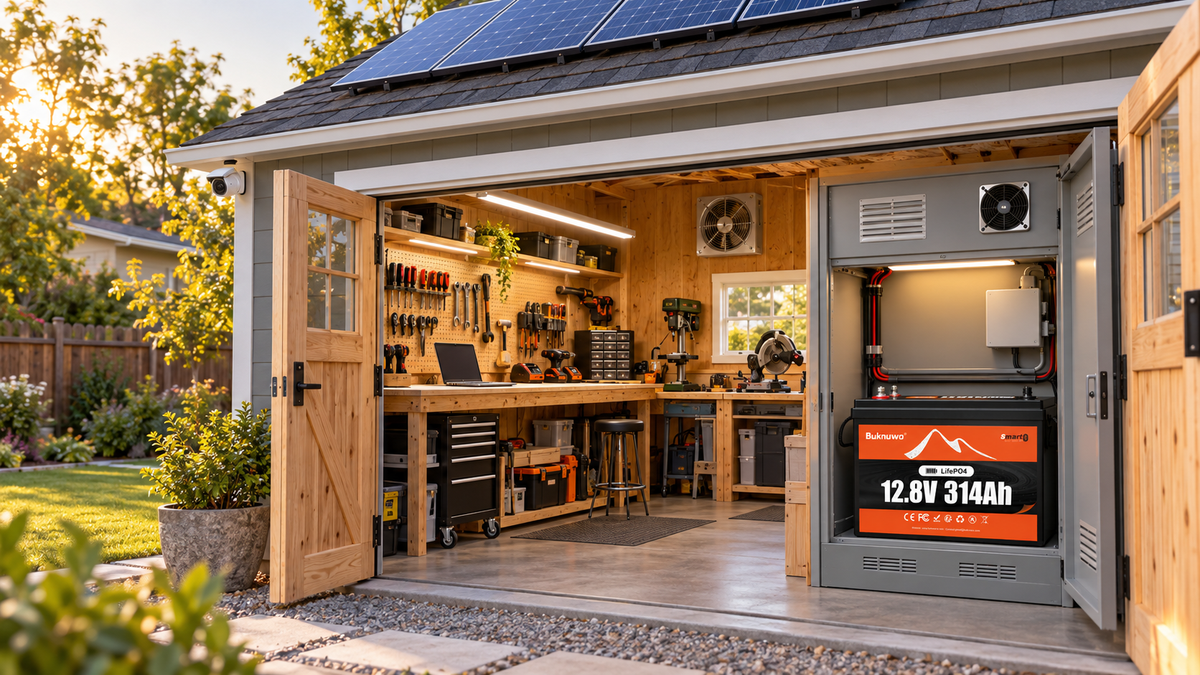
A backyard shed or detached workshop may need power for lighting, security cameras, ventilation, laptops, phone charging and cordless-tool chargers. A LiFePO4 battery can support these uses when the system is planned around real daily energy, tool startup demand, solar charging and the workshop environment.
Quick answer: which battery size works for a shed or workshop?
A BUKNUWO 12.8V 100Ah LiFePO4 battery can be a practical starting point for efficient LED lighting, cameras, phones, a laptop and cordless-tool charging. A 12.8V 150Ah LiFePO4 battery adds reserve for longer work sessions, more chargers and regular ventilation. A 12.8V 314Ah LiFePO4 battery may fit a workshop with several recurring loads or longer periods between charging.
These are planning roles—not guarantees that a battery can run every workshop tool. Table saws, compressors, dust collectors, welders, electric heaters and similar equipment can have high continuous or startup demand. Their compatibility must be checked separately across the complete electrical system.
Start by defining what the workshop system will power
Separate loads into three groups:
- Background loads: security cameras, network devices and equipment left on standby.
- Regular light loads: LED lighting, phones, laptops, radios, fans and cordless-tool chargers.
- Demanding or motor-driven loads: pumps, saws, compressors, dust collectors and larger benchtop equipment.
This separation prevents a common mistake: calculating enough watt-hours for a work session while overlooking whether a motor can start or whether several chargers and tools may operate at the same time.
Typical backyard shed and workshop loads
| Load | Likely use pattern | Planning consideration |
|---|---|---|
| LED ceiling and task lights | Several hours per session | Count every fixture and its operating time |
| Security camera and network device | Continuous or motion-activated | Standby use accumulates between visits |
| Laptop, phone and radio | Intermittent charging | Include conversion and charger losses |
| Cordless-tool chargers | One or more charging cycles | Several chargers may overlap |
| Ventilation fan | Seasonal or session-based | Summer runtime may increase daily use |
| Small drill press or pump | Short motor cycles | Startup current must be checked separately |
| Table saw, compressor or dust collector | High-power intermittent use | Requires equipment-specific continuous and startup analysis |
| Electric heater | Potentially long high-power use | Can dominate a small battery system’s energy budget |
For a simple first estimate:
Daily energy (Wh) = device power (W) × operating time (hours)
Add the results for the equipment expected to run during a normal session. Include unattended loads across the full day, then allow a reasonable planning margin for losses and changing use. Measured consumption is preferable when equipment cycles or varies under load.
100Ah for a light-duty backyard shed
A 12.8V 100Ah battery stores about 1,280Wh of nominal energy. It can suit a garden shed or light workshop used for LED lighting, a camera, phone and laptop charging, a small fan and one or two cordless-tool chargers.

Charging a cordless drill battery is different from running a large corded saw. A 100Ah battery may have enough stored energy for several small charging tasks, but that does not automatically make every AC power tool compatible. Check the power-conversion equipment, BMS, cables and protection devices as well as the appliance itself.
150Ah for longer sessions and more chargers
A 12.8V 150Ah battery provides about 1,920Wh of nominal energy. It can offer additional reserve for longer lighting hours, several cordless-tool chargers, laptop use, security equipment and regular ventilation.

This capacity may fit a frequently used hobby workshop where loads remain controlled. If a drill press, small pump or other motor is included, record its running requirement and startup behavior. Consider whether it might start while the fan, lights and several chargers are already operating.
314Ah for multiple recurring loads or longer autonomy
A 12.8V 314Ah battery stores about 4,019Wh of nominal energy. It may be appropriate when the detached workshop has several recurring loads, is used for longer sessions, or needs additional reserve during poor solar weather.
More capacity does not increase the rating of every other component. The battery BMS, wiring, fuse or breaker, connectors and power-conversion equipment must still support the load. A larger battery also takes longer to recharge from the same small solar array.
Compare the three capacity options
| BUKNUWO option | Nominal energy | Possible workshop role | Review before purchase |
|---|---|---|---|
| 12.8V 100Ah | 1,280Wh | Lighting, camera, electronics and limited tool-battery charging | Number of chargers and time between recharging |
| 12.8V 150Ah | 1,920Wh | Longer sessions, ventilation and several regular light loads | Overlapping chargers and any motor startup |
| 12.8V 314Ah | 4,019Wh | Multiple recurring loads, longer use or added reserve | Mounting, current path and solar recovery time |

Why tool startup power needs a separate check
Some power tools and workshop equipment use motors that can draw a brief startup current above their normal running level. A system can contain enough stored watt-hours for the planned work but still shut down when a motor starts.
For each demanding device, check:
- Rated running power or current.
- Startup or surge requirement when available.
- How long the tool normally operates.
- Whether other loads may run simultaneously.
- Battery BMS continuous and peak-current limits.
- Ratings of the cables, protection, connectors and conversion equipment.
Do not assume that a 314Ah battery can run a welder, large compressor or table saw simply because it stores more energy. If the manufacturer does not publish startup information, request it or measure the equipment with appropriate test tools.
Protect the battery from workshop dust and debris
Workshops create conditions that are different from an RV or living space. Sawdust, metal filings, fasteners and conductive debris can accumulate around work surfaces. Paint, solvents, fuels and other flammable materials may also be stored nearby.
Use a dedicated battery area that follows the product installation instructions. Keep terminals covered, wiring enclosed and the battery away from cutting, grinding, welding or spray-finishing zones. Do not store loose metal tools on top of the enclosure. A cabinet should remain accessible for inspection while preventing debris and accidental contact.
Dust control and ventilation should be designed for the workshop as a whole. A fan in the battery cabinet is not a substitute for controlling dust at its source, and airflow should not intentionally pull sawdust or metal particles across electrical connections.
Temperature planning for a detached building
Detached sheds can become hotter than the outdoor air in direct summer sun and may approach outdoor temperatures in winter. Avoid placing the battery against a hot roof, in direct sunlight or inside an unventilated metal box.
Low-temperature charging must remain within the range specified for the selected battery. A compatible BMS may stop charging when the cells are too cold. Do not bypass that protection. Discharge limits may differ from charging limits, so review the current model manual rather than applying one universal temperature rule.
If the workshop is used throughout the year, the related Seasonal LiFePO4 Power Planning guide can help organize summer and winter checks. Verify that the article is published at this URL before adding the link.
Solar charging for a backyard workshop
A roof-mounted solar array can support a detached workshop when the array, MPPT controller, battery and loads are planned together. Daily solar energy depends on panel orientation, shade from trees or nearby buildings, clouds, dirt, temperature and season.

A large battery paired with a very small array may provide useful storage but recover slowly after a busy workday. Compare expected daily solar production with daily energy use and decide how many days of recovery are acceptable.
Confirm the controller’s photovoltaic input limit, output-current capability and LiFePO4 charging settings. Include suitable disconnects, cable protection and overcurrent devices. For more system context, read How to Connect a BUKNUWO LiFePO4 Battery to a Solar System.
AC equipment without turning this into an inverter project
Many workshop devices use AC power. If AC equipment is included, the system needs compatible conversion equipment sized for continuous demand and startup peaks. Conversion loss also affects runtime.
Because BUKNUWO does not sell the workshop’s conversion equipment in this guide, verify compatibility using the equipment manufacturer’s specifications or ask a qualified installer. The battery capacity table alone cannot approve an AC tool.
Safe placement and wiring checklist
- Secure the battery upright on a stable surface according to its manual.
- Keep it dry and protected from direct sun, roof leaks and condensation.
- Separate it from sawdust, conductive filings, fuels, solvents and paint storage.
- Use covered terminals and prevent tools or fasteners from bridging them.
- Size cables for current, distance, voltage drop, insulation and installation method.
- Use appropriately selected overcurrent protection close to the source where required.
- Protect cables from doors, sharp edges, moving tools and foot traffic.
- Label disconnects so another workshop user can isolate the system.
- Follow applicable local electrical and building requirements.
Plan for periods when the shed is unused
Cameras, routers, battery chargers and indicator lights can remain active after the work session ends. Decide which circuits should stay powered and include their full-day energy use.
Bluetooth monitoring can help inspect compatible battery data while the phone is nearby, but it should not be presented as remote internet monitoring. For longer storage, follow the battery manual for state of charge, temperature and inspection intervals.
Common workshop battery-planning mistakes
- Assuming stored energy equals tool compatibility: watt-hours and startup current answer different questions.
- Counting only tool use: lights, cameras, fans and chargers may overlap.
- Installing the battery near a cutting or grinding station: dust and conductive particles require separation.
- Using electric heating as a routine small-system load: it can dominate the daily energy budget.
- Ignoring shed temperature: detached buildings may experience greater heat and cold swings.
- Oversizing storage without charging: recovery time may become impractical.
- Leaving every charger active: standby loads accumulate between visits.
- Using the battery for engine starting: energy-storage and starting duties are different applications.
Frequently asked questions
Is a 100Ah LiFePO4 battery enough for a backyard shed?
It may be enough for efficient LED lights, security equipment, phones, a laptop and limited cordless-tool charging. Calculate actual energy use and recharge access before deciding.
Can a LiFePO4 battery run power tools?
Some tools may be compatible, but the answer depends on running power, startup demand, operating time and the ratings of the BMS, wiring, protection and power-conversion equipment. Capacity alone is not approval.
What battery size works for cordless-tool charging?
A 100Ah or 150Ah battery can be considered for many light charging setups, depending on the number of chargers and cycles. A 314Ah option may suit more frequent use or several additional workshop loads. Use charger input specifications and measured energy where possible.
Can I keep the battery in an unheated shed during winter?
Storage, charging and discharge temperature limits are model-specific. Low-temperature charging may be blocked by the BMS and should not be forced. Follow the current battery manual and plan around the temperature at the battery location.
Can solar panels power a detached workshop?
They can contribute useful energy when the array, MPPT controller, battery and loads are correctly sized. The result depends on shade, season, daily usage and desired recovery time.
Is a 314Ah battery automatically better for workshop use?
No. It stores more energy, but requires more space and takes longer to recharge from the same array. Choose it only when the measured load and reserve requirement justify the larger capacity.
Can the workshop battery start a lawn tractor or generator?
No. The BUKNUWO batteries discussed here are intended for energy storage and should not be used as engine-starting batteries.
Final recommendation
Build a shed or detached workshop power plan from the loads outward. Consider 100Ah for lighting, security and light charging; 150Ah for longer sessions and more recurring loads; and 314Ah when the daily energy and reserve calculation supports it. Check demanding tools separately for continuous and startup requirements.
Before installation, confirm the current BUKNUWO manual, charging limits, environmental requirements and product specifications. Use a qualified installer when cable sizing, overcurrent protection, AC equipment or local electrical requirements are uncertain.