
How to Choose a LiFePO4 Battery for a 12V Portable Fridge: Runtime, Startup Power and Wiring
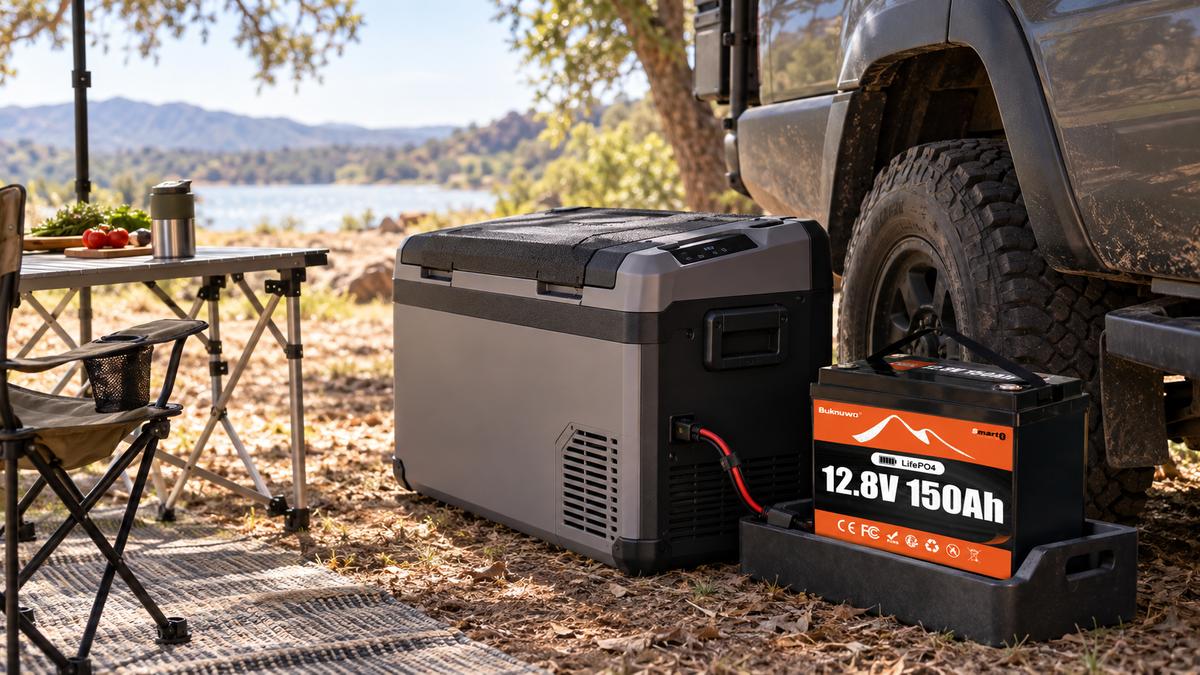
A portable refrigerator can be one of the most useful 12V appliances for camping, road trips, fishing, mobile work, and off-grid travel. It can also be one of the easiest loads to estimate incorrectly. A compressor refrigerator does not normally draw its rated power every minute of the day, but its actual energy use can change with ambient temperature, temperature setting, ventilation, food temperature, door openings, and wiring voltage drop.
This guide explains how to choose a LiFePO4 battery for a 12V portable fridge by using the refrigerator manufacturer's data, checking startup and maximum current, and considering how often the battery can be recharged. The 100Ah, 150Ah, and 314Ah examples are comparison points—not fixed recommendations, compatibility confirmations, or guaranteed runtime claims. Instructions for the exact refrigerator, battery and charging equipment take priority over this general guide.
Quick answer: start with the refrigerator, not the battery
There is no single battery capacity that fits every 12V refrigerator. First identify the refrigerator's input-voltage range, rated or maximum current, and measured or published energy use. Then add any other devices that will share the battery. Finally, include a reserve appropriate to the trip and confirm that the battery, fuse, connectors, and cable can support both normal and temporary peak demand.
A 12V refrigerator battery should therefore be sized from an energy budget and a circuit check together. Amp-hours alone do not show whether the wiring will maintain adequate voltage when the compressor starts.
- 100Ah may enter the comparison for one efficient 12V refrigerator with a measured energy budget and regular charging opportunities.
- 150Ah may enter the comparison when the calculated energy requirement is higher, charging is less frequent, or a small number of additional DC loads share the system.
- 314Ah may enter the comparison for longer stationary use or a larger calculated energy requirement, provided its size, weight, mounting, and recharge time are acceptable.
Larger capacity is not automatically the better choice. A battery that stores more energy also takes up more space, adds weight, costs more, and may take longer to recharge with the same charger or solar input.
Why a 12V refrigerator is different from a constant load
A light or resistive load may draw roughly the same power while it is switched on. A compressor refrigerator normally cycles: the compressor starts, cools the cabinet, stops after the target temperature is reached, and starts again when cooling is needed. The percentage of time the compressor operates is sometimes called its duty cycle.
The duty cycle is not a universal number. It can increase when:
- the surrounding air is hot;
- the refrigerator is exposed to direct sun;
- airflow around the condenser or vents is restricted;
- the temperature is set lower, especially in freezer mode;
- warm food or drinks are added;
- the lid or door is opened frequently;
- the seal is damaged or the cabinet is poorly insulated.
For this reason, multiplying the refrigerator's maximum wattage by 24 hours can substantially overstate energy use, while assuming a low duty cycle can understate it. If the manufacturer publishes average daily consumption in watt-hours, that figure is usually more useful for planning than the maximum input rating—provided the stated test conditions resemble your use.

Estimate portable fridge battery runtime with watt-hours
If the refrigerator documentation provides estimated daily consumption, begin with that value. If it provides only power and an estimated operating time, use this basic planning formula:
Energy (Wh) = Power (W) × Operating time (hours)
If the label lists current rather than watts:
Power (W) ≈ Voltage (V) × Current (A)
Do not treat the compressor's maximum current as though it runs continuously unless the manufacturer instructs you to do so. Instead, use manufacturer energy-consumption data, a plug-in DC energy meter suitable for the circuit, or measurements from a representative trip. Add phone charging, lights, fans, pumps, and other devices separately.
A simple battery comparison uses nominal stored energy:
Nominal battery energy (Wh) = Nominal voltage (V) × Capacity (Ah)
Nominal energy is not the same as guaranteed energy delivered to the refrigerator. Temperature, battery state, BMS limits, wiring losses, connectors, refrigerator behavior, and the reserve you choose all affect practical operation. Avoid publishing a fixed number of hours unless the refrigerator model, test conditions, assumptions, and measured energy use are stated.
Check 12V fridge startup current and maximum current
The compressor may briefly require more current when it starts than during steady operation. Many portable 12V refrigerators manage compressor startup through their internal electronics, but the external circuit must still maintain adequate voltage and support the refrigerator manufacturer's stated maximum current.
A battery can have sufficient watt-hours yet still experience a shutdown if the connector, fuse, or cable is unsuitable. A temporary current increase combined with cable resistance can create voltage sag at the refrigerator. The refrigerator may then activate its low-voltage protection even though the battery still contains energy.
Before installation, check:
- the refrigerator's rated and maximum DC current;
- any startup-current information in its manual;
- the battery BMS continuous and peak-current limits;
- the fuse rating required by the refrigerator or circuit;
- connector and socket current ratings;
- cable gauge, length, insulation rating, and expected voltage drop.

Why 12V refrigerator wiring and voltage drop matter
A vehicle accessory socket can be convenient, but it is not automatically suitable for every refrigerator or installation. The socket, plug, vehicle wiring, and fuse each have a current limit. A long or undersized cable can reduce the voltage reaching the refrigerator, especially during compressor startup.
Use the refrigerator manufacturer's supplied cable when appropriate, keep cable runs practical, and follow the specified fuse and connector requirements. Do not replace a vehicle fuse with a larger one simply to prevent nuisance trips. If a dedicated circuit is needed, it should be designed and protected for the actual load and installation environment.
Regularly inspect plugs and sockets for looseness, discoloration, corrosion, or unusual heat. Stop using the circuit if a connector becomes hot or damaged.
Understand portable fridge low-voltage protection
Some 12V refrigerators offer several low-voltage cutoff settings, often labeled high, medium, and low. These settings are intended to prevent the refrigerator from continuing to operate when its input voltage falls below a selected threshold. They are not a substitute for the battery's BMS, correct wiring, or proper system design.
Do not assume that the lowest setting is always appropriate. A low-voltage alarm can be caused by an actual low battery, but it can also result from an undersized cable, a long cable run, a loose connection, or a poor-quality socket. Use the refrigerator manual to select the setting and diagnose the circuit before changing it.
100Ah vs. 150Ah vs. 314Ah for a 12V portable fridge
| Capacity class | Nominal energy at 12.8V | When it may be evaluated | Tradeoffs to check |
|---|---|---|---|
| 100Ah | 1,280Wh | Measured refrigerator load, compact setup, frequent recharge access | Available reserve after other loads and poor-weather charging gaps |
| 150Ah | 1,920Wh | Higher calculated energy use, longer gap between charges, limited extra DC loads | More size, weight, cost, and energy to replenish than 100Ah |
| 314Ah | Approximately 4,019Wh | Longer stationary use or a larger verified energy budget | Substantially larger transport, mounting, and recharge requirements |
The current BUKNUWO listings provide three examples for this comparison: the 12.8V 100Ah model is listed at 1,280Wh with a 100A smart BMS; the 12.8V 150Ah model is listed at 1,920Wh with a 100A smart BMS; and the 12.8V 314Ah model is listed at approximately 4,019Wh with a 200A smart BMS. These are nominal specification comparisons rather than claims about how long any one refrigerator will run.
These specifications allow the models to be compared, but they do not confirm compatibility with a particular refrigerator. Verify the refrigerator voltage range, maximum current, cable, fuse, connector, dimensions, weight, charger, and operating-temperature requirements before selecting a battery.

Plan solar, charger or DC-to-DC energy replacement
A capacity decision is incomplete without a charging plan. A smaller battery with dependable daily charging may be more practical than a larger battery that cannot be fully replenished during the trip.
Compatible LiFePO4 charger
Use a charger with a profile and voltage that are compatible with the exact battery model. Charging time depends on the energy that must be replaced, the charger's actual output, temperature, and the battery's charging behavior. Do not estimate charging time from capacity alone.
Solar charging
Solar output varies with panel rating, sunlight, shading, panel angle, temperature, wiring, and charge-controller settings. Size the charging system from realistic daily energy production, not the panel's nameplate wattage alone. A compatible charge controller is required; do not connect a solar panel directly to the battery. See the BUKNUWO solar connection guide for the basic system layout.
Charging from a vehicle
If the battery is charged from a vehicle electrical system, use equipment designed for the vehicle, battery chemistry, and alternator configuration. A properly selected DC-to-DC charging system may be required. Do not connect a separate LiFePO4 house battery directly to a vehicle starting system without a compatible charging design. “DC-to-DC” describes the charging method; it does not by itself confirm that a particular charger is compatible.
Temperature affects both the fridge and the battery
High ambient temperature often makes the refrigerator compressor run more frequently. Very cold conditions introduce a different concern: the permitted battery charging temperature may be warmer than its permitted discharge temperature. Low-temperature charging protection may stop charging, but it does not automatically heat the battery.
Check the current manual for the exact battery before charging in cold conditions. Do not bypass BMS protection, and do not assume the air temperature matches the internal battery temperature. For storage between trips, see the LiFePO4 battery care and storage guide.
Reduce refrigerator energy use before adding battery capacity
- Pre-cool the refrigerator and contents before departure using an appropriate power source.
- Keep the refrigerator shaded while maintaining the ventilation clearances in its manual.
- Minimize unnecessary lid or door openings.
- Place already chilled food and drinks inside when practical.
- Use an appropriate temperature setting rather than a colder setting than the contents require.
- Inspect seals and keep vents free of luggage or fabric.
- Use an insulated cover only if it is approved for the refrigerator and does not block ventilation.

Installation and safety checklist
- Confirm that the refrigerator accepts the battery system's operating-voltage range.
- Record average energy use and maximum or startup current from the refrigerator documentation or measurements.
- Add every other device that will share the battery.
- Select cable, connectors, and fuse for the circuit—not only for the battery capacity.
- Install the fuse near the positive battery connection according to applicable guidance.
- Secure the battery and protect its terminals from tools and other conductive objects.
- Keep the battery and electrical connections dry and away from direct heat.
- Provide the refrigerator ventilation specified by its manufacturer.
- Confirm the charging source and expected energy replacement before the trip.
- Recheck the current manuals for both the refrigerator and battery.
The batteries discussed here are deep-cycle energy-storage batteries. They are not intended to start a car, truck, boat engine, or generator.
Selection summary
Choosing a portable fridge battery begins with the refrigerator's daily watt-hours and maximum current—not with a generic promise that a particular amp-hour rating will last a certain number of days. A 100Ah model may be included in a compact, frequently recharged plan; a 150Ah model provides more nominal energy for a higher calculated requirement; and a 314Ah model may be considered for longer stationary use after its size, weight, mounting, and charging needs are accepted.
A more defensible plan combines measured energy use, adequate current capability, low-resistance wiring, the correct fuse and connector, realistic environmental assumptions, and a dependable method of recharging. Recheck the plan whenever the refrigerator, cable route, additional loads or charging source changes.
Frequently asked questions
How long will a 100Ah LiFePO4 battery run a 12V fridge?
There is no model-independent answer. Use the refrigerator's measured or published daily watt-hour consumption, then account for other loads, temperature, wiring losses, battery limits, and the reserve you want to keep. Maximum refrigerator wattage alone does not describe its daily energy use.
Is 150Ah better than 100Ah for a portable refrigerator?
A 150Ah battery stores more nominal energy, but it is not automatically the more practical choice. Compare the calculated energy requirement, time between charges, space, weight, recharge time, and cost.
Do I need a 314Ah battery for multi-day refrigerator use?
Not necessarily. Multi-day operation depends on refrigerator energy use and energy added by solar, vehicle charging, or another compatible source. A larger battery may increase stored energy, but charging access and installation constraints remain important.
Why does the refrigerator show low voltage when the battery is not empty?
Possible causes include voltage drop in a long or undersized cable, a loose or warm connector, an unsuitable socket, a blown or undersized fuse, or a refrigerator low-voltage setting. Check the complete circuit and follow the equipment manuals rather than changing the cutoff setting immediately.
Can I connect a 12V refrigerator directly to a LiFePO4 battery?
Only when the refrigerator's accepted input-voltage range is compatible with the battery's full operating-voltage range and the circuit includes appropriate cable, connectors, and overcurrent protection. Confirm this in both manuals.
Can a LiFePO4 battery start the vehicle after running the fridge?
The BUKNUWO models discussed in this article are deep-cycle energy-storage batteries and are not designed for engine starting. Keep the vehicle starting system separate and use an appropriate charging and isolation design.