
Dock and Lakeside Power: Planning a LiFePO4 Battery System
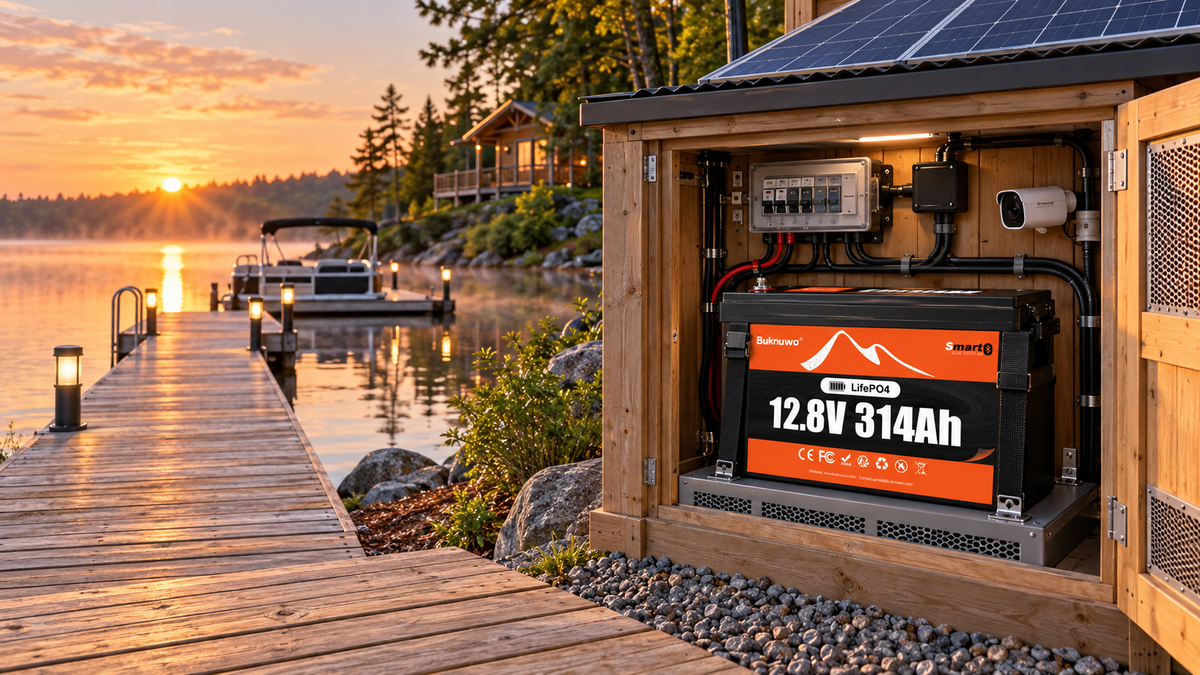
A dock or lakeside property may need power for lighting, security cameras, communications, a small water pump, device charging or a portable refrigerator. A LiFePO4 battery can support these loads, but the system must be planned around water exposure, changing lake levels, startup current, charging access and periods when the property is unattended.
Quick answer: how should a dock battery system be planned?
Start by identifying the equipment, daily operating time and any motor startup current. Then choose a battery capacity that can cover the planned energy use and reserve, confirm that the BMS and electrical path can support peak demand, and provide a realistic charging method.
For a controlled group of low-power lights, cameras, phones and a radio, a BUKNUWO 12.8V 100Ah LiFePO4 battery can be a useful planning starting point. A 12.8V 150Ah LiFePO4 battery adds reserve for a compact refrigerator or intermittent water pump. A 12.8V 314Ah LiFePO4 battery may suit longer stays, several recurring loads or periods of limited solar charging.
These are application examples rather than guaranteed runtimes. Water protection, cable routing, overcurrent protection, temperature limits and local electrical requirements are just as important as battery capacity.
Define the system boundary first
This guide focuses on a separate low-voltage energy-storage system for lakeside loads. It is not a design for marina shore-power infrastructure, submerged equipment, household service wiring or boat-engine starting.
Keeping the boundary clear prevents a small battery project from becoming an unsafe attempt to power an entire dock. Identify exactly which circuits belong to the battery system. Efficient low-voltage lighting, cameras and communication equipment are often easier to plan than mixed high-power equipment.
Common dock and lakeside loads
| Equipment | Likely use pattern | Planning issue |
|---|---|---|
| Low-voltage dock lights | Several evening hours | Count every fixture and actual runtime |
| Security cameras | Continuous or motion-activated | Cameras, recorder and network device all use energy |
| Phone and radio charging | Intermittent | Include charging and conversion losses |
| Portable refrigerator or cooler | Cycles throughout the day | Ambient heat, door opening and compressor startup matter |
| Small water-transfer pump | Short operating cycles | Startup current may exceed running current |
| Aeration or circulation equipment | Timed or continuous | Long runtime can dominate the daily total |
| Fish-cleaning or utility light | Short task-based use | Weather-resistant fixtures and safe placement matter |
For a basic estimate:
Daily energy (Wh) = device power (W) × daily operating time (hours)
Add the equipment totals, then include a reasonable planning margin for changing use, wiring losses and poor charging weather. When a device cycles automatically, measured daily energy is usually more useful than multiplying its maximum power by 24 hours.
100Ah for lighting, cameras and communication
A 12.8V 100Ah battery stores about 1,280Wh of nominal energy. It can fit a modest dock power system built around efficient LED lighting, a few device chargers, a radio and controlled security equipment.

Continuous cameras can consume more energy than expected because the recorder, network bridge or router may also run around the clock. Count the entire monitoring system. If the property remains unattended for long periods, compare daily use with the weakest expected solar production rather than with a sunny weekend.
150Ah for a refrigerator or intermittent pump
A 12.8V 150Ah battery provides about 1,920Wh of nominal energy. It may offer a more comfortable reserve when the lakeside setup includes a compact portable refrigerator, a small water pump or longer lighting hours.

A refrigerator’s real daily use depends on ambient temperature, insulation, thermostat setting, ventilation and how often it is opened. A pump’s total watt-hours may be small when it runs briefly, but its startup current can still be important. Do not select 150Ah solely because a device is described as “small.” Use its specifications or measured performance.
314Ah for longer stays and larger reserves
A 12.8V 314Ah battery stores about 4,019Wh of nominal energy. It may suit a lakeside system with refrigeration, pumps, cameras, lighting and communication equipment used together, or a property that needs additional reserve during cloudy weather.
The larger capacity must still be rechargeable. If the solar array or charger is small, recovering from a deep discharge can take a long time. The battery also needs suitable mounting, cable protection and a dry service area large enough for safe access.
Compare battery capacity by application
| BUKNUWO option | Nominal energy | Possible lakeside role | Confirm before selection |
|---|---|---|---|
| 12.8V 100Ah | 1,280Wh | Lights, cameras, phones and communication devices | Continuous monitoring time and recharge access |
| 12.8V 150Ah | 1,920Wh | Added reserve for a portable refrigerator or intermittent pump | Startup current, summer duty cycle and charging time |
| 12.8V 314Ah | 4,019Wh | Longer stays, several recurring loads or poor-weather reserve | Mounting space, system current and solar recovery |

The best battery is not automatically the largest one. A smaller system can be easier to protect and recharge when the loads are limited. A larger system becomes useful when the measured energy budget, visit length and reserve requirement support it.
Startup current matters near the water too
Water pumps, refrigerator compressors and some aeration equipment can briefly draw more current when starting than while running. Battery capacity in amp-hours or watt-hours does not by itself confirm that these loads can start.
Check the equipment manual for startup or surge information. Verify the battery BMS, fuse or breaker, cable size, connectors, distribution hardware and any power-conversion equipment as one current path. Also consider whether a pump and refrigerator could start at the same time.
For more detail about pump planning, see How to Choose a LiFePO4 Battery for a 12V Water Pump.
Keep the battery away from water exposure
A dock is exposed to spray, rain, humidity, flooding, movement and foot traffic. The battery should normally be installed on land or in a protected shore-side structure, raised above expected water exposure and secured against movement. Do not leave it loose on dock boards or in a location that can be submerged.
Use enclosures, cable entries and electrical components appropriate for their environment. Keep water plumbing separated from terminals and electrical distribution. Route cables so they are protected from abrasion, ultraviolet exposure, wildlife and people walking along the dock. Provide strain relief and prevent low cable loops from collecting or directing water into an enclosure.
A battery cabinet should remain dry while following the battery manufacturer’s installation and ventilation requirements. “Weather-resistant cabinet” does not mean the battery can be submerged. Inspect for condensation, corrosion, insects and damaged seals at the start of each season.
Plan solar charging as a complete system
Solar can support a remote dock or lakeside property, but the array, controller, battery and loads must be planned together. Panel nameplate power is not the same as daily energy delivered to the battery. Shade from trees, panel angle, clouds, dirt, snow, temperature and controller losses all affect production.

Use an MPPT controller compatible with the photovoltaic array and battery requirements. Confirm its photovoltaic input limit, output-current capability, cable sizing, disconnects and overcurrent protection. Larger battery capacity may require more charging time, so compare a realistic day of solar production with a realistic day of load use.
For the broader connection sequence, read How to Connect a BUKNUWO LiFePO4 Battery to a Solar System.
Account for seasonal lake conditions
Lakeside conditions change through the year. Summer can increase refrigerator runtime and visitor use. Autumn brings shorter solar days and falling leaves that can shade panels. Winter can introduce snow, ice and low battery temperatures. Spring can raise water levels and reveal damage caused during the off-season.
Low-temperature charging deserves particular attention. Charging LiFePO4 cells outside the range allowed for the specific battery can cause damage. A compatible BMS may block charging when the cells are too cold; do not bypass that protection. Discharge and charging limits are not necessarily the same, so follow the current model manual.
Review the related Seasonal LiFePO4 Power Planning guide when a dock system remains installed throughout the year.
Separate the dock system from engine starting
The BUKNUWO batteries discussed here are intended for energy-storage applications. They should not be used as starting batteries for a boat engine, personal watercraft, ATV, truck or generator. Keep engine-starting duties on the battery system specified by the equipment manufacturer.
If a battery powers electronics aboard a boat, that becomes a separate marine-system design with different wiring, isolation and protection considerations. Do not extend an informal dock cable to a boat and treat it as a permanent installation.
Planning for unattended operation
Security cameras, network devices, lights on timers and pumps controlled automatically can continue using energy after everyone leaves. Add every standby load to the daily estimate and decide what should happen during several cloudy days.
Bluetooth monitoring can help check compatible battery data while a phone is nearby, but local Bluetooth should not be described as remote internet monitoring. If remote status is required, plan a separate communications and monitoring system and include its continuous energy use.
Before leaving, confirm that optional circuits are off, automatic loads are intentional, the enclosure is closed and the charging path is appropriate for unattended operation. Follow the product manual for long storage periods.
Common dock power mistakes
- Placing the battery directly on the dock: splash, flooding, impact and foot traffic increase risk.
- Choosing by amp-hours alone: capacity does not confirm pump or compressor startup capability.
- Ignoring supporting devices: camera recorders, routers and control modules can run continuously.
- Routing cables across walkways: cables require mechanical protection and safe routing.
- Mixing plumbing and electrical connections: pumps and water lines should not create a leak path over the battery.
- Oversizing storage without increasing charging: recovery can become impractically slow.
- Assuming an enclosure permits submersion: keep the installation above expected water exposure.
- Using the storage battery for engine starting: these are separate applications.
Dock and lakeside planning checklist
- List all lights, cameras, chargers, pumps and refrigeration loads.
- Estimate daily watt-hours for the season of use.
- Check startup current and overlapping motor loads.
- Choose reserve based on visit length and charging reliability.
- Locate the battery on shore in a raised, dry and protected space.
- Confirm cable, connector and protection ratings.
- Keep water plumbing away from terminals and distribution equipment.
- Estimate realistic MPPT solar production and recovery time.
- Check temperature limits for seasonal operation.
- Create an unattended shutdown and inspection plan.
Frequently asked questions
Can a LiFePO4 battery be installed directly on a dock?
That is generally not the preferred location. A shore-side, raised and protected installation is easier to keep dry and secure. The final location must follow the battery manual, enclosure requirements and applicable electrical rules.
Is a 100Ah battery enough for dock lights?
It may be enough when the lights are efficient and operating hours are controlled. Include every fixture, camera, charger and standby device, then compare daily use with available charging and reserve.
What battery size works for a lakeside refrigerator?
It depends on measured daily refrigerator energy, ambient temperature, startup current, other loads and recharge access. A 150Ah battery may fit some compact refrigerator systems; longer operation or additional loads may justify evaluating 314Ah.
Can a solar panel keep the dock battery charged?
Possibly, if realistic daily solar production exceeds or balances the planned load over time. Trees, clouds, panel direction, seasonal daylight and unattended equipment must be included.
Can this battery run a dock water pump?
It can support a compatible pump system when voltage, running current, startup current, BMS capability, cable size and protection are all suitable. Check the pump documentation rather than judging by capacity alone.
Can I use the same battery to start my boat?
No. The batteries discussed in this article are for energy storage and should not be used as boat-engine starting batteries.
Is 314Ah always the best lakeside option?
No. It stores more energy, but requires more space and may take longer to recharge from the same solar array. Choose it only when the energy budget and reserve requirement justify the additional capacity.
Final recommendation
Plan dock and lakeside power from the equipment outward. Consider 100Ah for controlled lighting and communication loads, 150Ah when a compact refrigerator or intermittent pump is added, and 314Ah for longer stays or a larger reserve. Then verify peak current, charging recovery, water protection, temperature limits and safe cable routing.
Review the current BUKNUWO product specifications and manuals before purchase or installation. Because water and electricity create additional hazards, use a qualified installer when enclosure selection, wiring protection or local requirements are uncertain.