
How Long Can a LiFePO4 Battery Run a Trolling Motor?
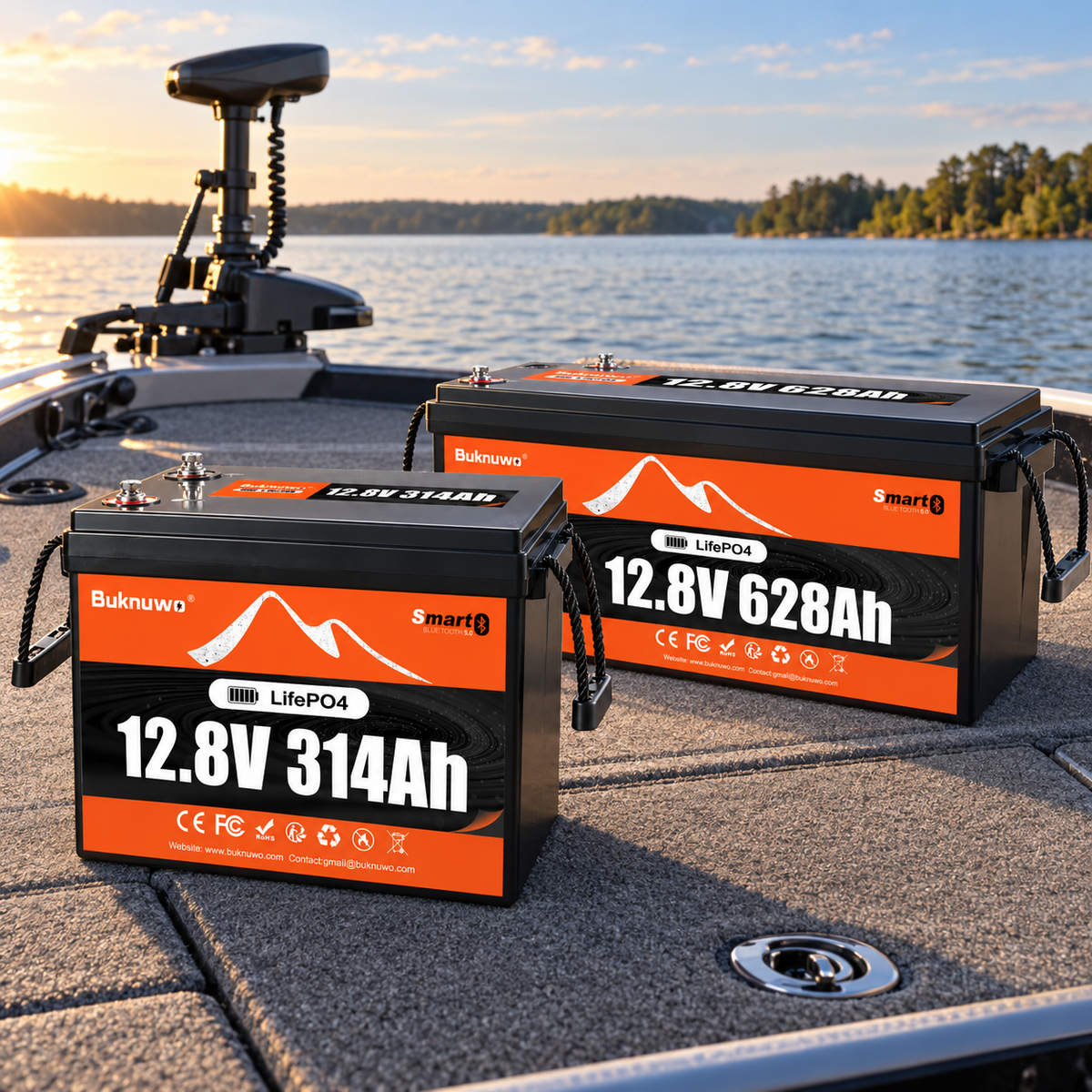
How long can a LiFePO4 battery run a trolling motor? A planning estimate depends on the battery capacity included in the calculation and the motor’s average current draw during the trip. A larger battery may run the same motor longer under comparable conditions, but speed, boat weight, wind, water current, propeller resistance, wiring and other onboard loads can change the result significantly.
Short answer: Under the same motor load and operating conditions, a 628Ah battery has twice the rated capacity of a 314Ah battery and may provide approximately twice the theoretical runtime. This is a capacity relationship, not a guaranteed field result.
This guide explains the main factors that influence LiFePO4 trolling motor battery runtime, shows one simple planning method and compares the BUKNUWO 12.8V 314Ah and 12.8V 628Ah Bluetooth LiFePO4 batteries. The calculations are illustrative and are not test results for a specific trolling motor.

Why Trolling Motor Runtime Is Not a Fixed Number
A trolling motor does not normally draw the same current for an entire trip. Current changes as the operator changes speed, steers, accelerates or moves through different water conditions. This is why the answer to “how long does a trolling motor battery last?” cannot be reduced to one universal number.
The main runtime factors are:
- Motor speed: Higher settings usually draw more current and shorten operating time.
- Boat weight: Passengers, fishing equipment, fuel and supplies increase the work required from the motor.
- Wind and water current: Moving against wind or current can increase motor demand.
- Propeller resistance: Weeds, fishing line, damage or an unsuitable propeller can increase current draw.
- Other electrical loads: Fish finders, lights, pumps and chargers reduce the energy available to the motor when connected to the same bank.
- Wiring and connections: Long, undersized or loose connections can create voltage drop and wasted energy.
- Temperature and battery condition: Operating conditions affect usable energy and voltage behavior.
Published maximum current is helpful for system compatibility, but it is not usually the same as average current during a normal day on the water.
The Two Numbers You Need
To estimate runtime, begin with two values:
- Battery capacity in amp-hours (Ah)
- Average trolling motor amp draw during actual use
Battery capacity is available in the battery specifications. Average current is more difficult because it depends on how the motor is operated. Look for current data in the trolling motor manual, ask the motor manufacturer or measure the current during representative use.
A Bluetooth battery monitor can help users observe current and state of charge during a trip. After several trips, recorded operating patterns provide a more useful basis for planning than the motor’s maximum amp draw alone.
A Simple Trolling Motor Runtime Estimate
For a basic planning estimate:
Estimated runtime ≈ planned battery capacity ÷ average motor current
“Planned battery capacity” means the amount of rated capacity you choose to include in the trip plan. Keeping a reserve helps account for changing conditions and the energy needed to return safely.
For example, if a calculation assumes a 90% planning window:
- The 314Ah example uses 282.6Ah as its planning capacity.
- The 628Ah example uses 565.2Ah as its planning capacity.
If a motor averaged 20A throughout an illustrative trip, the simple calculation would produce approximately 14.1 hours for 314Ah and 28.3 hours for 628Ah.
Example limitation: The 20A value is an assumption, not a BUKNUWO motor test. It does not represent every motor, speed setting, boat or water condition. Actual runtime may be shorter or longer.
The 90% planning window is also an example assumption. It is not a guaranteed usable-capacity specification and does not require the user to discharge the battery to that level.
314Ah vs. 628Ah Trolling Motor Battery Runtime
| Comparison | BUKNUWO 12.8V 314Ah | BUKNUWO 12.8V 628Ah |
|---|---|---|
| Rated capacity | 314Ah | 628Ah |
| Example planning capacity at 90% | 282.6Ah | 565.2Ah |
| Capacity relationship | Base comparison | Twice the rated capacity |
| Illustrative runtime at a 20A average load | Approximately 14.1 hours | Approximately 28.3 hours |
| Runtime direction under comparable conditions | Base comparison | May approach twice the theoretical runtime |
For users researching 314Ah trolling motor battery runtime or 628Ah trolling motor battery runtime, the most reliable comparison begins with the actual average current of the same motor on the same boat. Without that common load, an hour-based comparison can be misleading.

Why Motor Speed Changes Runtime
Motor speed is one of the largest day-to-day influences on trolling motor battery runtime. Low or moderate settings generally use less current than continuous high-power operation. The relationship between boat speed and electrical demand should not be assumed to be perfectly linear.
Two trips of the same length can produce very different battery use:
- A calm-water trip using steady low-speed positioning may consume relatively little energy.
- A trip involving strong wind, rapid repositioning and continuous high-speed operation may consume much more.
- Frequent acceleration and steering corrections can also change the average current.
When estimating how long a lithium battery will run a trolling motor, use the expected operating pattern rather than relying only on the motor’s lowest or highest published current.
Boat Weight, Wind and Water Conditions
A heavier or less efficient boat may require more thrust to maintain comparable movement. Passengers, fishing equipment, batteries and stored supplies all contribute to the total load.
Wind and water current can also have an important effect. Holding position against a headwind or moving upstream may require a higher motor setting for longer periods. Plan a reasonable energy reserve for returning to shore if conditions change.
Runtime planning should be conservative when:
- The route includes strong current or open water.
- Weather conditions are uncertain.
- The boat carries several passengers or heavy equipment.
- The trolling motor is the primary means of propulsion.
- Charging is not available between trips.
Include Other Onboard Electrical Loads
If other devices share the same battery bank, they reduce the energy available to the trolling motor. Common loads include:
- Fish finders and sonar
- Navigation and deck lights
- Bilge and livewell pumps
- Radios and marine electronics
- Phone, tablet and camera charging
Some of these loads are small compared with the motor, but they can become significant during a long trip. Include their consumption when planning the battery reserve.
Voltage and Compatibility Note
A runtime estimate is useful only after battery and motor compatibility has been confirmed. System voltage must match the motor rating. When comparing 12V trolling motor runtime, 24V trolling motor battery runtime or 36V trolling motor battery runtime, compare total stored energy and actual system current rather than comparing Ah alone across different voltages.
Compatibility reminder: A runtime calculation does not confirm that a battery can support a motor’s maximum or startup current. A BMS protection threshold is not a guaranteed surge-current rating. Review voltage, current and connection requirements in the separate battery selection guide before installation.
How to Extend Trolling Motor Runtime
- Use the lowest practical motor setting for the required control or movement.
- Avoid carrying unnecessary weight.
- Keep the propeller clean and inspect it for damage or tangled line.
- Use correctly sized cables and clean, secure connections.
- Fully charge the battery before a planned trip.
- Monitor current and state of charge during use.
- Turn off unnecessary onboard loads.
- Plan a return-to-shore reserve instead of operating until the BMS disconnects.
- Recharge the battery using equipment compatible with the exact LiFePO4 model.
Keep the Battery Protected
Follow the battery, trolling-motor and vessel manufacturer’s instructions. Install the battery in a dry, secure and ventilated location, and protect it and its connections from water, salt spray, impact and accidental short circuits. Detailed installation and connection planning is covered in the battery selection guide.
Not for engine starting: BUKNUWO 314Ah and 628Ah batteries are deep-cycle energy-storage batteries. They must not be used to start an outboard motor, inboard engine, automobile engine, generator or other engine.
A Practical Runtime Planning Checklist
- Measure or estimate average current for the planned operating pattern.
- Choose a transparent battery-capacity planning window.
- Add the consumption of other loads connected to the battery bank.
- Allow for motor speed, wind, water current, boat weight and changing conditions.
- Keep a return-to-shore energy reserve.
- Monitor actual use and adjust future estimates.
Read: How to Choose a LiFePO4 Battery for a Trolling Motor
View the BUKNUWO 12.8V 314Ah Bluetooth LiFePO4 Battery
View the BUKNUWO 12.8V 628Ah Bluetooth LiFePO4 Battery
Frequently Asked Questions
How long will a lithium battery run a trolling motor?
Runtime depends mainly on usable battery capacity and the motor’s average current draw. Divide the planned Ah capacity by the measured or estimated average amps for a rough planning result, then allow for other loads and changing conditions.
How long does a 314Ah battery last with a trolling motor?
There is no single runtime without knowing the average current. Using a 90% planning window and an illustrative 20A average load gives approximately 14.1 hours. This is a mathematical example, not a motor test or guaranteed result.
How long does a 628Ah battery last with a trolling motor?
Using the same illustrative 90% planning window and 20A average load gives approximately 28.3 hours. Actual runtime changes with motor speed, boat weight, wind, current, wiring and other loads.
Will a 628Ah battery always last twice as long as a 314Ah battery?
No. It has twice the rated capacity, so it may provide approximately twice the theoretical runtime only when both batteries operate under comparable loads and conditions. Different motors, boats or operating patterns should not be compared using capacity alone.
Does a higher trolling motor speed use more battery?
Generally, yes. Higher motor settings normally increase current draw and shorten runtime. The exact relationship depends on the motor, boat and water conditions.
Can I estimate runtime from maximum amp draw?
Maximum amp draw can provide a conservative reference but may not represent average use. Measured current across a representative trip usually produces a more useful estimate.
Does Bluetooth monitoring increase runtime?
No. Bluetooth does not add energy. It helps users observe current, state of charge and battery status so they can manage energy and improve future trip estimates.
Final Answer
The duration of a trolling motor battery is influenced by both stored capacity and real operating demand. A 628Ah battery contains twice the rated capacity of a 314Ah battery, so it may provide approximately twice the theoretical runtime under comparable conditions. Motor speed, boat weight, wind, water current and shared electrical loads influence how closely real use follows that relationship.
Use the motor’s measured average current, keep a return reserve and confirm voltage and current compatibility before installation. Treat every calculated runtime as a planning estimate rather than a guaranteed performance figure.
Contact BUKNUWO Support for Runtime Planning Help
Methodology and Product Reference
This guide uses the confirmed BUKNUWO specifications supplied for the 12.8V 314Ah and 12.8V 628Ah Bluetooth LiFePO4 batteries. Nominal energy is calculated from rated voltage and capacity: approximately 4.02kWh for 314Ah and 8.04kWh for 628Ah. Both models have a documented 200A maximum continuous discharge current. Runtime examples use a 90% planning window and an illustrative 20A average load; they are not results from a specific trolling motor test.
Last updated: September 2026.
This article provides general planning information. Actual runtime depends on the battery, motor, boat, wiring, operating conditions and other connected equipment. Follow all battery, trolling-motor and vessel manufacturer instructions.