
LiFePO4 Battery Power for a Remote Hunting Cabin
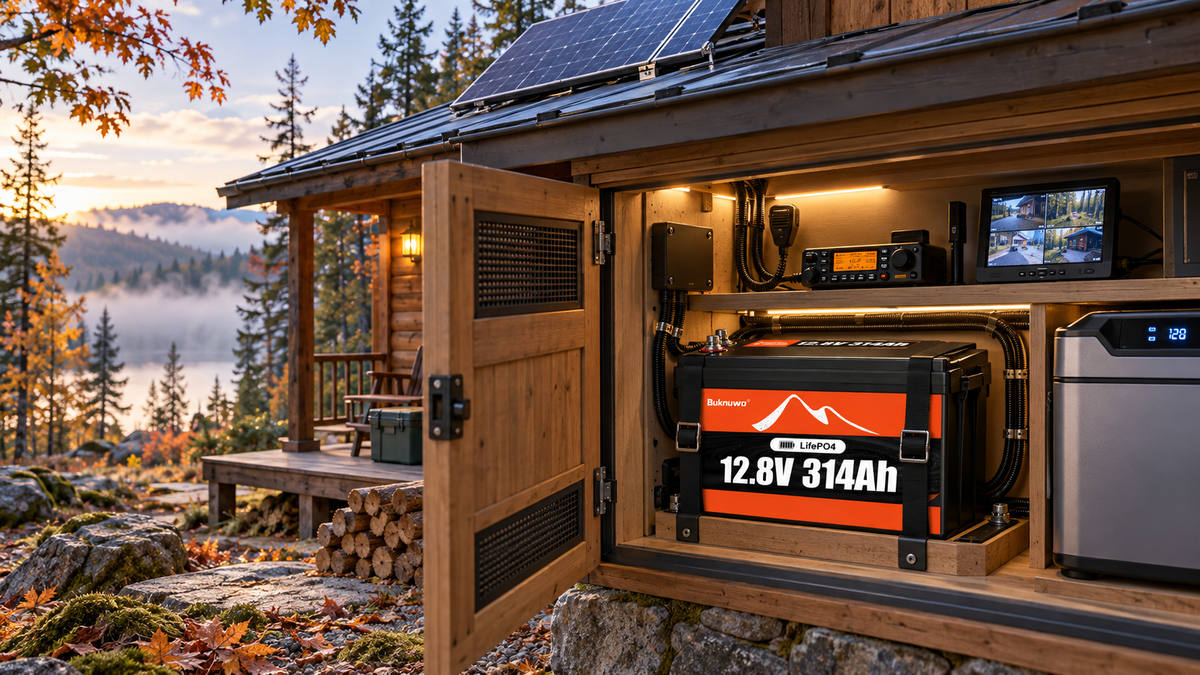
A remote hunting cabin needs a different power plan from a full-time home. The system may sit unused for weeks, then support lighting, communications, cameras, a water pump and refrigeration during a short visit. A suitable LiFePO4 battery system should therefore be based on the cabin’s real loads, available charging time, cold-weather conditions and the consequences of running low on power.
Quick answer: what battery size works for a remote hunting cabin?
There is no single capacity that fits every cabin. A BUKNUWO 12.8V 100Ah LiFePO4 battery can be a practical starting point for efficient lights, phone charging, a radio and a small camera system. A 12.8V 150Ah LiFePO4 battery provides additional energy for a compact refrigerator, intermittent water pump or longer visits. A 12.8V 314Ah LiFePO4 battery may suit cabins with several recurring loads, longer stays or a larger poor-weather reserve.
These are planning roles, not guaranteed runtimes. Before selecting a battery, confirm daily watt-hours, motor startup current, BMS limits, charging temperature, solar production, wiring and overcurrent protection.
Why a hunting cabin needs its own power plan
Remote cabins are often used intermittently and may be difficult to reach after heavy rain or snow. That creates several planning challenges:
- The battery may remain in storage between visits.
- Solar production may change substantially with season, shade and snow.
- A refrigerator or pump can add both daily energy use and brief startup demand.
- Cold battery temperature may prevent safe charging even when sunlight is available.
- Communications, lighting and security equipment may be more important than convenience loads.
A good remote hunting cabin battery system begins by separating essential loads from optional ones. This makes it easier to preserve energy when weather delays charging or a visit lasts longer than expected.
Start with the cabin load list
List every device that may use battery power, its wattage and how long it normally runs. If a device cycles automatically, such as a refrigerator, use measured daily consumption when possible instead of multiplying its maximum label wattage by 24 hours.
| Cabin load | Typical use pattern | Planning consideration |
|---|---|---|
| LED lighting | Several hours in the evening | Count the number of lamps and actual hours used |
| Phones and small electronics | Intermittent charging | Include conversion and charging losses |
| Radio or communication equipment | Standby plus short transmit periods | Transmit power may be higher than standby demand |
| Security cameras and recorder | Continuous or motion-activated | Continuous monitoring adds up across unattended days |
| Compact refrigerator | Cycles throughout the day | Ambient temperature, door opening and startup current matter |
| Water pump | Short intermittent cycles | Check startup current and possible overlapping loads |
| Ventilation fan | Seasonal or intermittent | Long summer runtime can change the daily total |
For a simple initial estimate:
Daily energy (Wh) = device power (W) × daily operating time (hours)
Add the devices together, then include a reasonable planning margin for measurement error, wiring losses and unexpected use. Avoid promising an exact runtime from capacity alone; refrigerator duty cycles, weather and user behavior can change the result.
Light cabin loads: when 100Ah may be enough
A 12.8V 100Ah battery stores about 1,280Wh of nominal energy. It can be considered for a carefully managed cabin with efficient LED lights, phone charging, a small radio and modest security equipment. The important phrase is “carefully managed.” A refrigerator, high-power cooking appliance or electric heater can quickly change the calculation.

This capacity may be appropriate when visits are short, charging is dependable and optional loads can be switched off. It may be less comfortable for an unattended camera system running for many days or for refrigeration combined with a pump and longer evening use.
Moderate loads: where 150Ah can fit
A 12.8V 150Ah battery provides about 1,920Wh of nominal energy. The additional capacity can create more flexibility for weekend stays, a compact efficient refrigerator, an intermittent water pump and regular electronics charging. Suitability still depends on the actual equipment rather than the category name.

If the refrigerator and pump might start at the same time, evaluate that overlap. A system may have enough stored energy for the day yet still reach a BMS, fuse or equipment current limit during startup.
Longer stays and larger reserves: when to consider 314Ah
A 12.8V 314Ah battery provides about 4,019Wh of nominal energy. It may suit a cabin with refrigeration, lighting, communications, cameras and water equipment used across longer visits. It can also provide more reserve when solar recovery is uncertain.
More capacity does not solve every design problem. A larger battery takes longer to refill with the same charging source, requires suitable mounting space and must be paired with compatible cables, protection devices and charging equipment. Select 314Ah because the load and reserve calculation supports it—not simply because the cabin is remote.
Battery comparison for a remote hunting cabin
| Battery option | Nominal energy | Possible cabin role | Check carefully |
|---|---|---|---|
| 12.8V 100Ah | 1,280Wh | Lighting, communication and small electronics | Unattended camera days and available recharge time |
| 12.8V 150Ah | 1,920Wh | Weekend use with a compact refrigerator or intermittent pump | Compressor and pump startup current |
| 12.8V 314Ah | 4,019Wh | Longer stays, multiple recurring loads or added poor-weather reserve | Mounting, wiring, protection and solar recovery time |

Do not overlook refrigerator and pump startup current
Motor-driven equipment can briefly draw more current when it starts than while it runs. This applies to many compressors, pumps and fans. Amp-hours or watt-hours describe stored energy, but they do not prove that a battery system can start every connected device.
Check the equipment manual for startup or surge requirements. Then verify the complete path: battery BMS rating, fuse or breaker, cable size, connectors, DC distribution and any power-conversion equipment. Consider whether two motor loads can start together. If the information is unavailable, obtain it from the equipment manufacturer or measure the load with suitable test equipment.
BUKNUWO batteries in this guide are intended for energy-storage applications. They should not be used as engine-starting batteries for an ATV, truck, boat or generator.
Planning solar charging at an isolated cabin
A solar array can reduce dependence on transported charging, but panel wattage alone does not define how much energy reaches the battery. Daily production depends on location, season, panel direction, shade, clouds, dirt, snow and system losses.

Use an appropriately sized MPPT solar charge controller that is compatible with the panel array and the battery charging requirements. Confirm photovoltaic input limits, output-current capability, wire size, disconnects and overcurrent protection. Do not simply match the solar-array wattage to a large current number without checking the controller specification.
Estimate charging around the weakest season in which the cabin will actually be used. A 314Ah battery can store more energy than a 100Ah battery, but the same small array may need substantially more time to restore it after several cloudy days. For a broader system overview, read How to Connect a BUKNUWO LiFePO4 Battery to a Solar System.
Cold-weather LiFePO4 planning
Many hunting cabins are used when nighttime temperatures are low. The key distinction is between charging and discharging. Low-temperature charging can damage LiFePO4 cells, so charging must remain within the range specified for the particular battery. A compatible BMS may block charging when the cells are too cold. Do not bypass that protection.
Some batteries allow discharge below their minimum charging temperature, although available performance and exact limits vary. Always use the current BUKNUWO manual for the selected model. Battery temperature—not only the outdoor forecast—should guide charging decisions.

Solar panels can operate efficiently in cool conditions, but total winter production may still be limited by shorter days, a low sun angle, clouds, shade or snow coverage. Avoid improvised heaters or direct heat sources around the battery. If cold-weather charging is required, use a battery, enclosure or warming solution specifically approved for the installation.
Safe installation inside a remote cabin
- Mount the battery securely on a stable surface where it cannot shift.
- Keep it dry and protected from direct sunlight, conductive debris and physical impact.
- Follow the product instructions for orientation, clearance and environmental conditions.
- Place correctly selected overcurrent protection close to the energy source as required by the design.
- Use cable sized for current, length, voltage drop, insulation rating and installation method.
- Cover exposed terminals and prevent tools or metal objects from bridging them.
- Keep combustion appliances and fuel storage separated from electrical equipment according to applicable requirements.
- Label disconnects so another cabin user can isolate the system safely.
Remote locations can make repairs harder, so simple, accessible and well-documented wiring is valuable. Have the design reviewed by a qualified installer when load current, code requirements or protection selection is uncertain.
Plan for unattended periods
Before leaving the cabin, decide which loads should remain active. Security cameras, communications gateways and monitoring equipment can slowly discharge a system over a long absence. Bluetooth monitoring is useful while you are physically near a compatible battery, but local Bluetooth should not be treated as remote internet monitoring.
Follow the battery manual for long-term storage state of charge, temperature and inspection intervals. Turn off unnecessary loads, verify that essential circuits are intentional and check that the solar charging path is appropriate for unattended use. Do not assume a panel will always keep up with a continuous camera or network system.
Common remote cabin planning mistakes
- Choosing only by amp-hours: capacity does not confirm startup-current compatibility.
- Using appliance maximum power as a daily estimate: cycling equipment needs measured or realistic operating time.
- Ignoring winter solar conditions: summer production may not represent autumn or winter use.
- Charging a cold battery because the sun appeared: battery temperature and model limits still apply.
- Running electric space heating as a routine load: resistance heating can dominate the energy budget.
- Oversizing storage without charging capacity: a larger battery may take too long to recover.
- Leaving every circuit active between visits: small continuous loads accumulate over time.
- Using an energy-storage battery for engine starting: cabin storage and starter-battery duties should remain separate.
Remote hunting cabin checklist
- Separate essential and optional loads.
- Estimate daily watt-hours for the actual season of use.
- Check startup current for the refrigerator, pump and fans.
- Choose a reserve based on visit length, access and poor weather.
- Estimate realistic daily solar production and recovery time.
- Confirm battery, BMS, charger and controller compatibility.
- Size cables and protection for the real current and installation.
- Verify charging-temperature limits before winter operation.
- Create a shutdown plan for unattended periods.
- Keep the engine-starting system separate.
Frequently asked questions
Is a 100Ah LiFePO4 battery enough for a hunting cabin?
It may be enough for efficient lighting, phones, a radio and modest security equipment during short visits. It may not provide the desired reserve when refrigeration, pumping or unattended continuous loads are added. Calculate the cabin’s daily watt-hours and charging opportunity first.
What size LiFePO4 battery is suitable for a cabin refrigerator?
The answer depends on the refrigerator’s measured daily energy, ambient temperature, visit length, startup demand and recharge plan. A 150Ah battery may fit some compact efficient refrigerator systems, while longer stays or several additional loads may support considering 314Ah. These are planning examples rather than runtime guarantees.
Can solar panels keep a remote cabin battery charged all winter?
Sometimes, but it should not be assumed. Winter daylight, shade, clouds, snow coverage, panel orientation and continuous loads determine the result. Also confirm that the battery is warm enough to accept a charge under its product requirements.
Can I leave security cameras running when the cabin is empty?
Yes, if their total daily use and the charging system are deliberately sized for unattended operation. Include the cameras, recorder, network equipment and any cold-weather effects in the calculation, then provide a low-energy or shutdown strategy for extended poor weather.
Can the cabin battery start an ATV or generator engine?
No. The BUKNUWO batteries discussed here are energy-storage batteries and should not be used as engine-starting batteries. Use the starting battery specified by the vehicle or generator manufacturer.
Is 314Ah automatically better than 100Ah or 150Ah?
No. It stores more energy, but it also requires more space and may take longer to recharge from the same solar array. The best option is the capacity that meets the measured load, current and reserve requirements without creating an impractical charging plan.
Final recommendation
Plan a remote hunting cabin LiFePO4 system from the loads outward. Use 100Ah for a controlled group of light essentials, consider 150Ah when refrigeration or pumping is added, and evaluate 314Ah for longer stays or greater reserve. Then confirm startup current, seasonal solar recovery, low-temperature charging limits, safe installation and unattended-load strategy.
Review the latest BUKNUWO product specifications and manuals before purchase or installation. When system current, wiring protection or local requirements are unclear, consult a qualified electrical or off-grid installer.