
What Size LiFePO4 Battery Do I Need? A Practical Sizing Guide
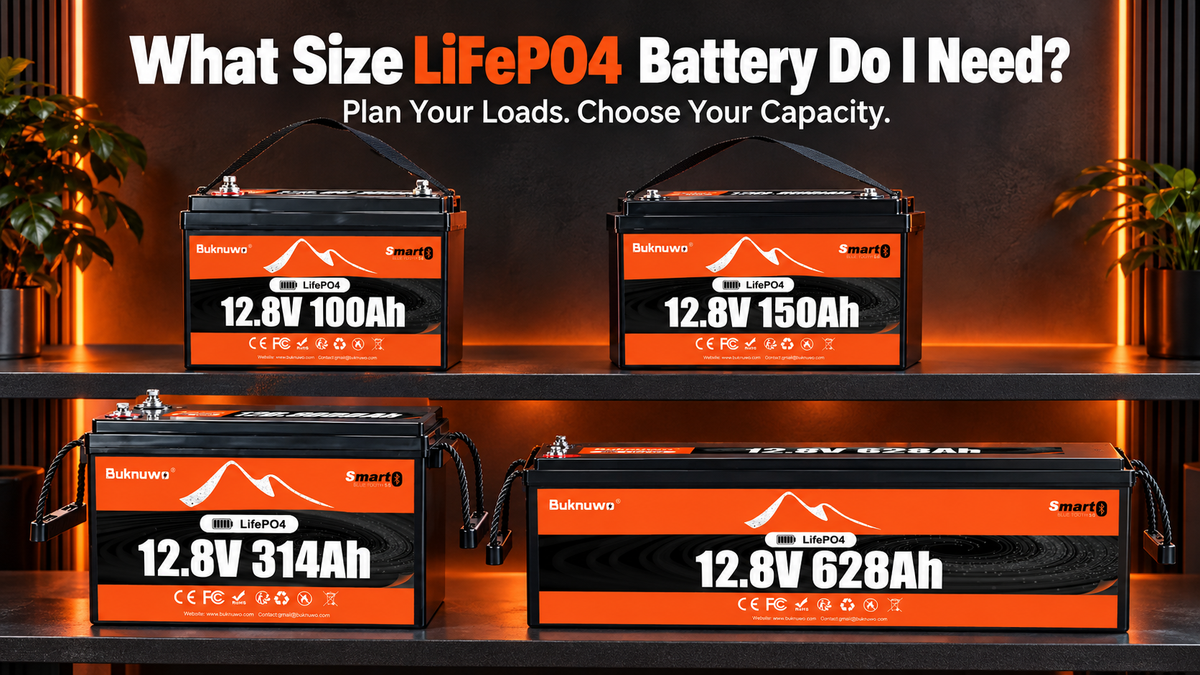
What size LiFePO4 battery do I need? Choose a battery that covers your daily energy use for the time you expect to go between charges, with a reserve for losses and changing conditions. Then check system voltage, continuous current, startup demand and installation fit. Capacity in amp-hours alone cannot determine whether a battery will run your equipment.
For a 12V system, a 100Ah battery may suit a modest camping energy budget, while 150Ah provides additional reserve. A 314Ah or 628Ah battery is worth considering when your measured energy needs or time between charges are substantially greater. This LiFePO4 battery sizing guide explains how to choose without relying on complicated calculations or a one-size-fits-all recommendation.
Start with Your Equipment, Not a Battery Size
Before choosing a 12V LiFePO4 battery, write down what you need to power. Separate daily essentials from occasional extras. A few lights and phone chargers have a different energy budget from refrigeration, ventilation and mobile work equipment running every day.
- Camping: LED lanterns, phones, a fan and other compatible low-power electronics.
- RV house power: a 12V refrigerator, interior lights, vent fans, a water pump and device charging.
- Off-grid solar: daily loads plus the reserve needed when solar collection is limited.
- Essential backup: selected communication, lighting and work devices, using suitable connections and conversion equipment where required.
A household AC appliance cannot simply connect to battery terminals. Check its supply requirements and the complete system design. These BUKNUWO batteries are for deep-cycle energy storage and must not be used for engine starting.

Step 1: Estimate Your Daily Energy Use
Look for energy consumption in watt-hours (Wh), or estimate it from device power and operating time. The simple relationship is watts × hours = watt-hours. Use actual measurements whenever possible, especially for equipment that cycles on and off.
The following is an illustrative daily budget, not a specification for your appliances:
| Device | Example assumption | Daily energy |
|---|---|---|
| LED lighting | 10W total for 5 hours | 50Wh |
| Fan | 20W for 6 hours | 120Wh |
| Laptop | 50W average for 3 hours | 150Wh |
| Phone charging | Assumed daily energy | 20Wh |
| 12V refrigerator | Assumed measured daily energy | 400Wh |
| Total | Illustrative device-side demand | 740Wh per day |
The refrigerator figure is a placeholder for measured daily consumption, not its instantaneous power. Ambient temperature, thermostat setting, door openings and appliance design can change it substantially. Include standby use and conversion losses when moving from a device-side budget to a battery budget.
Step 2: Decide How Long You Need to Go Between Charges
Daily consumption is only half the picture. Ask how long the battery must support your equipment before a dependable recharge.
In the example above, one day requires 740Wh at the devices; two days require 1,480Wh before allowing for losses and reserve. A trip lasting five days does not necessarily require five days of battery autonomy if dependable charging is available each day. Conversely, a short trip can need more reserve if charging is uncertain.
For a LiFePO4 battery for camping, consider the next reliable charging opportunity. For an off-grid solar battery, consider consecutive periods of weak solar collection. For essential backup, define which devices remain on and how long they need to operate.
Step 3: Add a Planning Reserve
Avoid planning around every nominal watt-hour reaching your appliances. Allow for system losses, unused reserve, battery condition and changes in consumption.
For a simple screening example, this guide budgets 80% of nominal battery energy toward device use. This is an illustrative combined allowance, not a manufacturer efficiency, measured usable-capacity figure or recommended discharge limit. Your actual system may need a different allowance.
| 12.8V capacity | Nominal energy | 80% planning budget | At the example 740Wh/day, without recharging |
|---|---|---|---|
| 100Ah | 1,280Wh | 1,024Wh | About 1.4 days |
| 150Ah | 1,920Wh | 1,536Wh | About 2.1 days |
| 314Ah | 4,019.2Wh | About 3,215Wh | About 4.3 days |
| 628Ah | 8,038.4Wh | About 6,431Wh | About 8.7 days |
Nominal energy is calculated from the labeled 12.8V voltage and capacity. The day estimates compare the same assumed energy budget and do not prove that any specific appliance is compatible.
For the two-day example, 150Ah only narrowly covers 1,480Wh under this allowance. If consumption is uncertain or charging could be delayed, choose more reserve or reduce the load. A battery that just meets a paper calculation may leave little flexibility.
Step 4: Check Voltage and Current Before Buying
Ah is useful when comparing batteries at the same voltage. Across different voltages, compare Wh. The BUKNUWO models discussed here are marketed for 12V systems and labeled with a nominal voltage of 12.8V. Equipment still needs to accept the battery's operating voltage range.
Capacity determines the energy budget; current limits determine which loads the battery can support. The BUKNUWO 100Ah and 150Ah models list 100A Smart BMS ratings, while the 314Ah model lists 200A. Do not infer a model's current limits from capacity alone. Check the current specifications and manual for your selected battery.
Pumps and compressors can briefly draw more current at startup than during normal operation. Compare both continuous demand and startup demand with documented battery limits and the rest of the system. An appliance can fit your daily energy budget yet still trigger protection when it starts.
Cables, connectors, fuses and any power conversion equipment must also suit the load. Bluetooth battery monitoring can help you observe battery status, but it does not replace correct installation or current checks.

Which BUKNUWO Battery Capacity Should You Consider?
100Ah: Start with a Modest, Measured Energy Budget
A 100Ah LiFePO4 battery is a candidate when your daily loads are modest and charging is dependable. Think of lights, phones and a small fan, then add refrigeration only after checking its daily consumption and startup requirements. Do not choose 100Ah simply because a trip is described as a weekend.
View the BUKNUWO 12V 100Ah Bluetooth LiFePO4 battery.
150Ah: Add Reserve for Everyday RV and Camping Loads
A 150Ah LiFePO4 battery provides 50% more nominal energy than 100Ah at the same voltage. Consider it when a smaller battery leaves too little overnight reserve, but your daily energy needs remain moderate. Confirm that the extra capacity and available charging support your intended time away.
View the BUKNUWO 12V 150Ah Bluetooth LiFePO4 battery.
314Ah: Plan for a Larger Daily Budget or Longer Charging Gaps
A 314Ah LiFePO4 battery is worth considering for larger RV house energy budgets, refrigeration with mobile work equipment, or solar storage where longer charging gaps matter. Check the mounting space, weight, installation requirements and time needed to replenish it.
View the BUKNUWO 12V 314Ah Bluetooth LiFePO4 battery.
628Ah: Evaluate Higher Storage Needs Carefully
A 628Ah LiFePO4 battery labeled 12.8V has approximately 8.04kWh of nominal energy. It may be a candidate when a measured storage requirement exceeds smaller capacities, provided the charging system and installation can support it. That energy figure is not a whole-home runtime or an output-power rating.
Browse BUKNUWO 12V LiFePO4 batteries and check current 628Ah specifications.

What Size Battery Do I Need for an RV or Solar System?
For RV battery sizing, count the loads used while parked: refrigeration, lighting, fans, pumps and electronics. Keep vehicle starting requirements separate. Choose capacity for your real overnight or multi-day energy use rather than RV length alone.
For solar battery sizing, check how much energy you consume, how much you can realistically collect and how long storage must bridge the gap. More battery capacity does not increase solar generation. Use a compatible MPPT controller with suitable LiFePO4 settings; do not connect a panel directly to the battery.
U.S. camping conditions can change the plan. Hot-weather trips in Arizona may increase refrigerator consumption. Shaded campsites in the Pacific Northwest can reduce solar yield. Cold mountain trips in Colorado require checking the battery's charging temperature limits. These are examples of local planning factors, not regional runtime promises.
Follow the selected battery's permitted charging range and protection behavior. Low-temperature charging protection does not mean a battery heats itself or can charge safely at every outdoor temperature.
Common Battery Sizing Mistakes
- Choosing by appliance count: several small lights may use less energy than one continuously running device.
- Treating Ah as output power: capacity and current capability answer different questions.
- Ignoring charging: more storage still needs enough charging time and energy.
- Using generic refrigerator figures: replace example numbers with your appliance's measured consumption.
- Forgetting physical fit: check clearance, terminal access, mounting and weight.
- Assuming mixed batteries can be combined: follow the manual's matching and expansion requirements.
Frequently Asked Questions
Is a 100Ah LiFePO4 battery enough for camping?
It can be enough for a modest energy budget with dependable charging. Add up daily consumption, choose the time between charges, allow reserve and check load compatibility before deciding.
How many Ah do I need for two days off-grid?
There is no universal Ah figure. In this guide's 740Wh/day example, two days require 1,480Wh at the devices. A 150Ah battery narrowly meets that under an illustrative 80% planning allowance; uncertain consumption or delayed charging calls for more margin.
Can a larger battery run any appliance?
No. Larger capacity increases stored energy. Appliance compatibility also depends on system voltage, running current, startup demand and the complete installation.
Should I size my solar battery by panel wattage?
Panel wattage alone is insufficient. Size storage around daily loads and the charging gaps you need to cover, then check realistic solar yield and controller compatibility.
Can I use these batteries to start an RV engine?
No. These BUKNUWO batteries are intended for deep-cycle energy storage, including RV house loads, rather than engine starting.
Choose Capacity That Matches Your Plan
Start with daily Wh, decide the time between reliable charges, add reserve and check electrical and physical compatibility. This gives you a practical way to answer “What size lithium battery do I need?” without assuming the largest battery is always the right purchase.
Explore BUKNUWO 12V LiFePO4 batteries, or visit the Help Center & FAQ with your device list and charging plan.