
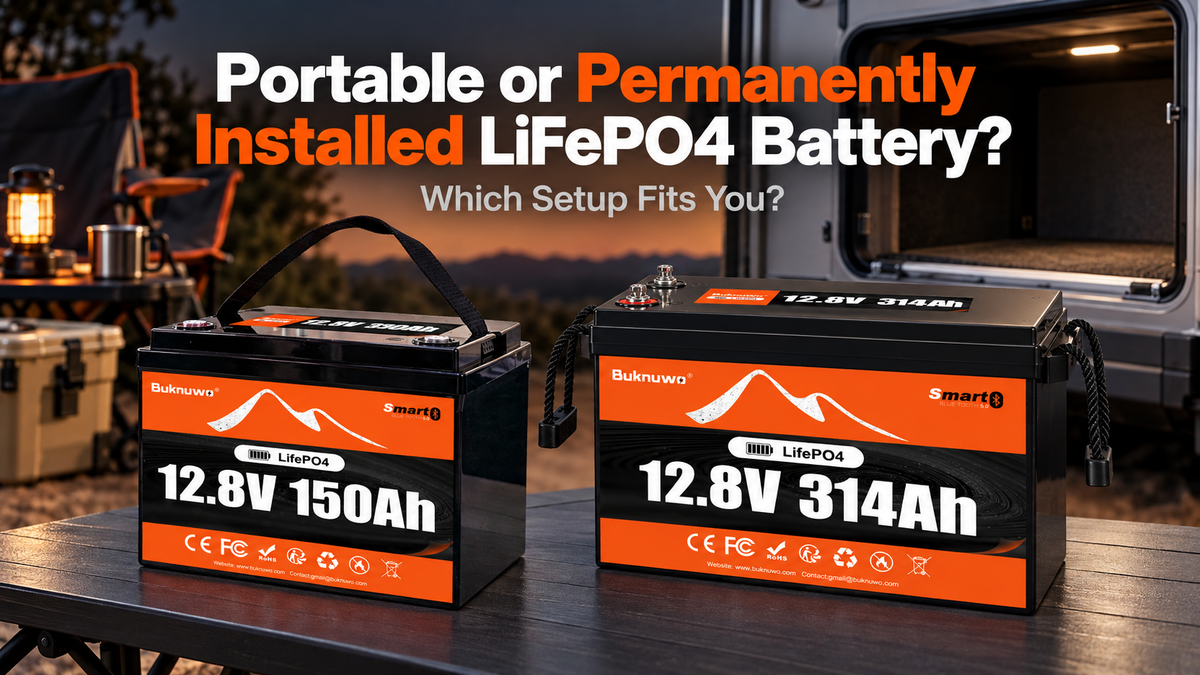
Portable or Permanently Installed LiFePO4 Battery: Which Setup Fits You?
BUKNUWO · Buying Guides
Compare moving, mounting, charging, and everyday access before choosing your 12V lithium battery setup.
A portable or permanently installed LiFePO4 battery setup can serve different needs. A removable arrangement may suit occasional camping or seasonal use. A fixed installation may be more practical when the same RV, solar system, or backup setup uses the battery regularly.
The choice involves more than a carrying handle. Consider the complete system's weight, safe connection method, mounting, charging location, weather conditions, and access for maintenance.
This buying guide compares both arrangements and helps you evaluate BUKNUWO 12.8V batteries around your actual use.
Quick answer: Should you choose a portable or fixed LiFePO4 battery setup?
Choose a removable setup when moving the complete equipment is practical and you have a suitable connection, charging, and storage plan at each location. Choose a fixed setup when the battery serves one installation regularly, frequent lifting would be inconvenient, or a larger battery needs secure support. Both arrangements require appropriate wiring, protection, environmental conditions, and restraint during vehicle transport.
First, define what “portable” means
In this article, portable means a battery arrangement intended to be disconnected and moved between uses or locations. It does not mean the battery includes household outlets, a charger, or a complete ready-to-use electrical system.
A standalone 12V LiFePO4 battery normally needs appropriate connections, overcurrent protection, and compatible equipment for its loads. Ordinary 120V AC devices require suitable power conversion. Check what is actually included in the product package.
Likewise, a permanently installed battery is securely mounted and integrated into its intended system. It should still have appropriate service access and isolation provisions. “Permanent” does not mean impossible to remove for authorized maintenance.
Portable and fixed setups compared
| Consideration | Removable setup | Fixed installation |
|---|---|---|
| Location | Can move between compatible uses | Usually serves one system |
| Handling | Requires a realistic lifting and transport plan | Reduces routine lifting after installation |
| Connections | Needs a suitable repeated connection method | Connections can remain in place with service provisions |
| Mounting | Needs stable placement during use and restraint in transport | Needs secure mounting and suitable structural support |
| Charging | May charge at a separate location | Can integrate with approved charging sources |
| Storage | May be moved to a suitable storage environment | The installed location must meet storage and operating limits |
| Cost | May need enclosure, connectors, and duplicated equipment | May need compartment work and installed components |
Neither arrangement is automatically cheaper or more suitable. Compare the complete equipment and installation required by your plan.
When a removable battery setup may fit
Occasional camping with manageable equipment
If you use lighting, small electronics, or selected DC equipment on occasional trips, a removable arrangement may be worth evaluating. Choose a capacity that covers your energy budget and a complete system you can move comfortably.
Consider the route from storage to vehicle and vehicle to campsite. Stairs, uneven ground, lifting height, and distance can make the same battery much harder to manage. The weight of a case, cables, charger, and other equipment adds to the battery's listed weight.
Seasonal use and storage at another location
A removable setup may suit an RV or camping system that is used seasonally, provided removal and reconnection are practical and supported by the design. It may allow storage in a location that meets the exact battery's temperature and maintenance requirements.
Do not assume moving the battery indoors automatically makes charging safe. The battery must meet its approved charging conditions, and the charging area must be suitable for the equipment.
Sharing one arrangement between compatible activities
You may want to use the same battery for more than one activity. Verify voltage, current demand, charging, protection, connectors, and mounting at every destination. Compatibility with one set of devices does not establish compatibility with another.
Plan the transition procedure before buying. Do not move the battery while connected or disconnect loaded circuits using a connector that is not approved for that purpose.

When a fixed installation may fit better
Regular RV house power
For an RV used frequently, a fixed installation may reduce repeated handling and setup. The battery can be mounted for travel and connected to approved charging and distribution equipment.
For U.S. campground trips, check shore-power charging compatibility. For boondocking without hookups, evaluate your actual energy budget and charging opportunities. The installation style does not itself determine runtime.
Solar energy storage in one location
A fixed arrangement may fit a solar storage system used at one site. Plan the battery location, MPPT compatibility, cable runs, protection, and service access together.
Shorter suitable cable routes can help the design, but placement must also meet temperature, environmental, and mounting requirements. A battery compartment that is convenient in summer may become too cold for permitted charging in winter.
Larger batteries and selected backup systems
As battery weight and storage capacity increase, frequent moving may become less practical. A properly supported fixed location can be worth evaluating for a larger energy budget or a regularly used backup arrangement.
For home backup, a standalone 12V battery does not directly supply household 120V outlets. Use compatible conversion and protection equipment. Integration into home circuits requires suitable transfer equipment and qualified installation. Never backfeed an outlet.

Use weight to evaluate handling, not to promise portability
The supplied BUKNUWO sheet lists these battery-only weights and electrical ratings:
| Model | Listed weight | Nominal energy | Max continuous discharge |
|---|---|---|---|
| 12.8V 100Ah | 10.5kg | 1,280Wh | 100A |
| 12.8V 150Ah Smart | 18.9kg | 1,920Wh | 100A |
| 12.8V 314Ah Smart | 26.7kg | 4,019.2Wh | 200A |
| 12.8V 628Ah Smart | 53.1kg | 8,038.4Wh | 200A |
Values are from the supplied BUKNUWO sheet. Confirm current dimensions and weight for the exact variant. Nominal Wh is calculated and is not guaranteed usable output. Accessories add weight.
Evaluate 100Ah first when your energy needs are modest and frequent handling matters. The 150Ah model offers more nominal energy but adds weight. Neither should be described as easy to carry for every person.
For 314Ah and especially 628Ah, begin by evaluating a fixed or infrequently moved arrangement with a suitable handling and support plan. A handle is not proof that a battery is convenient for daily lifting, and it is not a substitute for a transport restraint.
Five checks before choosing your arrangement
1. Can you move the complete system safely?
Include every item that moves with the battery. Measure carrying distance and lifting height, and consider appropriate assistance or handling equipment. Protect terminals during transport and secure the equipment in the vehicle.
2. Is the connection method designed for the intended use?
For repeated connection, ask about suitably rated connectors, polarity control, cable strain relief, and isolation. Check voltage, current, environmental rating, and whether the connector is approved to disconnect under load.
A bolted battery terminal is not automatically a convenient quick-release connection. Follow the manufacturer's hardware and tightening instructions.
3. Does the location meet environmental requirements?
Check operating and storage temperatures, moisture protection, mounting orientation, and clearance. Neither portable nor fixed equipment should be assumed suitable for snow, rain, submersion, or an unheated winter compartment.
Insulation does not continuously provide heat, and low-temperature charge protection does not establish self-heating.
4. Can you recharge where and when you need to?
A removable battery may be convenient to charge elsewhere, but moving it can be inconvenient. A fixed battery may integrate with multiple charging sources, but each must follow the exact battery's profile and input limits.
Evaluate the energy you need to replace between uses. Installation style does not fix an undersized or incompatible charging arrangement.
5. Have you checked protection and service access?
Both arrangements need appropriate DC protection and wiring. A BMS does not replace cable protection. Fixed installations also need access for inspection, isolation, and authorized service.
Check current demand and brief startup surges separately from capacity. All referenced BUKNUWO models are for deep-cycle storage and are not for engine starting.
A removable installation can be a useful middle option
You do not always have to choose between frequent carrying and a battery that stays in place indefinitely. A design can be securely installed during use and removed occasionally for service or seasonal storage.
If that suits your needs, discuss access, isolation, connection method, and lifting with the installer before buying. Keep the normal installation secure rather than leaving the battery loose to make removal easier.
Compare the complete cost
For a removable plan, check any enclosure, connector, protection, charger, and transport-restraint costs. If multiple locations need separate equipment, include those additions.
For a fixed plan, check trays, brackets, cable routes, protection, compartment modifications, and installation work. A larger or heavier battery may change handling and structural requirements.
Request itemized quotes. “Portable” does not mean no installation work, and “fixed” does not guarantee a lower or higher total cost.
Frequently asked questions
Is a standalone LiFePO4 battery a portable power station?
No. A battery may be movable, but it does not necessarily include a charger, AC outlets, conversion equipment, or complete load protection. Check the package and system requirements.
Is 150Ah a good portable battery size?
It depends on energy demand and the complete system's handling requirements. The supplied 150Ah model weighs 18.9kg before accessories. Evaluate your own lifting and transport route.
Does a fixed installation provide more runtime?
Not by itself. Runtime depends on usable energy, device consumption, and charging. Installation style affects handling and integration.
Can I remove a fixed battery for storage?
Possibly, if the design provides safe isolation, access, and a documented removal and reconnection process. Confirm that plan before installation.
Do portable setups still need fuses?
They still need appropriate external overcurrent protection for the actual circuit. Portability and an internal BMS do not remove that requirement.
Can I leave the battery loose in an RV compartment?
No. Use suitable secure mounting or transport restraint and protect connections. A carrying handle does not restrain the battery during vehicle movement.
Choose around your actual routine
List how often the battery moves, its complete transport weight, the locations where it operates, and how it recharges. Then compare that routine with a secure removable or fixed design.
Compare BUKNUWO 12V LiFePO4 batteries
For compatibility help, visit the BUKNUWO Help Center FAQ with your loads, charging equipment, and planned installation location.