
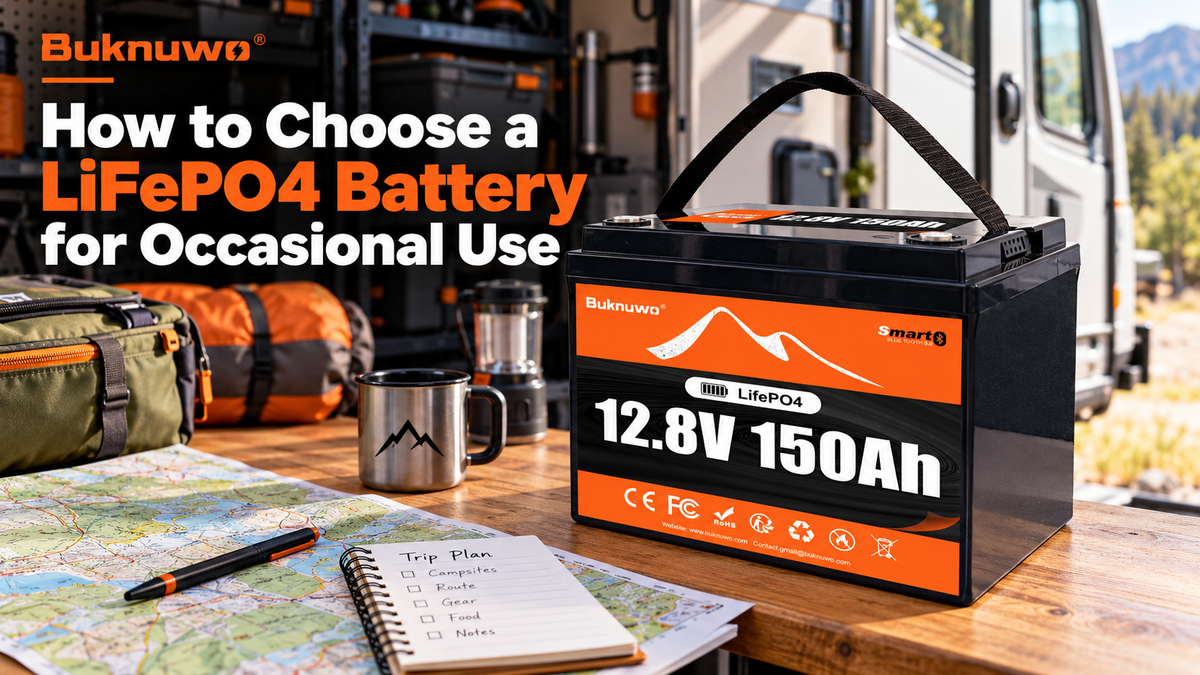
How to Choose a LiFePO4 Battery for Occasional Use
BUKNUWO · Buying Guides
Choose a battery around each trip, the time between uses, and the effort required to keep it ready.
How do you choose a LiFePO4 battery for occasional use? Start with what you need during each outing or backup event. Then check how the battery will be stored, monitored, and prepared before its next use.
A battery used for a few camping trips each year can still need substantial capacity for a long trip. A battery used infrequently for backup may need to stay ready at short notice. Frequency alone does not determine the right Ah rating.
This buying guide covers seasonal RV use, occasional camping, and selected backup needs, with practical checks for choosing a BUKNUWO 12V LiFePO4 battery.
Quick answer: What matters most when buying a battery for occasional use?
Choose capacity and current capability for the actual time you need power, then verify storage instructions, idle power draw, charging compatibility, handling, and return-to-service checks. Occasional use does not automatically mean a smaller battery or no maintenance. Separate a stored travel battery from an actively maintained standby system that must be ready for an outage.
1. Define your occasional-use pattern
Write down how often you use the battery, the duration of each event, and how much notice you have before using it again. These details affect charging and storage arrangements as much as capacity.
| Use pattern | Main priority | Question to ask |
|---|---|---|
| A few camping weekends | Trip energy, handling, and preparation | Can I charge and check it before each outing? |
| Seasonal RV travel | Installed storage conditions and residual loads | What remains connected while the RV is parked? |
| Occasional off-grid visits | Time between dependable charges | Will charging be available when I arrive? |
| Selected emergency backup | Maintained readiness | How will I know it is ready when needed? |
For example, a scheduled U.S. campground trip gives you time to prepare and may provide shore power. A power outage offers less notice. Choose the management plan that fits the use rather than assuming all idle batteries should be treated alike.
2. Size capacity for each event, not the number of trips
List the devices you need, their energy use, and how long they operate before the next reliable charge. Use measured daily energy for cycling appliances such as refrigerators.
A light weekend of LED lighting and phone charging differs from a longer stay with laptops, fans, and a refrigerator. More days without charging can increase storage needs even if you travel only once a year.
Allow for reserve and system losses using realistic assumptions. Do not choose the smallest battery solely because it will be used infrequently, or the largest solely because you want to avoid preparation.
Ask before buying: “Does this model cover my expected device energy until the next dependable charge?”
3. Check current and startup demand separately
Capacity determines nominal stored energy. Continuous discharge current helps determine what can run at once. A device used rarely can still demand substantial current when operating.
Check the maximum realistic simultaneous load and short startup surges from motors or compressors. Confirm any permitted surge magnitude and duration. An overcurrent protection trip threshold is not an approved operating rating.
These checks remain necessary for a small number of annual uses. The referenced BUKNUWO batteries are for deep-cycle energy storage and are not for engine starting.
4. Ask for model-specific storage instructions
Before buying, obtain written guidance for storage temperature, storage state of charge, isolation, inspection intervals, and when recharging is required. Follow the exact model instructions rather than a generic internet percentage.
Storage, charging, and discharging temperature limits are different specifications. A location permitted for storage may still be too cold for charging. Confirm safe charging conditions before preparing a battery that has been stored in an unheated garage or RV compartment.
Do not assume a low-temperature protection feature includes self-heating. Likewise, a low self-discharge claim does not establish that a connected system can be ignored indefinitely.
Ask before buying: “What storage procedure applies to this exact SKU, and what checks are required during my expected idle period?”

5. Identify everything that draws power while parked
Battery self-discharge and external standby loads are different. A monitor, controller, connected accessory, or other device can continue using energy even when the main appliances appear off. Battery electronics can also have a model-dependent idle draw.
A simple hypothetical example shows why small loads matter: a constant 0.05A draw over 30 days uses 36Ah, calculated as 0.05 × 24 × 30. That is charge drawn by the example load, not a prediction of BUKNUWO self-discharge or remaining capacity.
Measure or obtain the residual consumption for your own system. Do not assume a master switch disconnects every circuit. At the same time, do not disable required RV safety devices as a shortcut to reducing idle draw. Review the storage arrangement with the RV or equipment instructions.
Do not rely on a BMS low-voltage shutdown as a long-term storage method. Protective shutdown is not a substitute for managing remaining charge and following the recovery instructions.
6. Match charging to your preparation window
Think about when you can recharge before a trip. If you normally prepare the night before departure, check whether the compatible charger can restore the energy required in that time.
A larger battery does not necessarily charge faster. Charging time depends on starting state of charge, approved charging current, the charger's profile, battery conditions, and any loads operating while charging.
The supplied BUKNUWO sheet lists a standard charging voltage of 14.4V ± 0.2V for the referenced 12.8V models. Confirm the complete charging profile and conditions for the exact variant. That voltage alone does not establish charger compatibility.
Do not leave a generic charger connected indefinitely just because it has a maintenance setting. Long-term connection requires manufacturer-approved settings, suitable temperature conditions, and an appropriate unattended-operation plan.
7. Separate stored travel equipment from standby backup
A travel battery can be prepared before a scheduled departure. A standby backup system must be maintained so it can support the selected loads when an event occurs.
For backup, check the charging arrangement, monitoring, inspection schedule, and realistic energy reserve. Verify the readiness of the complete system, including the equipment needed to operate the loads.
A standalone 12V battery cannot directly power ordinary household 120V AC outlets. Use compatible conversion and protection equipment. Home circuit integration requires suitable transfer equipment and qualified installation. Never backfeed an outlet.
Buying takeaway: Ask for the procedure that matches your readiness goal. Do not automatically apply a disconnected-storage plan to a system intended to provide immediate backup.
8. Consider handling, access, and simple monitoring
If you plan to move the battery between storage and use, include the weight of its enclosure and equipment as well as the battery itself. Check lifting height, carrying distance, and secure restraint during vehicle transport.
If the battery stays installed, leave access for inspection, isolation, and authorized service. A convenient compartment is useful only if it also meets mounting and environmental requirements.
Bluetooth monitoring may make supported readings easier to inspect when you return to the battery. Confirm the exact model's readings and connection requirements. Bluetooth alone does not establish remote internet monitoring or automatically keep a stored battery charged.
Which BUKNUWO capacity should you evaluate?
Choose from the electrical and handling requirements you have identified, rather than from how often you expect to use the battery.
| Model | Nominal energy | Max continuous discharge | Listed battery weight |
|---|---|---|---|
| 12.8V 100Ah | 1,280Wh | 100A | 10.5kg |
| 12.8V 150Ah Smart | 1,920Wh | 100A | 18.9kg |
| 12.8V 314Ah Smart | 4,019.2Wh | 200A | 26.7kg |
| 12.8V 628Ah Smart | 8,038.4Wh | 200A | 53.1kg |
Values come from the supplied BUKNUWO sheet. Confirm the exact current variant. Nominal Wh is calculated as 12.8V × Ah and is not guaranteed usable output. Accessories add weight.
Evaluate 100Ah or 150Ah when lighter event energy needs fit their usable capacity and current limits. The 150Ah model adds nominal energy but also adds weight.
Evaluate 314Ah or 628Ah when longer intervals without charging or a larger event energy budget justify them. Frequent lifting is a separate concern, especially for heavier models. More capacity cannot replace a suitable storage or charging plan.
Check readiness before the next use
Allow preparation time rather than first checking the battery at the campsite or during an outage. Follow the model's return-to-service instructions and review:
- Physical condition: inspect for damage, moisture, corrosion, or abnormal changes. Do not use a visibly damaged or abnormal battery.
- Installation: check secure mounting, terminal protection, cable condition, and connections according to the instructions.
- Temperature: confirm charging is permitted under the actual battery conditions.
- Charge and status: use the documented method to assess readiness and recharge as needed.
- Equipment: confirm charger settings, protection, and intended loads remain compatible.
- Operation: perform an appropriate check of the complete system before depending on it.
If a protection event or abnormal reading is present, resolve the cause through the manual or support guidance. Do not bypass protection to make the equipment operate.

Questions to ask before buying
- What capacity and current limits fit my longest planned event?
- What are the exact storage charge, temperature, and inspection instructions?
- What remains powered when my system is switched off?
- Can my charger prepare the battery within my available time?
- What procedure applies to long-term connected standby use?
- What return-to-service checks and warranty conditions apply?
Frequently asked questions about occasional battery use
Should I buy a smaller battery if I only camp a few times a year?
Not necessarily. Choose capacity for the energy needed during each trip and the time between charges. Frequency alone does not determine battery size.
Can I leave a LiFePO4 battery unused for months?
Only within the exact model's storage instructions, including charge level, temperature, isolation, and periodic checks. Do not assume low self-discharge removes those requirements.
Should I store it at 50% or fully charged?
Use the exact model instructions and your storage or standby plan. There is no single percentage in this guide that applies to every battery and system.
Can I leave it connected to the RV?
Possibly, if the manufacturer-approved storage or standby arrangement supports it. Identify residual loads, charging behavior, temperature conditions, and required checks.
Does occasional use guarantee a longer service life?
No. Calendar age, storage conditions, charge management, temperature, and actual use all matter. A cycle-life claim does not establish a fixed number of years for an infrequent user.
Is Bluetooth useful for occasional use?
It may make supported readings easier to inspect, but it does not eliminate preparation or maintenance. Confirm the actual app features for your SKU.
Choose for both use and idle time
Start with your event energy and current demand, then confirm how you will store, check, recharge, and recommission the battery. A practical occasional-use setup should match your routine between outings as well as during them.
Compare BUKNUWO 12V LiFePO4 batteries
For model-specific help, visit the BUKNUWO Help Center FAQ with your event duration, loads, charging equipment, and expected idle period.