
LiFePO4 Battery Buying Checklist: 10 Things to Check Before You Buy
BUKNUWO · Buying Guides
A practical LiFePO4 battery buying checklist for RVs, camping, solar storage, and essential home backup.
Buying a LiFePO4 battery involves more than comparing amp-hours and prices. A battery can offer plenty of stored energy and still be unsuitable for your charging equipment, available space, or simultaneous electrical loads.
Whether you are shopping for a 12V lithium battery for an RV, a camping battery, or solar energy storage, the useful question is: Does this exact battery match my complete system?
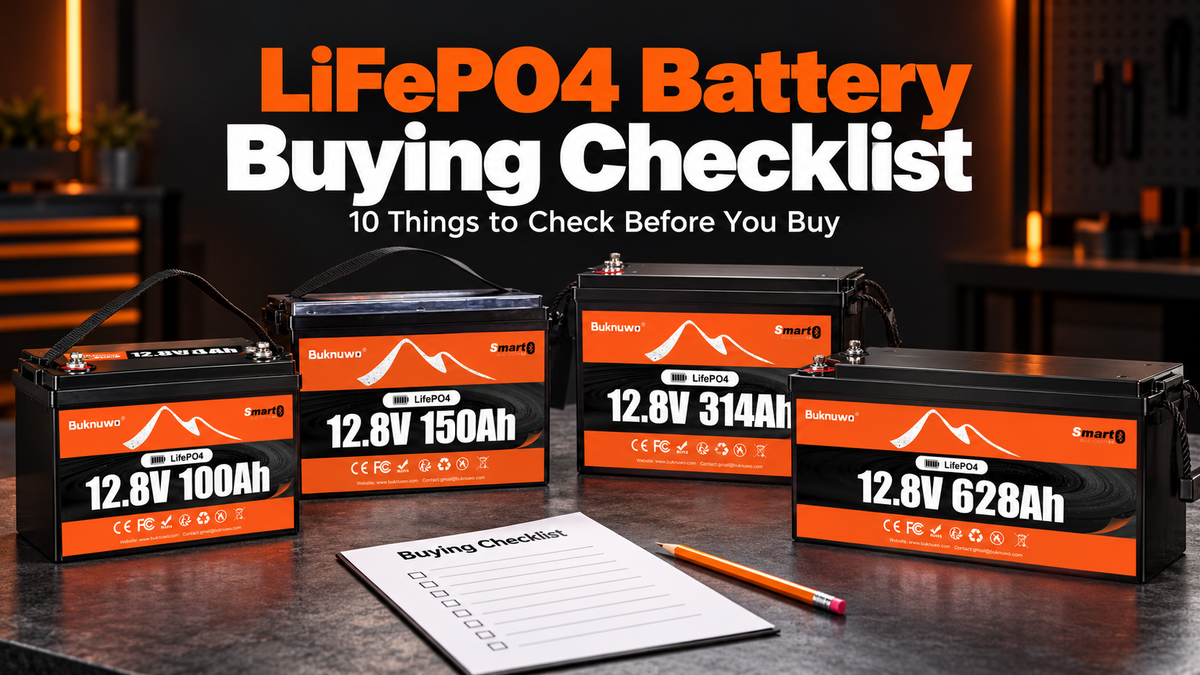
This guide covers ten things to check before you buy, with examples from the supplied specifications for BUKNUWO 12.8V 100Ah, 150Ah Smart, 314Ah Smart, and 628Ah Smart batteries.
Quick answer: What should you check before buying a LiFePO4 battery?
Check system voltage, energy capacity, continuous and startup current, charging compatibility, temperature protection, physical fit, expansion limits, monitoring features, model-specific test documentation, and warranty terms. Verify each item for the exact variant you intend to order. A larger Ah rating does not automatically mean higher output power, faster charging, self-heating, or compatibility with your existing equipment.
Your LiFePO4 battery buying checklist at a glance
| Check | What to confirm |
|---|---|
| 1. Voltage | The battery matches your system and equipment. |
| 2. Capacity | Usable energy covers your planned time without charging. |
| 3. Current | Running and startup demand fit the published limits. |
| 4. Charging | Charger settings and current suit the exact model. |
| 5. Temperature | Charging and discharge limits suit your climate. |
| 6. Fit | Dimensions, weight, terminals, and mounting suit the location. |
| 7. Expansion | Planned series or parallel connections are supported. |
| 8. Monitoring | The exact variant has the app features you need. |
| 9. Documentation | Test and specification documents match the product. |
| 10. Purchase terms | Warranty, returns, support, and total installation cost are clear. |
1. Match the battery voltage to your system
Start with system voltage before comparing capacity. A battery marketed as a 12V LiFePO4 battery may have a nominal voltage of 12.8V. Nominal voltage is different from charging voltage, and the connected equipment must support the battery's operating voltage range.
For an RV battery replacement, check your existing DC appliances, charging equipment, and any power-conversion equipment. For a trolling motor, use the motor manufacturer's voltage and current requirements rather than selecting by boat size alone.
Ask before buying: “Is this exact model compatible with my system voltage and equipment input range?”
The BUKNUWO models compared here are rated at 12.8V. They are deep-cycle energy-storage batteries and are not for engine starting.
2. Choose capacity using energy and time between charges
Amp-hours (Ah) are useful when comparing batteries at the same nominal voltage. Watt-hours (Wh) make energy comparisons clearer, especially across different voltages.
Nominal energy = nominal voltage × amp-hours. A 12.8V 100Ah battery stores 1,280Wh nominally, while a 12.8V 150Ah battery stores 1,920Wh. That is 50% more nominal energy at the same voltage.
List the devices you want to use, their measured or estimated energy consumption, and your longest expected period without charging. Account for reserve and system losses. For a refrigerator, use measured daily Wh or kWh because the compressor cycles.
Ask before buying: “Does the usable energy cover my device energy budget until the next dependable charge?”
A battery capacity estimate should reflect your own usage. Daily shore power at a U.S. RV campground creates different storage needs from several nights of boondocking without hookups.
3. Check continuous current and startup demand separately
The battery's maximum continuous discharge current helps determine how much current it can supply during normal operation. Capacity describes stored energy. These ratings answer different buying questions.
The supplied BUKNUWO specifications list 100A maximum continuous discharge for the 100Ah and 150Ah models, and 200A for the 314Ah and 628Ah models. Increasing from 314Ah to 628Ah doubles nominal stored energy while retaining the listed 200A continuous limit.
A refrigerator compressor, pump, or other motor load may briefly require more current when starting. Verify the permitted surge magnitude and duration for both the battery and other equipment. Do not treat a BMS overcurrent protection trip threshold as an approved operating rating.
Ask before buying: “What are the continuous and permitted surge ratings, and can they support my simultaneous loads?”
A BMS protection function does not replace properly rated external wiring, disconnects, and overcurrent protection.
4. Confirm charger and solar-controller compatibility
Check whether your existing charger or solar controller supports the battery's required LiFePO4 charge profile, voltage settings, and current limits. A label saying “lithium compatible” does not confirm compatibility with every lithium chemistry or battery.
The supplied BUKNUWO sheet lists a standard charging voltage of 14.4V ± 0.2V for the referenced 12.8V models. Use the exact model manual for the complete charging profile and operating conditions. The listed maximum charge current is a ceiling, not an instruction to charge at that rate.
Also consider your charging schedule. A larger battery requires more energy to refill after a deeper discharge. Buying extra storage will not compensate indefinitely for a charging source that supplies less energy than you use.
Ask before buying: “Can my charger or MPPT controller use the settings required by this model, and replenish my daily usage?”
Do not enable equalization or recovery modes unless the battery manufacturer explicitly approves them for the exact model.

5. Check low-temperature protection and actual operating limits
Charging and discharging can have different temperature limits. For winter RV travel, an unheated storage compartment, or seasonal solar storage, confirm the safe charging range and how charging stops when the battery is too cold.
Low-temperature charge protection and self-heating are separate features. Protection can stop charging. Self-heating requires a heating system and specific operating conditions. Do not assume a battery heats itself because its specification sheet mentions cold protection.
The supplied BUKNUWO sheet includes low-temperature charge protection values, but does not establish self-heating for these models. Follow the exact manual's safe operating limits instead of using a protection trip tolerance as permission to charge below the recommended minimum.
Ask before buying: “What are the safe charge and discharge temperatures, protection behavior, and restart conditions? Is self-heating actually included?”
6. Measure physical fit, weight, and terminal clearance
Measure the installation location before ordering. Check length, width, and height, plus room for terminal covers, cable bends, and access for tightening connections. A battery that fits into a compartment may still leave insufficient room to connect it properly.
Weight also changes handling and mounting needs. The supplied sheet lists 10.5kg for the 100Ah model, 18.9kg for 150Ah Smart, 26.7kg for 314Ah Smart, and 53.1kg for 628Ah Smart. Verify current dimensions and weight for the exact variant.
Check permitted mounting orientation, support requirements, terminal hardware, and tightening instructions. Do not assume a water-resistant case permits submersion or exposure to every outdoor environment.
Ask before buying: “Will this battery fit with cables and terminal protection installed, and can my mounting location support it?”

7. Verify series and parallel expansion before planning a bank
If you expect to add batteries later, check the manufacturer's supported bank configurations now. Series connections increase bank voltage. Parallel connections increase charge capacity at the same voltage. Each arrangement requires compatible equipment and appropriate protection.
The supplied BUKNUWO sheet lists up to 4S4P, but you should confirm the exact model instructions and matching requirements before building a bank. That listing does not authorize mixing different capacities, brands, ages, or states of charge.
Ask before buying: “Is my intended bank configuration supported, and what matching and initial charging steps does the manufacturer require?”
Budget for bank wiring, protection, mounting, and suitable charging equipment. Expansion can change more than the number of batteries.
8. Confirm Bluetooth and app features for the exact variant
A Bluetooth LiFePO4 battery can make battery information easier to inspect, especially when the installation is difficult to reach. However, supported readings, controls, and phone compatibility vary by product.
Confirm the app name, supported operating systems, available readings, and connection method. Bluetooth monitoring does not automatically provide Wi-Fi access or remote monitoring away from the battery.
The supplied product range includes Smart Bluetooth variants. Confirm that the exact SKU you order includes the feature, particularly where standard and Smart versions share a capacity name.
Ask before buying: “Which app works with this SKU, what information can I see, and does monitoring require me to be nearby?”
9. Review model-specific specifications and test documents
Ask for a readable manual and documents that identify the model you are buying. Product-page logos alone do not explain what was tested, by whom, or under which conditions.
Transport testing, electrical safety assessments, environmental compliance, and dangerous-goods classifications serve different purposes. A transport-test document should not be presented as proof of unlimited safety in every installation.
Review cycle-life claims with their test conditions, including discharge depth, temperature, charge and discharge rates, and remaining capacity. A cycle count does not establish the exact number of service years in your own system.
Ask before buying: “Can you provide the model-specific manual and applicable test documents, and explain the conditions behind the performance claims?”
10. Read warranty, returns, and total installed cost
Compare the complete purchase rather than the battery price alone. Include any needed charger, cables, fuses, disconnects, mounting hardware, and installation work. A lower purchase price can mean little if the battery requires equipment changes you have not budgeted for.
Read the written warranty for eligibility, exclusions, required evidence, claim steps, and shipping responsibilities. Check the return window and process before paying. For U.S. customers, confirm delivery availability and the return destination for the exact order.
Ask before buying: “What is covered, how do I request support, what documents should I keep, and what costs apply to a return or warranty claim?”
Keep your invoice, serial number, model details, and installation records. Review the BUKNUWO warranty registration page and current written purchase terms.
BUKNUWO models to compare after completing the checklist
| Model | Nominal energy | Max continuous discharge | Buying question |
|---|---|---|---|
| 12.8V 100Ah | 1,280Wh | 100A | Does it cover my lighter daily loads between charges? |
| 12.8V 150Ah Smart | 1,920Wh | 100A | Do I need more reserve than 100Ah provides? |
| 12.8V 314Ah Smart | 4,019.2Wh | 200A | Do my larger energy and current needs fit this model? |
| 12.8V 628Ah Smart | 8,038.4Wh | 200A | Can my installation and charging plan support more storage? |
Specifications are from the supplied BUKNUWO product sheet. Energy figures are calculated nominal values, not guaranteed usable output. Confirm the exact current variant, manual, and listing before purchase.
For essential home backup, a standalone 12V battery cannot directly supply household 120V AC outlets. Use properly matched conversion and protection equipment. Home circuit integration needs suitable transfer equipment and qualified installation. Never backfeed an outlet.
Frequently asked questions before buying a LiFePO4 battery
What is the most important thing to check first?
Confirm voltage and equipment compatibility first. Then verify usable energy, current limits, charging, and physical fit. A battery that fails an essential compatibility check is unsuitable regardless of its capacity.
Is a higher Ah battery always better?
No. Higher Ah at the same voltage means more nominal stored energy. It also affects weight, space, cost, and charging needs. Maximum output current is a separate rating.
Can I use my existing charger?
Only if its chemistry profile, voltage settings, and current meet the exact battery instructions. Check all active charging sources, including an RV converter and solar controller.
Does low-temperature protection mean self-heating?
No. Low-temperature protection can stop charging. Self-heating is a separate feature that must be explicitly specified for the model.
Can I add another battery later?
Possibly, if the manufacturer supports the configuration and the batteries meet its matching requirements. Confirm expansion rules before ordering and again before connecting a new battery.
Can these BUKNUWO batteries start an engine?
No. The referenced batteries are for deep-cycle energy storage, not engine starting. Evaluate them for compatible RV house loads, camping, solar storage, or selected backup loads.
Choose the battery that passes your checklist
Before placing your order, record your system voltage, device energy budget, running and startup demand, charging setup, temperature conditions, and installation measurements. Then compare the exact model's specifications and written support terms.
Compare BUKNUWO 12V LiFePO4 batteries
Need help with a compatibility question? Visit the BUKNUWO Help Center FAQ with your model and equipment details.