
How to choose a LiFePO4 battery for your camping trip?
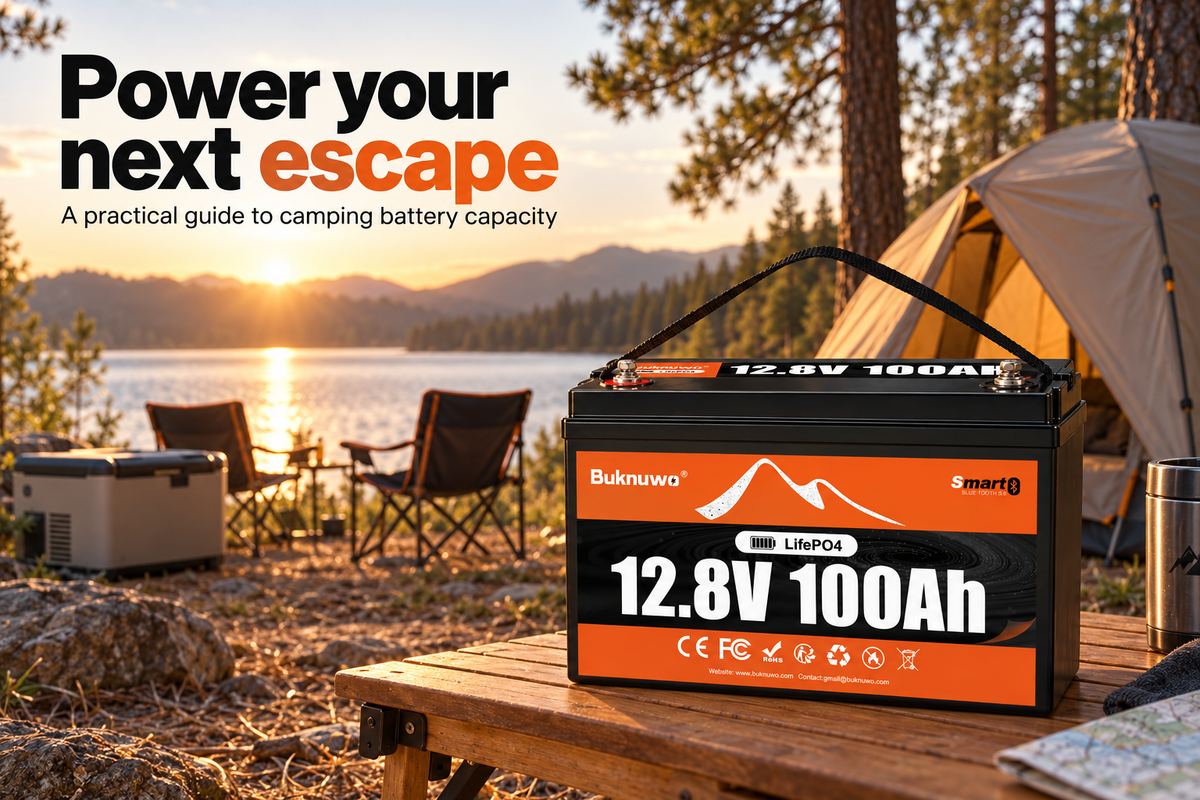
A weekend of lights, phone charging, and a small fridge puts different demands on a battery than several days of remote work in an RV. Before choosing a capacity, work out what you will run and how long you may go between charges.
That gives you a more useful starting point than buying the largest battery you can fit. More capacity brings extra cost, weight, and space requirements, so it helps to know how much reserve your trip actually needs.
Work out a day's energy use
List the devices you expect to use: a 12V refrigerator, LED lights, fans, a water pump, phones and tablets, a laptop, a CPAP, or other small appliances. For each device, estimate energy use with:
Daily energy use (Wh) = Appliance power (W) × Hours used
A device drawing 50W for five hours uses 250Wh. Add the energy use of all your devices to estimate the daily total.
Keep this figure in watt-hours when comparing batteries. It lets you relate the energy you use to the energy a battery stores.

Compare battery capacity in watt-hours
Nominal battery energy is calculated as:
Battery energy (Wh) = Voltage × Amp-hours (Ah)
At BUKNUWO 12.8V, a 100Ah battery stores 1,280Wh, a 150Ah battery stores 1,920Wh, and a 314Ah battery stores approximately 4,019Wh. At the same voltage, moving from 100Ah to 150Ah gives you 50% more stored energy and usually longer runtime.
BUKNUWO's Bluetooth battery options offer these general starting points:
|
Camping style |
Battery to consider |
Nominal energy |
|
Weekend trips and light use |
12.8V 100Ah BT |
1,280Wh |
|
Multi-day camping |
12.8V 150Ah BT |
1,920Wh |
|
Extended off-grid stays |
12.8V 314Ah BT |
Approximately 4,019Wh |
For lights, phone charging, fans, and a small refrigerator, 100Ah can be practical with efficient 12V loads and regular recharging. A 150Ah battery adds reserve if you also use laptops, a TV, a larger refrigerator, or more electronics. For remote work, longer stays, heavier inverter loads, or a larger RV system, consider 314Ah or a larger bank, then check its power-delivery limits as described below.
These are starting points, not guarantees of a particular number of days. Your daily energy use and charging options should determine the final size.

Count the days between charges
Estimate the energy needed between charging opportunities:
Required energy ≈ Daily energy use × Days without charging
At 800Wh per day, two days without charging require about 1,600Wh. That already exceeds the 1,280Wh nominal energy of a 12.8V 100Ah battery.
You could choose a larger battery, reduce daily consumption, or plan to recharge using solar, DC-DC charging, or shore power. Decide which options will be available on the trip before settling on a battery size.

Where solar fits
Solar can replace part of the energy you use each day and extend your time off-grid. A typical setup runs from solar panels through an MPPT charge controller to the BUKNUWO battery. The battery then supplies an inverter or DC loads.
You do not always need solar for camping. For multi-day or off-grid trips, though, regular solar charging can reduce the capacity you need to carry. How much it helps depends on your charging conditions and energy use.
Check whether the battery can run your largest load
Stored energy and power delivery answer different questions. Ah helps you estimate runtime; it does not tell you how much power the battery can deliver at once.
Coffee makers, microwaves, hair dryers, pumps, and other large inverter loads need a separate check. Match the battery's BMS capability, the inverter, and the appliance load. A larger Ah rating alone does not establish that an appliance will run.
Check the specifications before a winter trip
Look for low-temperature charging protection, an operating temperature range suited to the trip, and self-heating if you need it.
LiFePO4 batteries can often discharge in cold conditions, but their charging limits are usually stricter. Check the specifications for the exact model before planning winter use.

Make monitoring easy once you are away
Bluetooth is useful when the battery sits inside an RV compartment or storage area. Depending on the model and app, you can check state of charge (SOC), voltage, current, temperature, charging status, and protection status from your phone.
Before you buy, compare your daily energy estimate and expected time between charges with the battery's capacity. Then confirm that its BMS, your inverter, and its temperature limits fit the equipment and conditions you expect on the trip.
Frequently Asked Questions
1:Is a 100Ah LiFePO4 battery enough for camping?
Yes, for light weekend camping with efficient 12V loads and regular recharging, 100Ah can be a practical starting point.
2:Is 150Ah better than 100Ah?
A 150Ah battery stores about 50% more energy than a 100Ah battery at the same voltage: 100Ah = 1,280Wh; 150Ah = 1,920Wh.
3:Do I need solar for camping?
Not always, but solar is very useful for multi-day and off-grid camping because it can replace part of the energy used each day.
4:Should I buy the largest battery possible?
Not necessarily. A larger battery costs more, weighs more and takes up more space. Choose based on your actual energy use and charging options.