
How to Compare LiFePO4 Battery Warranty Terms Before Buying
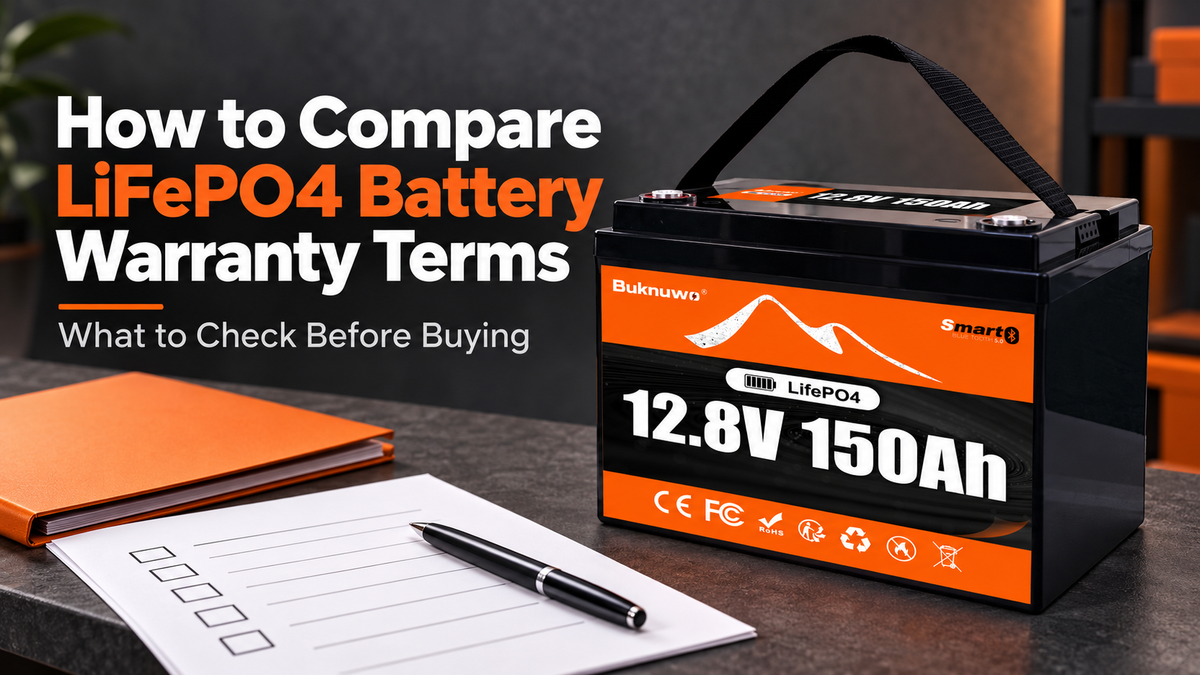
BUKNUWO · Buying Guides
Compare coverage, claim steps, possible costs, and support before choosing a lithium battery.
How do you compare LiFePO4 battery warranty terms before buying? Start with the written coverage for the exact model and purchase channel. Then check who provides the warranty, what qualifies for a claim, how an approved claim is resolved, and which costs may remain with you.
A long warranty period can be useful, but the headline alone does not explain repair, replacement, capacity loss, shipping, installation labor, or service access. Two warranties with the same duration can offer different practical outcomes.
This buying guide gives you a structured way to compare lithium battery warranty coverage for RV, camping, solar storage, and selected backup applications.
Quick answer: What should you compare in a LiFePO4 battery warranty?
Compare eligibility, covered defects, warranty duration and start date, any written capacity guarantee, exclusions, available remedies, claim evidence, shipping responsibilities, and replacement coverage. Review returns separately from warranty service. Keep the written terms that apply to your order and request clarification before buying if important details are missing or inconsistent.
1. Identify who provides coverage and which purchases qualify
Find the company responsible for the warranty and the channel through which claims are submitted. A retailer's return process and a manufacturer's warranty service may involve different organizations.
Confirm the exact model, condition, seller, purchase channel, and region. Ask whether the terms differ for a new product, an open-box item, a marketplace purchase, or a secondhand battery. Do not assume a policy for another seller applies to your order.
Ask before buying: “Who handles claims for this exact product and seller, and does coverage apply where I plan to use it?”
2. Check the start date and how the period is calculated
A headline such as “five-year warranty” does not tell you when the period begins. Check whether the terms identify purchase, delivery, registration, or another documented event as the start.
Also check what happens if a claim is opened near the end of the period. Ask which reporting deadline applies and what records establish that you reported the issue in time.
Keep an invoice or order confirmation that identifies the seller, product, and purchase date. Save a dated copy of the applicable terms instead of relying only on a promotional banner.
3. Read what is covered
Look for the actual coverage statement. It may address defects in materials or workmanship, specified components, or another defined problem. Do not infer coverage from a general statement about durability or reliability.
For a Smart battery, ask whether the written terms address electronics, Bluetooth hardware, or other included features. A battery warranty does not automatically promise lifetime app availability or every future phone operating-system update.
Ask before buying: “What specific defects or components are covered, and where is that scope stated in writing?”
4. Separate capacity guarantees from cycle-life marketing
Cycle-life figures and warranty coverage answer different questions. A cycle claim may describe performance under particular test conditions. It is not automatically a promise of free replacement after any loss of runtime.
If the warranty includes a capacity guarantee, check the remaining-capacity threshold, applicable time or cycle limits, test procedure, and required conditions. Confirm who performs or accepts the test.
A short runtime can also reflect device consumption, temperature, available charge, or system losses. Ask how the provider distinguishes a covered battery issue from a system-sizing or usage issue.
Ask before buying: “Is there a written capacity-retention guarantee, and how is a qualifying capacity claim assessed?”

5. Review use conditions and exclusions carefully
Check how the warranty addresses installation, charging, temperature, storage, environmental exposure, damage, modification, and use outside the approved application. If a clause is unclear, request an explanation for your intended setup.
For an RV battery, confirm compatible charging and secure mounting. For winter storage or solar use, verify the actual charging and storage instructions. For pumps or compressors, check continuous and startup demand before purchase.
The referenced BUKNUWO deep-cycle batteries are not for engine starting. A warranty headline is not permission to use a battery beyond its approved limits.
Read the terms alongside the model manual. Do not assume every third-party accessory or independent service automatically cancels coverage; ask how the written condition applies to the issue and your location.
6. Compare what happens after a claim is approved
Check which remedies the provider may offer: repair, parts, replacement, refund, or another specified solution. Also check who chooses the remedy.
If replacement is available, ask whether the terms specify a new, refurbished, or equivalent product. If the original model is discontinued, check how an alternative is selected.
If coverage changes over time, request the schedule. “Prorated” coverage generally means the benefit depends on a stated formula or schedule rather than necessarily paying the full original purchase price. Read that calculation before comparing offers.
Ask before buying: “What remedies are available, who selects them, and do benefits or customer costs change during the warranty period?”
7. Identify claim-related costs
Read who pays for diagnosis, approved return transport, replacement delivery, packaging, removal, reinstallation, or other service work. Do not assume the word “replacement” includes every related expense.
For U.S. RV owners, also ask how service works if you are traveling away from your delivery address. If you may use the battery in Canada or another region, confirm claim destinations and cross-border responsibilities before buying.
Do not ship a battery simply because a return address appears online. Obtain the provider's authorization and instructions. If damage is suspected, describe it first and obtain the appropriate handling guidance.
For BUKNUWO website orders, the published Return & Refund Policy distinguishes return-shipping responsibilities by cause and requires authorization before shipping. Check the provisions applicable to your situation; ordinary return terms should not be assumed to define every warranty-service cost.
8. Understand claim evidence and safe troubleshooting
Find out what support normally requests. Useful records may include the order number, exact model, serial number, symptoms, photos, and relevant charging or installation details.
Provide only relevant information and follow the documented support process. Do not open the battery, bypass the BMS, reproduce an unsafe fault, or perform hazardous tests just to gather evidence.
If you rely on the battery for an outing or backup, ask about the service process and expected next steps. A response target is different from a guaranteed repair or replacement completion time.
Ask before buying: “What evidence is needed, which troubleshooting checks are appropriate, and how will I be updated during the claim?”

9. Confirm registration, transfer, and replacement terms
Ask whether registration is requested, what information is needed, and how any stated deadline relates to the coverage offered. Do not assume registering a product broadens the written warranty.
Check whether coverage transfers to a new owner. This can matter when buying a used battery or selling an RV with an installed battery.
Also confirm the period that applies to a replacement or repaired product. It might follow the remainder of the original period, a separate stated period, or another written rule. Do not assume a replacement restarts the entire warranty.
10. Keep returns, warranty service, and paid service plans separate
| Term | What to examine |
|---|---|
| Return policy | Return window, item condition, authorization, and costs for the reason you are returning it |
| Included warranty | Covered problems, eligibility, claim procedure, remedies, and cost responsibilities |
| Paid service plan | Provider, extra benefits, overlap with included coverage, fees, and cancellation terms |
A battery that does not suit your installation is a different situation from a verified defect. Measure the compartment, check voltage and current, and confirm charging compatibility before purchase.
Written warranty terms are one part of the purchase. Applicable consumer protections can vary by location, so do not assume a summary of a seller's policy describes all rights that may apply.
A comparison worksheet for your shortlist
Fill in the following items from each provider's actual written terms. Mark a missing answer as “clarification needed” instead of assuming it is covered.
| Comparison item | Record for each option |
|---|---|
| Eligibility | Exact SKU, seller, purchase channel, purchaser, and region |
| Period | Start date, duration, reporting deadline |
| Coverage | Covered defects, components, any capacity guarantee |
| Conditions | Installation, charging, storage, and relevant exclusions |
| Remedy | Repair, replacement, refund, equivalent product, any prorating |
| Costs | Diagnosis, approved transport, packaging, removal, installation |
| Process | Contact route, evidence, authorization, service steps |
| After service | Replacement period and transfer rules |
Checking BUKNUWO warranty information
The BUKNUWO Warranty Registration page presents a five-year limited warranty and collects purchase and product details. Confirm the complete terms and eligibility for your exact model, seller, and region before ordering.
Registration and technical support serve different purposes. If a battery has a problem, use the BUKNUWO Contact Us page to request assistance. Keep your purchase record and model details available.
Frequently asked questions about battery warranties
Is the longest warranty always the best?
No. Compare coverage, remedies, costs, eligibility, and the process as well as duration. The number of years alone does not establish the practical benefit.
Does a five-year warranty mean free replacement for every problem?
No. Review the written coverage, conditions, and remedies for the exact purchase. Do not infer unlimited replacement from a duration headline.
Does a cycle-life claim guarantee capacity under warranty?
Not automatically. A capacity guarantee needs written conditions, a qualifying threshold, and an assessment procedure.
Are warranty service and a change-of-mind return the same?
No. Review their separate conditions and processes. Confirm which procedure applies to your issue.
Should I send the battery back before contacting support?
No. Obtain authorization and appropriate instructions first. Tell support if the battery is damaged or abnormal before arranging transport.
Does a replacement restart the original warranty period?
Only if the applicable terms say so. Confirm the coverage that applies after repair or replacement.
Compare the written promise before buying
Choose a battery that fits your electrical and installation needs, then compare the complete warranty promise. Resolve missing details in writing and keep the applicable terms with your purchase records.
Explore BUKNUWO 12V LiFePO4 batteries
Further reading for U.S. shoppers: FTC consumer guidance on warranties. This article is a buying checklist and does not create or modify a product warranty.