
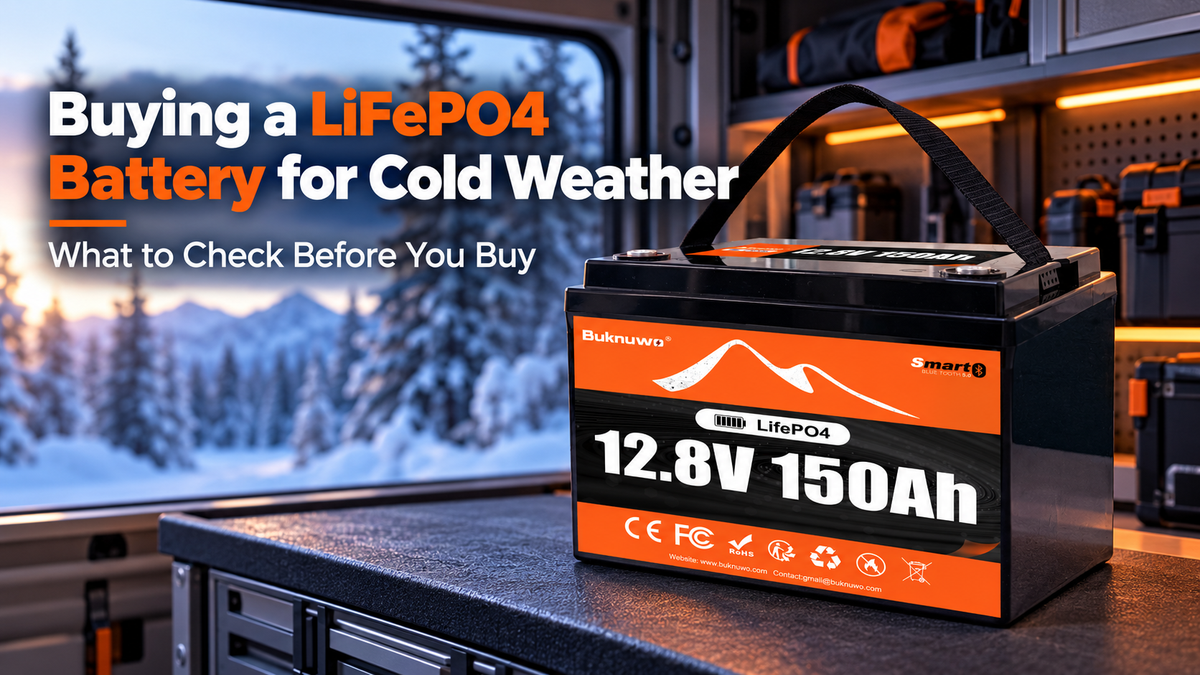
Buying a LiFePO4 Battery for Cold Weather: What to Check
BUKNUWO · Buying Guides
A winter battery buying guide for RV travel, camping, solar storage, and selected backup loads.
Buying a LiFePO4 battery for cold weather means checking more than capacity. A battery may supply compatible loads in conditions where charging is restricted. It may also have low-temperature charge protection without including a heater.
For winter RV trips, camping, or off-grid solar storage, the practical question is: Can this exact battery operate and recharge safely in my planned installation?
This guide focuses on purchase decisions: which temperature specifications to request, how to compare cold-weather features, and what to verify before selecting a BUKNUWO 12V LiFePO4 battery.
Quick answer: What should you check before buying a cold-weather LiFePO4 battery?
Check the safe charging and discharging temperature ranges, low-temperature charge cutoff and restart conditions, whether self-heating is actually included, and how the installation will keep the battery within its operating limits. Then verify your charger, solar controller, winter energy budget, monitoring, and storage plan. A Bluetooth label or cold-protection feature alone does not establish suitability for unattended freezing-weather charging.
1. Check charging and discharging temperatures separately
Charging puts energy into the battery. Discharging supplies energy to your devices. The permitted temperature ranges can differ, so a single broad “operating temperature” line may not answer both questions.
Charging lithium cells outside their approved temperature conditions can damage them. Use the exact manufacturer's limits. Do not apply another brand's minimum temperature to the battery you are buying.
For an RV battery, ask about every charging source: an AC charger or converter, an MPPT solar controller, and any vehicle-based charging equipment. Morning sunlight can start solar charging even when a battery is still cold from the previous night.
Ask the seller: “What are the approved charging and discharging temperatures for this SKU, and are there current restrictions near those limits?”
2. Understand low-temperature charge protection
Low-temperature charge protection is designed to stop charging under specified cold conditions. Its practical value depends on the temperature sensor, cutoff logic, tolerances, and recovery behavior documented for the exact battery.
A protection threshold is not the same as a recommended operating boundary. For example, a threshold written with a tolerance should not be interpreted as permission to charge anywhere inside that tolerance. Choose operating conditions from the manual's safe charging range.
Also confirm whether charge protection is present on the exact variant. Standard and Smart versions may have different details even when their capacity labels are similar.
Ask the seller: “What temperature is monitored, when does charging stop, and how do all connected charging sources respond?”
3. Distinguish cold protection from self-heating
| Feature | Purpose | What to verify |
|---|---|---|
| Low-temperature charge protection | Stops charging under specified cold conditions | Cutoff, sensor, tolerance, and recovery logic |
| Self-heating | Uses a heater to warm the battery under defined conditions | Included hardware, activation, power source, and charging sequence |
| Insulation | Slows heat transfer | Approved enclosure design and temperature control |
| Temperature monitoring | Shows supported temperature information | Sensor location, app features, and automatic actions |
Cold protection stops charging. A heater supplies heat. Neither a Bluetooth logo nor insulation establishes that heating is built in.
When evaluating a self-heated LiFePO4 battery, ask whether the heater draws energy from the battery or an external charging source, what activates it, and whether incoming power warms the cells before charging is permitted. These details vary by model.
The supplied BUKNUWO specification sheet lists low-temperature charge protection, but the self-heating field is blank. It does not confirm self-heating for the referenced models. Obtain written confirmation before relying on any heating feature.
4. Check restart conditions after a cold shutdown
Charging may not restart at the exact temperature where it stopped. A separate recovery threshold can help prevent repeated on-off switching near the cutoff.
A battery may also need a particular recovery process, such as temperature recovery, charger reconnection, or another documented step. Do not assume an app can override a temperature restriction.
Plan around the time when the battery is warm enough to accept energy again. A short winter solar window can be less useful if the battery remains below its permitted charging temperature for much of the morning.
Ask the seller: “At what condition does charging resume, is recovery automatic, and what should I do if it remains blocked?”

5. Evaluate where the battery will actually live
An outdoor forecast describes the surrounding air, not necessarily the battery's internal temperature. A battery stored overnight in an unheated compartment may remain cold after the air outside warms. A sheltered location is not automatically a temperature-controlled location.
Before buying, identify whether the battery will be in a maintained indoor area, an unheated RV compartment, a garage, or an outdoor enclosure. Consider what happens when the RV heating or building heat is switched off.
Insulation alone does not continuously generate heat. If heating is required, use a manufacturer-approved arrangement with appropriate controls. Do not use an improvised heater, direct flame, or uncontrolled heating device.
Also verify mounting orientation, moisture protection, terminal clearance, and condensation precautions. A case rating does not automatically authorize placement in snow or exposure to every outdoor condition.
Ask the seller: “Is this model suitable for my planned location, and what enclosure or temperature-control conditions are required?”

6. Match every charging source to the winter plan
A compatible charging voltage does not by itself make a system suitable for cold weather. Check chemistry settings, current limits, temperature sensing, and how charging is inhibited when necessary.
The supplied BUKNUWO sheet lists a standard charging voltage of 14.4V ± 0.2V for the referenced 12.8V models. Use the model manual for the complete profile and temperature-dependent restrictions. The listed maximum charge current is a limit, not a recommendation for every temperature.
If your controller has a temperature sensor, confirm what it measures and whether its location represents the battery conditions used by the manufacturer's charging rules. A controller inside a warm living area may not reflect a battery in a cold external compartment.
Ask the seller: “How should my AC charger, MPPT controller, and other charging equipment be configured for this installation?”
Do not bypass temperature protection or assume reducing charge current makes otherwise prohibited charging acceptable.
7. Size winter energy storage around charging opportunities
Cold conditions can affect available energy and power. Do not assume a room-temperature capacity rating guarantees the same delivered runtime in your winter setup.
List your actual device energy, desired runtime, and expected time between permitted charging sessions. Include any approved heater's energy demand. If a heater depends on incoming power, account for the energy and time used for warming before useful recharge occurs.
For RV camping in the northern United States or Canada, consider shorter daylight, shade, snow-covered panels, and changing weather. Use site-specific conservative estimates rather than treating panel wattage as dependable daily energy.
A larger battery adds nominal storage, but it cannot solve a charging-temperature problem. You still need conditions that let the battery accept replacement energy safely.
8. Confirm monitoring features without assuming automatic control
A Bluetooth LiFePO4 battery may make supported readings easier to inspect from a nearby phone. Ask whether the exact app displays temperature, charge status, or protection information.
Temperature monitoring does not mean self-heating, and displaying a warning is not the same as automatically controlling a charger. Bluetooth alone also does not establish remote internet monitoring for an unattended cabin or solar site.
Ask the seller: “Which readings are available, where is temperature measured, and which protective actions happen automatically?”
How to evaluate BUKNUWO models for winter use
Begin with environmental compatibility, then compare capacity. The following electrical ratings are useful for sizing, but they do not certify cold-weather suitability or establish low-temperature performance.
| Model | Nominal energy | Max continuous discharge | Sizing question |
|---|---|---|---|
| 12.8V 100Ah | 1,280Wh | 100A | Does it cover lighter loads between dependable charges? |
| 12.8V 150Ah Smart | 1,920Wh | 100A | Do moderate RV or camping loads need more reserve? |
| 12.8V 314Ah Smart | 4,019.2Wh | 200A | Does the larger energy budget fit the installation? |
| 12.8V 628Ah Smart | 8,038.4Wh | 200A | Can the charging and mounting plan support more storage? |
Ratings are from the supplied BUKNUWO sheet. Nominal Wh is calculated as 12.8V × Ah, not a winter usable-output guarantee. Confirm the exact current variant and manual.
For a temperature-controlled installation, evaluate a capacity that covers your measured energy needs and charging gaps. For an unheated freezing-weather installation, obtain confirmed charging, discharge, protection, and heating guidance before choosing any listed model.
Both larger models have a listed 200A continuous discharge limit. More Ah does not automatically mean more output power. Check startup surges from pumps or compressors separately. These batteries are for deep-cycle storage and are not for engine starting.
Questions to send before placing your order
- What are the safe charging, discharging, and storage temperatures for this exact SKU?
- Does it include low-temperature charge protection, and what are the cutoff and recovery conditions?
- Is self-heating included? What powers and activates it?
- What installation conditions are required for my unheated or controlled location?
- Are temperature-dependent current limits or cold-performance test results available?
- Will my existing charging equipment follow the required settings and restrictions?
- Which temperature or protection readings can I monitor?
- What winter storage instructions and warranty exclusions apply?
Frequently asked questions about cold-weather LiFePO4 batteries
Can you charge a LiFePO4 battery below freezing?
Do not charge outside the exact model's approved limits. Some batteries use documented heating systems that warm cells before charging. A cold-protection label alone is not permission to charge below freezing.
Can a battery discharge when charging is blocked?
Some models permit discharge at temperatures where charging is restricted. Confirm separate ranges and current limits. Continued discharge is not guaranteed for every battery or condition.
Does low-temperature protection mean self-heating?
No. Charge protection stops charging under specified conditions. Self-heating requires a heating system and documented activation rules.
Can insulation make a battery suitable for winter charging?
Insulation can slow heat loss, but it does not continuously supply heat. The battery must still remain within its approved charging conditions.
Will a larger battery fix cold-weather charging problems?
No. More nominal storage can extend time between charges, but it cannot remove charging temperature restrictions or replace a suitable thermal plan.
How should I store the battery over winter?
Follow the exact model instructions for storage temperature, state of charge, disconnection, and periodic checks. Do not assume charging is safe simply because the storage location is permitted.
Choose a complete winter power plan
Choose a cold-weather LiFePO4 battery around its charging conditions, protected installation, recovery behavior, and realistic energy budget. Confirm protection and heating features separately before comparing Ah.
Compare BUKNUWO 12V LiFePO4 batteries
For model-specific help, visit the BUKNUWO Help Center FAQ with your installation location, expected temperatures, and charger details.