
Why parallel LiFePO4 batteries discharge at different rates?
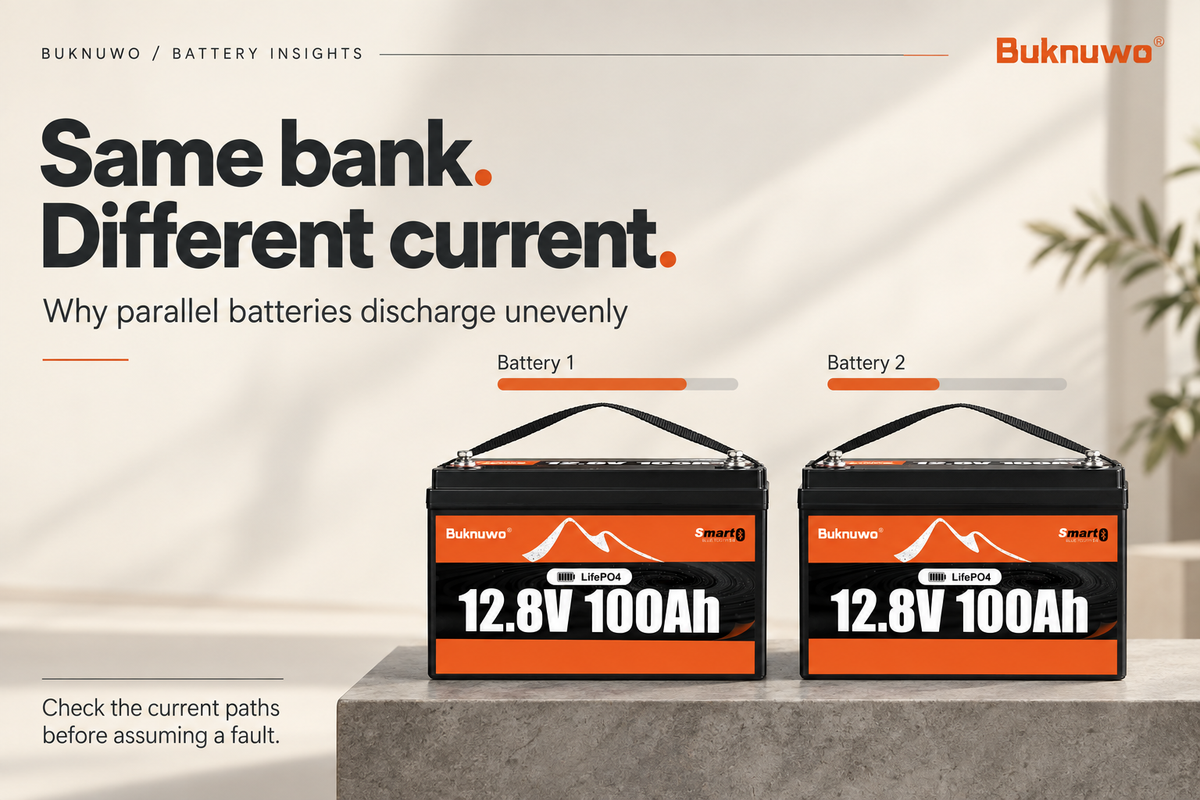
Understanding parallel LiFePO4 battery systems can be challenging, especially when batteries don't discharge evenly. If you've noticed one battery consistently supplying more current than another, the issue is usually not a faulty battery—it's often related to wiring, connections, or how the batteries are configured. Let's walk through the main culprits and how to diagnose them.
Start with the cables and connections
Even a short battery cable has resistance. If one battery has a shorter or thicker cable path to your inverter, it will naturally supply more current than the others. This is one of the most common reasons for uneven discharge.
To minimize this effect:
- Use the same cable gauge for all battery paths
- Keep cable lengths as similar as practical
- Use the same terminal type across all connections
- Ensure all connections are clean and tight
For larger battery banks, equal-length cables running to common busbars are preferred because they create more balanced current paths. Inspect the entire path—battery terminals, cable lugs, busbars, fuses, breakers, and disconnect switches. A single loose or corroded connection can shift how the load is shared between batteries.

Check where the system connects to the bank
The way you connect your inverter and charger to the battery bank significantly impacts current sharing. Connecting both positive and negative leads to the same battery gives that battery the shortest electrical path, and it will likely carry more of the load.
For two batteries: Use a diagonal connection—take the system positive from Battery 1 and the system negative from Battery 2. The batteries remain in parallel with their positive terminals linked and negative terminals linked.
For three or more batteries: Connect each battery to common positive and negative busbars using similar cable lengths from each battery:
| Battery | Positive connection | Negative connection |
| Battery 1 | Positive busbar | Negative busbar |
| Battery 2 | Positive busbar | Negative busbar |
| Battery 3 | Positive busbar | Negative busbar |
Connect the inverter and charger to the busbars. This layout helps balance current paths across all batteries. For a BUKNUWO parallel bank, use matching batteries, properly sized cables, and appropriate circuit protection.

Compare the batteries before blaming the wiring
A battery at 100% state of charge (SOC) will not share current evenly with one at 80%. Before connecting batteries in parallel, bring them reasonably close in both voltage and SOC. Ideally, they should match in capacity, model, age, and condition.
Key battery factors that affect discharge rates:
- Internal resistance (even identical batteries differ slightly)
- State of charge (SOC) differences
- Temperature variations
- Cell tolerances and cycle history
- BMS resistance
The battery with lower internal resistance may naturally supply more current. A modest difference in current readings is often not a sign of failure. Temperature is especially worth comparing between batteries, as it can significantly affect both resistance and discharge behavior.

See whether a BMS is affecting the readings
Each battery has its own battery management system (BMS). If one BMS enters protection mode or temporarily limits current, the other battery will take on more of the load. Differences in BMS internal resistance can also affect current sharing.
To diagnose BMS issues:
- Check the protection status for each battery using the app or monitoring system
- If displayed readings differ greatly, measure the actual current from each battery using a DC clamp meter
- Compare the clamp meter readings to the app readings to verify accuracy

Work through the checks in order
Follow this sequence to identify the cause of uneven discharge:
- Compare each battery's SOC and voltage
- Check cable gauge and length for each battery path
- Inspect terminals, busbars, and all connections along those paths
- Confirm the wiring uses a balanced busbar layout or an appropriate diagonal connection
- Measure the current from each battery with a clamp meter
- Check each BMS for protection events or current limiting
- Compare battery temperatures
- Test the batteries individually if further diagnosis is needed
Uneven discharge alone does not mean a battery is faulty. A cable-path difference, poor connection, or BMS protection event often explains the behavior. By checking these factors alongside SOC and temperature, you'll have a solid basis for deciding whether an individual battery needs further testing.

Frequently Asked Questions
Is it normal for parallel LiFePO4 batteries to discharge at different currents?
Yes, a small difference is normal. Slight differences in SOC, internal resistance, temperature, and BMS behavior can create different current readings.
Why is one battery discharging much faster than the other?
Common causes include unequal cable resistance, poor connections, different SOC levels, battery resistance differences, or BMS protection behavior.
Do parallel battery cables need to be the same length?
Keeping each battery's current path as equal as practical helps improve current sharing. Equal-length, equal-gauge cables to busbars are a best practice for most installations.
Can batteries with different capacities be connected in parallel?
For most consumer LiFePO4 installations, use matching batteries unless the manufacturer explicitly approves mixed configurations. Matching voltage, capacity, model, and age helps reduce uneven current sharing.
Does uneven current mean one battery is bad?
Not necessarily. First check wiring resistance, SOC, BMS readings, and connections before assuming the battery has failed.