
LiFePO4 Inverter Matching Review: Where Systems Go Wrong
A calculation-based review of battery voltage, BMS current, startup surge, cable drop, and shutdown symptoms
A large inverter specification can look impressive on paper, but the inverter only works as well as the battery system feeding it. This review checks the electrical path behind the wattage label and explains why many apparent inverter faults begin elsewhere.
Verdict: Match voltage first, then prove that the BMS and DC wiring can supply both running and startup current.
Review verdict
A battery and inverter are properly matched only when the full DC path can support the load. Battery capacity matters for runtime, but it does not prove that the BMS, cables, fuse, and connections can deliver the required current.
Our assessment is straightforward: check system voltage first, calculate battery current second, then confirm startup surge and the hardware between the battery and inverter. Most shutdown complaints can be traced by following that order.
First check: battery and inverter voltage
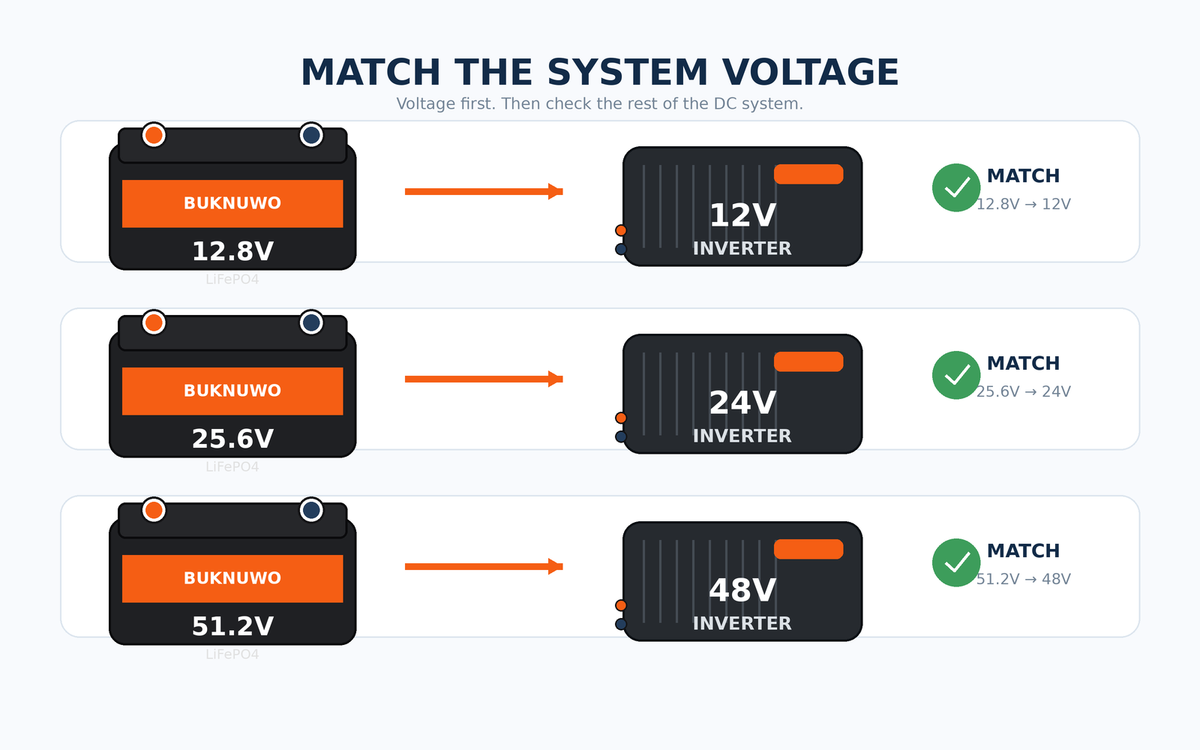
The inverter must match the nominal battery-system voltage, and its actual DC input range must be confirmed before installation. The common BUKNUWO LiFePO4 voltage pairings are shown below.
|
Battery System |
Matching Inverter |
|
12.8V LiFePO4 |
12V inverter |
|
25.6V LiFePO4 |
24V inverter |
|
51.2V LiFePO4 |
48V inverter |

Battery capacity and power capability are different
Amp-hours mainly describe how long the battery can support a load. The continuous discharge rating of the BMS helps determine how much current the battery can deliver without entering protection.
This is why the question 'Can a 100Ah battery run a 2000W inverter?' cannot be answered from 100Ah alone. The decision also depends on BMS current, inverter efficiency, startup demand, cable size, and the rest of the DC circuit.
Current calculation review
Use the inverter load, battery voltage, and inverter efficiency to estimate the current drawn from the battery:
Battery current = inverter load ÷ battery voltage ÷ inverter efficiency
A 2000W load requires much more current from a 12V system than from a 24V or 48V system. At the same efficiency, doubling the battery voltage roughly halves the current for the same power. The calculated result must remain within the BUKNUWO battery's continuous BMS rating.

Continuous power is only half the inverter rating check
An inverter has a continuous rating and a surge rating. The connected equipment can also have a steady running demand and a much larger startup demand.
Running power must stay below the inverter continuous rating, and startup surge must stay below the inverter surge rating.
Motors, pumps, refrigerators, and air conditioners are common sources of startup trouble. An inverter may run them normally after startup yet shut down during the first moment of operation because the surge exceeds the inverter or battery-system limit.
Cable voltage drop can imitate a weak battery
Long or undersized battery cables add resistance. Under a heavy load, the battery itself may still show a reasonable state of charge while the voltage at the inverter terminals falls below the inverter's low-voltage cutoff.
That is why voltage should be measured at the inverter input while the load is running. A no-load battery reading can miss the drop across cables, lugs, fuses, breakers, and loose connections.

Treat the DC side as one system
BUKNUWO battery > BMS > cable > fuse > inverter
Every part of that path has to support the expected current. A suitable inverter cannot compensate for an undersized cable, a poor crimp, a restrictive fuse connection, or a BMS current limit.
This system view also prevents unnecessary part swapping. An inverter shutdown does not automatically prove that the inverter is defective.
What the shutdown symptom suggests
The error code and the exact moment of shutdown usually provide the fastest clues. The table below links common symptoms with the areas worth checking first.
|
Observed Problem |
Common Cause |
|
Low-voltage alarm |
Low SOC or cable voltage drop |
|
Shuts off under load |
BMS current limit or inverter overload |
|
Shutdown at startup |
High startup surge |
|
Repeated on and off |
Voltage sag or poor connections |
|
Over-temperature |
Poor ventilation or excessive load |
|
BMS protection |
Excessive discharge current |

Troubleshooting order
1. Check battery state of charge and battery voltage.
2. Read the inverter error code.
3. Compare the load wattage and startup surge with the inverter ratings.
4. Confirm the battery's continuous BMS discharge current.
5. Inspect cable size, cable length, lugs, and terminal connections.
6. Check the fuse and breaker.
7. Measure voltage at the inverter input while the load is operating.
8. Check inverter temperature and ventilation.
Final assessment
The strongest inverter match follows a clear sequence: voltage, load power, BMS current, startup surge, cable, and fuse. Skipping directly to inverter wattage leaves too many failure points unchecked.
If a BUKNUWO LiFePO4 inverter system shuts down repeatedly, begin with current capability, BMS status, startup surge, and voltage at the inverter under load. That evidence will usually separate an inverter problem from a battery, wiring, or installation problem.
Frequently Asked Questions
Can a 100Ah LiFePO4 battery run a 2000W inverter?
Battery capacity alone cannot answer this.
You must check the battery's BMS continuous discharge current, inverter efficiency, surge current and wiring.
Why does my inverter shut off when I turn on a large appliance?
Common causes are startup surge, insufficient BMS current, battery voltage sag or undersized cables.
Why does the inverter say low voltage when the battery is charged?
Measure voltage directly at the inverter while the load is running. Cable resistance or loose connections can create significant voltage drop.
Does a bigger battery mean I can use a bigger inverter?
Not necessarily.
A higher Ah rating mainly increases runtime. The battery's BMS current rating determines how much continuous current it can safely deliver.