
How to choose the right battery cable lug size?
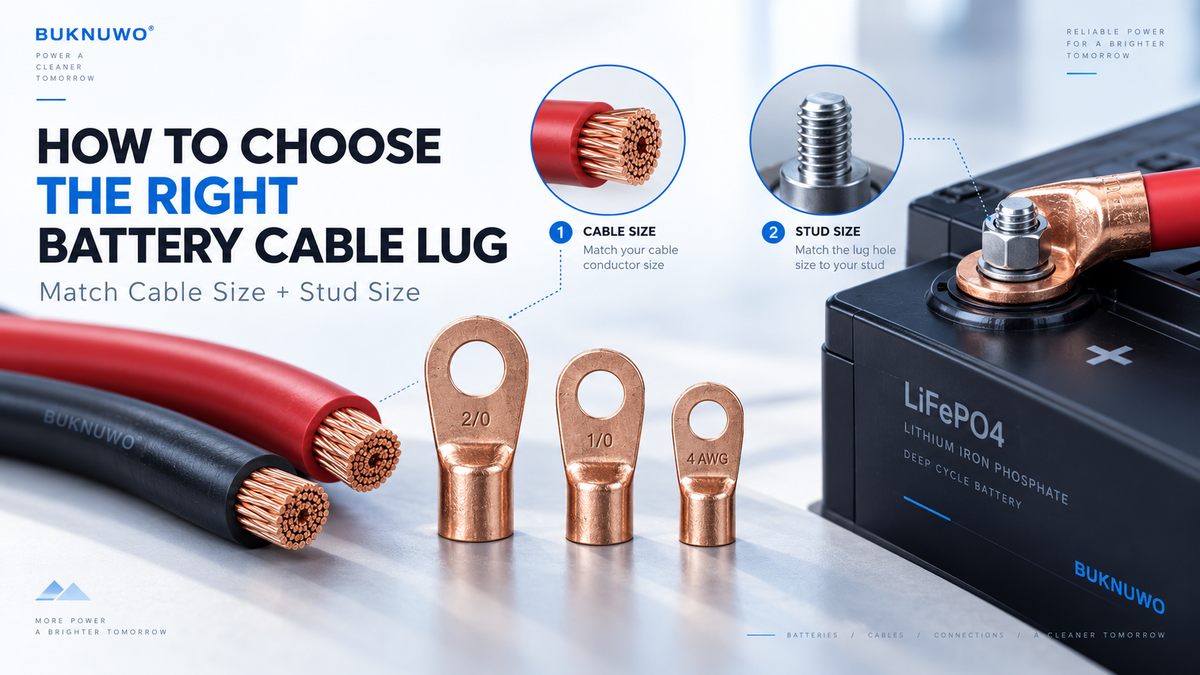
A battery lug has to fit two things: the cable conductor and the terminal stud. Matching only one of them can leave you with a barrel that will not crimp correctly or a ring that does not sit securely on the battery, inverter, busbar, or fuse holder.
Battery capacity in amp-hours does not determine the lug size. Start with the current and cable run, choose the cable, then select a lug whose barrel and hole match the installation.
Choose the cable before the lug
Determine the maximum current the cable needs to carry. Cable length, installation temperature, routing method, and acceptable voltage drop also affect the conductor size.
Once the cable is selected, match the lug barrel to its cross-sectional area. A 16 mm² cable needs a 16 mm² lug, a 35 mm² cable needs a 35 mm² lug, and a 50 mm² cable needs a 50 mm² lug.
Do not force a large cable into a smaller barrel. An oversized barrel on a smaller conductor is also unsuitable because it may not produce a reliable crimp.

Match the ring hole to the terminal stud
The lug's ring hole needs to fit the stud without unnecessary movement. The BUKNUWO reference uses these typical hole sizes:
|
Terminal stud |
Typical lug hole |
|
M8 |
8.5 mm |
|
M10 |
10.5 mm |
|
M12 |
12.5 mm |
|
M14 |
14.5 mm |
An M10 lug may physically go over an M8 stud, but the larger hole is not the preferred fit. Use the correct M8 lug when the terminal has an M8 stud, while also checking that the barrel matches the cable.
For example, a 35 mm² cable connected to an M8 terminal needs a 35 mm² lug with an M8-size hole. If the same cable connects to an M10 busbar stud, it needs a 35 mm² lug with an M10-size hole.

Use the current chart as a reference
The following values come from the BUKNUWO reference chart:
|
Cable size |
Reference current |
Lug hole |
|
16 mm² |
100A |
8.5 mm |
|
25 mm² |
150A |
8.5 mm |
|
35 mm² |
200A |
10.5 mm |
|
50 mm² |
250A |
10.5 mm |
|
70 mm² |
300A |
12.5 mm |
|
95 mm² |
350A |
12.5 mm |
|
120 mm² |
400A |
14.5 mm |
|
150 mm² |
450A |
14.5 mm |
These current values apply as reference values for the cable type represented in the chart. They do not replace cable sizing for the actual installation. A long 200A run may require a larger conductor than a short 200A run because voltage drop and installation conditions are different. If the cable size changes, the lug barrel size changes with it.
The selection order is:
Maximum current to cable size to lug barrel size to terminal stud size

Make the crimp part of the selection
Use a crimping tool and die intended for the cable and lug size. The finished connection should hold the conductor tightly, leave no loose copper strands, and provide a strong mechanical joint with low electrical resistance.
Heat-shrink tubing can protect the completed connection. Before putting the system into service, inspect the lug for movement, exposed strands, damage, or a ring that does not sit flat on the terminal surface.
For a BUKNUWO LiFePO4 system, confirm the cable size and stud diameter at every connection point. The battery terminal, busbar, inverter, fuse holder, and disconnect may not all use the same stud size, even when the same cable gauge is used between them.

Frequently Asked Questions
What size lug do I need for an M8 battery terminal?
Use a lug specifically manufactured for an M8 terminal, typically with a mounting hole slightly larger than the nominal 8 mm stud.
You must also choose the correct barrel size for your cable.
Can I use an M10 lug on an M8 battery terminal?
It may physically fit over the stud, but the oversized hole can reduce positioning accuracy and is generally not the preferred choice.
Use a lug matched to the actual stud whenever possible.
Does cable lug size depend on battery Ah?
No.Battery Ah describes energy capacity.
Cable and lug selection depends primarily on:Current + Cable Size + Terminal Stud Size + Installation Conditions
What lug should I use for 35 mm² cable?
Use a lug with a barrel designed for 35 mm² conductor.
Then choose the mounting hole according to your equipment terminal—for example M8 or M10, depending on the actual stud.
Is a bigger cable lug always better?
No.The lug should fit the conductor and the terminal correctly.
An oversized barrel can produce a poor crimp, while an oversized mounting hole can result in a less secure connection.