
How to choose an inverter for your LiFePO4 battery?
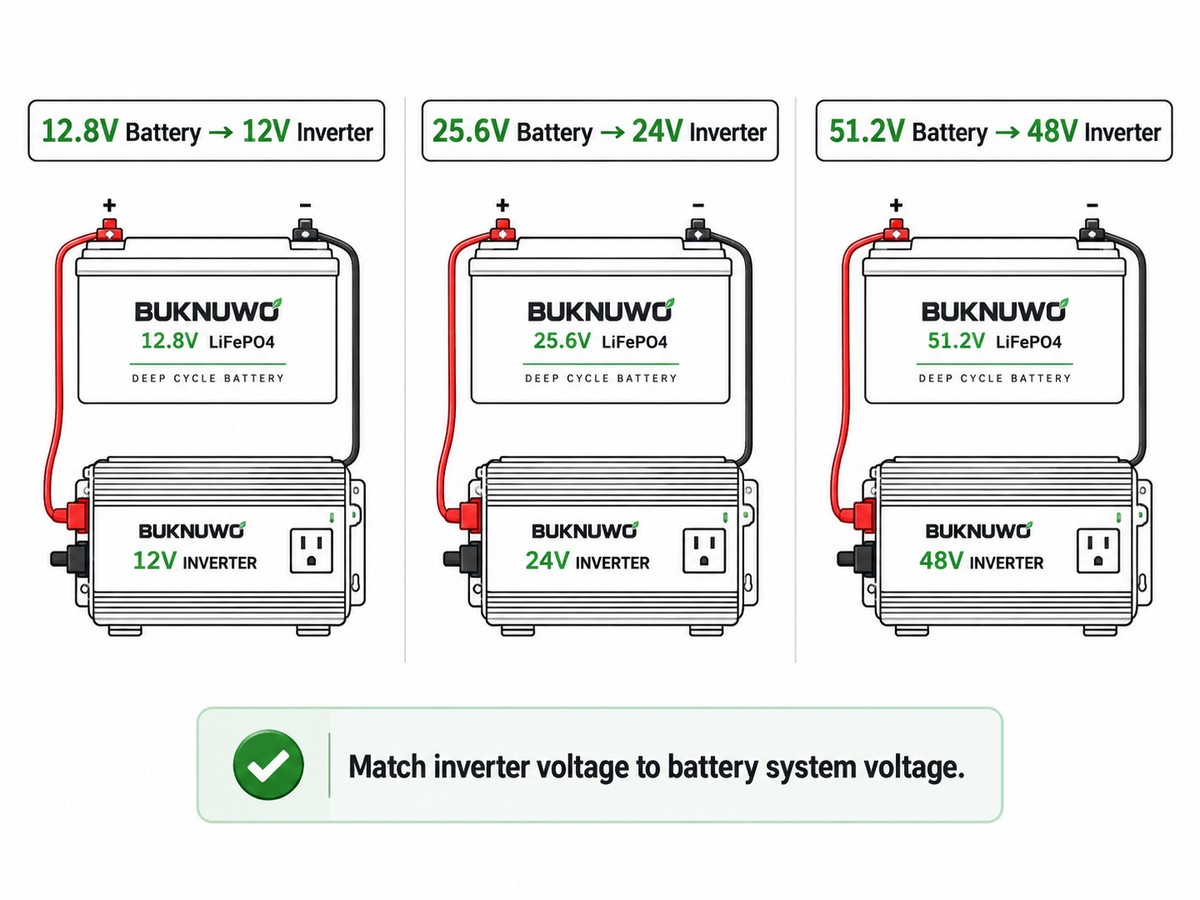
A 100Ah battery does not tell you enough to choose an inverter. You also need to know the battery voltage, its continuous discharge limit, and what you plan to run. A battery may store enough energy for your appliances but still be unable to supply the current they need.
Start with the appliances, then check the inverter and battery together. The examples below show how load power, startup demand, and BMS current affect the choice, using a 12.8V 100Ah battery as a reference.
Match the inverter to the battery voltage
The inverter's DC input must match your battery system. These are the usual voltage classes:
|
Battery system |
Inverter voltage class |
|
12.8V LiFePO4 |
12V inverter |
|
25.6V LiFePO4 |
24V inverter |
|
51.2V LiFePO4 |
48V inverter |
Check the inverter's actual DC input-voltage range as well as the voltage class
on its label.

Add up the appliances you will run together
Use the combined wattage of the appliances that may be on at the same time. For example:
|
Appliance |
Example power draw |
|
Refrigerator |
200W |
|
TV |
100W |
|
Lights |
100W |
|
Microwave |
600W |
|
Total |
1000W |
Choose an inverter whose continuous output covers the load with some reserve. The figures above are an example; use the power requirements of your own appliances when sizing the system.
Startup power needs a separate check. Refrigerators, air conditioners, pumps, compressors, and power tools can draw much more power as they start. Look at both the inverter's continuous rating and its surge or peak rating before deciding it can run those loads.

Check how much current the battery must supply
The BMS discharge limit can rule out a load even when the inverter is large enough. Estimate the battery current with:
Battery current ≈ Load power ÷ Battery voltage ÷ Inverter efficiency
For a 1000W load on a 12.8V battery, assuming 90% inverter efficiency:
1000 ÷ 12.8 ÷ 0.90 ≈ 87A
That is below a 100A continuous BMS rating. Under those assumptions, a battery with that rating can usually support a load around 1000W, provided the rest of the system is correctly sized. Startup demand still needs to be checked.
At 1500W, the same calculation gives:
1500 ÷ 12.8 ÷ 0.90 ≈ 130A
That exceeds a 100A continuous rating. Increasing the inverter size does not increase the current the battery can supply.
What this means for a 12.8V 100Ah battery
If the battery has a 100A continuous BMS, a 1000W pure sine wave inverter is a practical starting point for selection. Its final suitability depends on your actual continuous load, required reserve, and startup demand.
A 2000W load would draw about 174A at 12.8V and 90% efficiency, which is too much for that single battery's 100A continuous BMS. This calculation describes running a 2000W load; the inverter's 2000W nameplate alone does not establish the load you will draw.
If your appliances need that much power, consider a larger battery bank, parallel batteries where supported, or a 24V or 48V system. For BUKNUWO batteries, confirm the exact model's continuous discharge current and supported configuration before choosing an inverter.

When a higher voltage system makes sense
For the same power, a higher battery voltage means less current. At a 2000W load, the approximate currents before inverter losses are:
|
Battery voltage |
Current before inverter losses |
|
12.8V |
156A |
|
25.6V |
78A |
|
51.2V |
39A |
This is why 24V and 48V banks are often better suited to larger inverter systems. These figures exclude inverter losses, unlike the earlier 90%-efficiency examples.

Check the waveform and wiring
A pure sine wave inverter is usually the better choice for RVs, solar systems, home backup, and sensitive electronics. It is a useful starting point when your loads include refrigerators, TVs, computers, pumps, chargers, or other electronic equipment.
Check the wiring before treating the battery and inverter as a complete system. Cable gauge and length, fuse or breaker sizing, busbar ratings, and terminal ratings all matter. Undersized cables can cause voltage drop, heat, and inverter shutdown even when the battery and inverter are otherwise suitable.
Work out runtime separately
Once you know the battery can supply the required current, estimate how long it will run the load. Amp-hour capacity mainly affects runtime; battery voltage and the BMS current limit determine the power the battery can supply within its operating limits.
A 12.8V 100Ah battery stores about 1280Wh. A simple runtime estimate is:
Runtime ≈ Battery energy × Inverter efficiency ÷ Load power
For a 500W load at 90% efficiency:
1280 × 0.90 ÷ 500 ≈ 2.3 hours
Actual runtime varies with battery limits, reserve capacity, temperature, inverter idle consumption, and operating conditions. Use the estimate for planning, then check it against the specifications of the battery and inverter you intend to use.