
BUKNUWO Inverter Selection Review: What Actually Matters
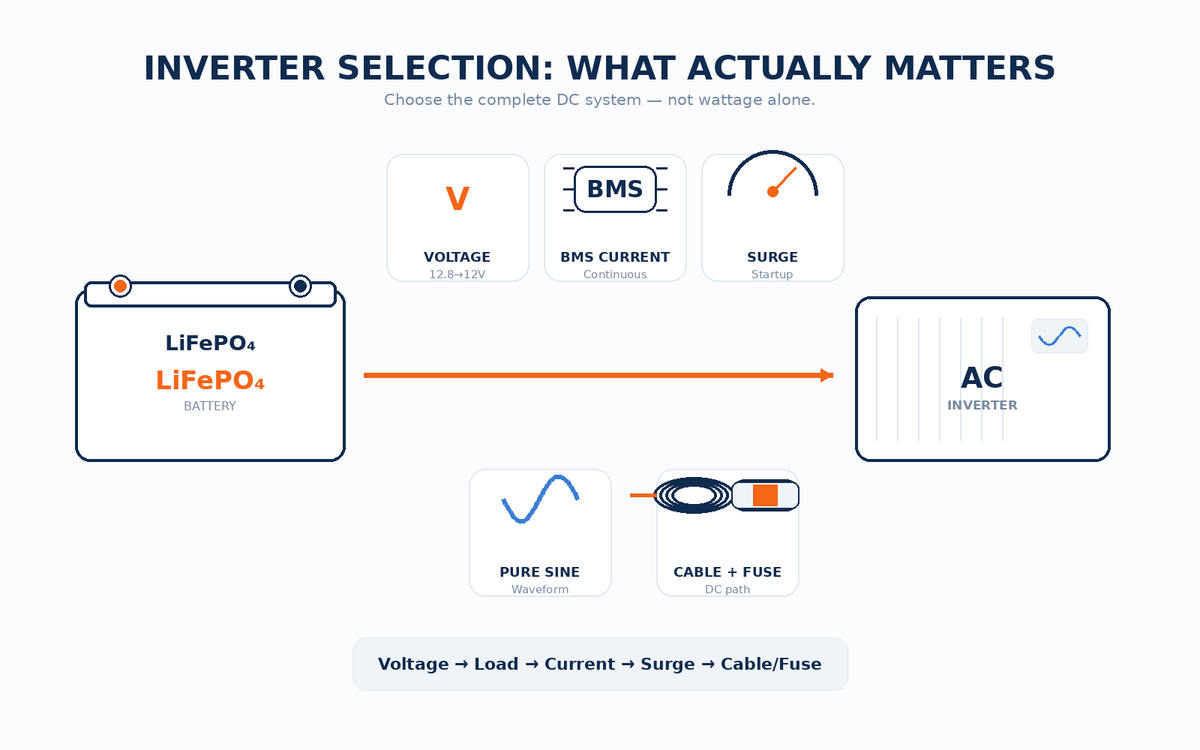
A practical buying review based on battery voltage, BMS current, appliance surge, pure sine wave output, and DC wiring
Choosing an inverter by wattage alone is an easy way to build a system that looks powerful and shuts down when a real appliance starts. This review focuses on the specifications that decide whether a BUKNUWO battery and inverter will work together.
Verdict: Use the appliance load and BMS current rating to choose the inverter, then prove the cable and fuse can carry the result.
Our review summary
The inverter wattage on the front label is only one part of the decision. A useful match must work with the battery voltage, remain within the BMS current limit, start the connected appliances, and receive power through cables and a fuse sized for the job.
For BUKNUWO LiFePO4 systems, the buying sequence is clear: confirm voltage, list the loads, calculate DC current, check surge demand, then review the cable and fuse. Choosing by battery amp-hours alone leaves the most important power limits unanswered.
Compatibility check: match the system voltage
Start with the nominal voltage of the battery bank. The inverter must be designed for that system voltage, and its actual DC input range should be checked in the product documentation before installation.
|
Battery System |
Recommended Inverter Voltage |
|
12.8V LiFePO4 |
12V inverter |
|
25.6V LiFePO4 |
24V inverter |
|
51.2V LiFePO4 |
48V inverter |

Why battery Ah is not an inverter rating
Battery amp-hours mainly affect runtime. The BMS continuous discharge rating determines how much current the battery can supply continuously before protection may intervene.
A larger Ah figure can provide longer operating time, but it does not automatically approve a larger inverter. Two batteries with similar capacity can support different loads if their BMS current ratings are different.
Calculation review: a 1000W load
A simple current estimate makes the BMS check concrete:
Battery current = load power ÷ battery voltage ÷ inverter efficiency
For a 1000W load on a 12.8V battery at 90% inverter efficiency, the calculation is 1000 ÷ 12.8 ÷ 0.90, which is about 87A.
That 87A result must be compared with the continuous discharge rating of the exact BUKNUWO battery. It also shows why cable and fuse selection become more demanding in a lower-voltage, high-power system.

Running watts and startup surge
The inverter's continuous rating must cover the appliances that may run at the same time. Its surge rating must also handle the brief startup demand from equipment such as refrigerators, pumps, motors, and air conditioners.
Running power must remain below the inverter continuous rating, and startup power must remain below the inverter surge rating.
A system can pass the continuous-wattage check and still fail when a motor starts. That behavior does not necessarily mean the battery is empty or the inverter is defective. The startup surge may be exceeding the inverter or BMS limit.

Pure sine wave: when it is the better choice
For sensitive electronics, refrigerators, pumps, and many RV or household appliances, a pure sine wave inverter is generally the more suitable option. Its output is intended to work more like utility AC power than a simplified waveform.
The waveform choice does not replace the electrical sizing checks. A pure sine wave inverter can still shut down if its surge rating is too low or the battery system cannot deliver the required current.
Cable and fuse review
High-power inverters draw high DC current. Cables that are too thin or too long add resistance and voltage drop. Under load, this can produce low-voltage alarms, shutdowns, cable heating, and lost power even when the battery still has charge.
BUKNUWO battery > BMS > cable > fuse > inverter
The battery, BMS, cable, fuse, and inverter should be treated as one DC system. A suitable inverter cannot correct an undersized cable or a poor terminal connection.
What common problems tell us
The shutdown pattern is useful evidence. Match the symptom with the likely causes below before replacing the inverter or battery.
|
Problem |
Possible Cause |
|
Inverter shuts down |
BMS current limit or overload |
|
Low-voltage alarm |
Low SOC or cable voltage drop |
|
Starts then stops |
Startup surge is too high |
|
Repeated on and off |
Voltage sag or loose connection |
|
Over-temperature |
Poor ventilation or excessive load |
|
No output |
Fuse, wiring, or inverter fault |

Buyer and installer checklist
1. Confirm the battery-system voltage and the inverter DC input range.
2. Add the wattage of appliances that may run together.
3. Check the startup surge of motors, pumps, refrigerators, and air conditioners.
4. Calculate battery current using the expected inverter efficiency.
5. Compare the result with the battery's continuous BMS rating.
6. Confirm the inverter continuous and surge ratings.
7. Check cable size, cable length, and fuse or breaker rating.
8. Provide suitable inverter ventilation.
Final verdict
The best inverter is not simply the largest model the budget allows. It is the model whose voltage, continuous rating, surge capability, and DC current demand fit the complete battery system.
For a BUKNUWO LiFePO4 battery, begin with the real appliance load and the battery's published BMS rating. Once those two figures work together, the inverter, cable, and fuse can be selected as a coherent system rather than a collection of separate parts.