
Why Parallel LiFePO4 Batteries Share Current Unevenly?
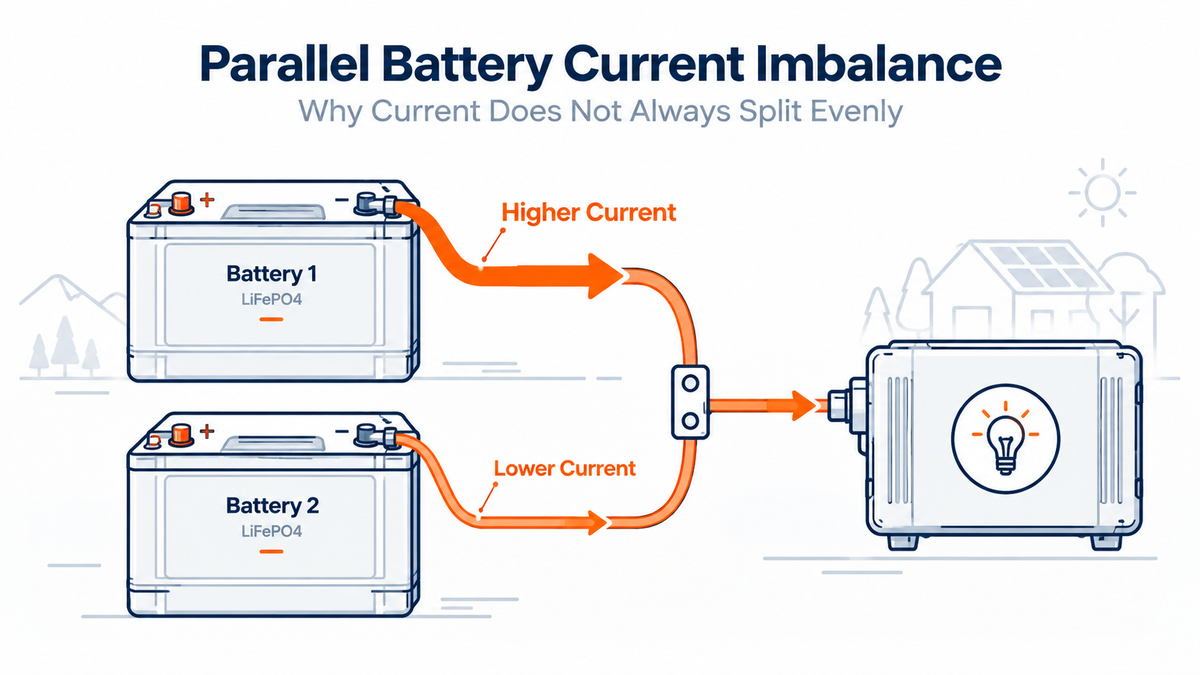
A practical guide to cable resistance, wiring layout, state of charge, BMS behavior, and branch-current testing
Two batteries can be the same model, show nearly the same voltage, and still carry different currents when connected in parallel. The difference often comes from the path around the batteries rather than the batteries themselves.
What current imbalance means
Connecting LiFePO4 batteries in parallel keeps the system voltage the same and increases the total available capacity. The batteries share the load, but they do not always contribute exactly the same current at every moment.
A small difference can be normal. Each battery and cable path has some resistance, and no two paths are perfectly identical. The issue deserves attention when the difference is large, persists under similar conditions, or causes one battery to reach a protection limit much earlier than the others.
Key principle: parallel batteries share the same voltage, but balanced current depends on similar electrical paths.
Cable resistance usually comes first
Current tends to favor the path with lower resistance. If one battery has a shorter cable, a larger conductor, a better crimp, or a cleaner connection, that branch may supply more of the load.
Use the same cable gauge for each battery branch and keep the positive and negative path lengths as similar as practical. Matching lugs and clean, tight connections also help. Equal batteries can only share current well when the routes between them and the system are comparable.

The connection layout changes the current path
A common wiring mistake is to take both the main positive and main negative connections from the battery nearest the load. That battery has the shortest combined path and may carry more current.
With two batteries, a diagonal connection can improve sharing by taking the main positive from one end of the bank and the main negative from the other. For a larger bank, positive and negative busbars make it easier to give every battery a similar branch-cable path.

State of charge matters before connection
Batteries connected in parallel should be reasonably close in voltage and state of charge. They should also be compatible in capacity, model, age, and condition. If one battery starts at a different SOC, it may charge or discharge at a different rate from the rest of the bank.
Comparing voltage and SOC before connecting the bank removes one variable from the diagnosis. It also helps distinguish a wiring problem from a difference that was already present in the batteries.
Internal resistance will never match perfectly
Even batteries of the same model can have slightly different internal resistance. Cell variation, age, temperature, BMS resistance, and terminal resistance all influence how current divides.
For that reason, a perfect 50/50 split between two batteries is not a realistic requirement in every operating condition. Look for the pattern over time. A modest difference that moves between batteries is different from one branch that remains consistently far above or below the others.
Connections and BMS status can change one branch
Loose terminals, poor crimps, resistive fuses, busbar connections, and disconnect switches can add resistance to a single branch. The affected battery may then carry less current, while the other batteries make up the difference.
A BMS in protection or limiting operation can create a similar result. Check the protection status in each battery app, but do not rely on app readings alone when the difference is large. Verify each branch with a DC clamp meter.

A quick comparison of the common causes
Most current-sharing problems can be narrowed down by comparing the electrical path, battery state, and protection status of each branch.
|
Possible Cause |
What It Changes |
What to Check |
|
Unequal cable paths |
One battery sees less resistance |
Gauge, length, lugs, connections |
|
Wiring layout |
One battery sits closer to both main connections |
Diagonal wiring or common busbars |
|
Different SOC |
Batteries charge or discharge at different rates |
Voltage and SOC before paralleling |
|
Internal resistance |
Current naturally divides unevenly |
Age, temperature, condition |
|
Connection or BMS issue |
A branch gains resistance or limits current |
Terminals, fuses, switches, BMS status |

A practical troubleshooting order
Work through the bank in a consistent order so that one change does not hide another problem:
1. Compare the voltage and SOC of every battery.
2. Check that branch cables use the same gauge and similar lengths.
3. Inspect battery terminals, cable lugs, fuses, busbars, and disconnect switches.
4. Confirm that the main positive and negative connections do not favor one battery.
5. Measure the current in each battery branch with a DC clamp meter.
6. Review BMS protection status and compare battery temperatures.
7. If the difference remains, test the batteries individually.
The preferred layout for several batteries
For a multi-battery bank, connect each battery to common positive and negative busbars with the same cable size and similar branch-cable lengths. This gives each battery a comparable route to the system.
Battery 1 positive > positive busbar | Battery 1 negative > negative busbar
Battery 2 positive > positive busbar | Battery 2 negative > negative busbar
The busbars do not guarantee mathematically identical current, but they make unequal wiring resistance less likely and keep the installation easier to inspect.
When uneven current needs more attention
Uneven current does not automatically mean a battery has failed. Start with wiring, SOC, connections, temperature, and BMS status. These causes are common and can make healthy batteries appear mismatched.
If one battery continues to carry much more or much less current after those checks, isolate and test the batteries individually. The goal is consistent behavior from the bank, not a perfect split on every reading.
Frequently Asked Questions
Is different current between parallel batteries normal?
Yes. Small differences can be normal.
Large or persistent differences should be checked.
Why does one battery discharge faster?
Common causes include unequal cable resistance, different SOC, poor connections, internal resistance and BMS behavior.
Do parallel battery cables need to be the same length?
They should be as similar as practical to improve current sharing.
Does uneven current mean the battery is bad?
Not necessarily.
Check wiring, SOC, connections and BMS status first.