
What 4000 cycles means for LiFePO4 battery life
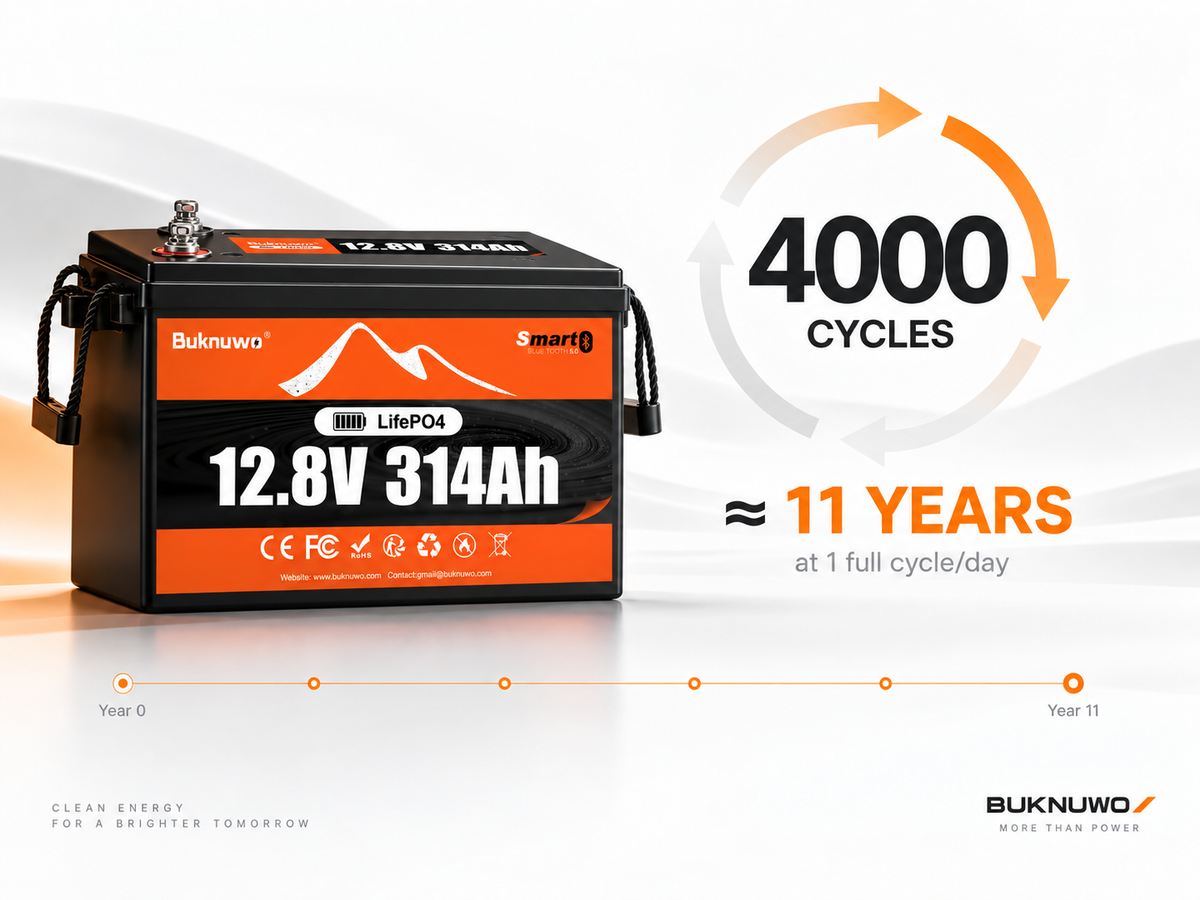
A LiFePO4 battery rated for 4000 cycles could take roughly 11 years to reach that count if it completes one equivalent full cycle every day:
4000 ÷ 365 ≈ 10.96 years
That calculation answers how long it takes to accumulate the cycles. It does not predict an exact service life. Temperature, depth of discharge, charging conditions, storage, and calendar aging also affect how long the battery remains useful.
A cycle is not the same as one charging session
Battery cycle counts are based on energy used, so several partial discharges can add up to one equivalent full cycle.
For example, using a battery from 100% state of charge (SOC) to 50%, then recharging it, uses about half of its capacity. Repeating that pattern a second time adds up to approximately one equivalent full cycle.
This distinction matters when comparing the cycle rating with everyday use. A battery charged every day may accumulate less than one full cycle per day if each discharge is shallow.

How long it takes to reach 4000 cycles
The cycle frequency changes the mathematical estimate:
|
Usage frequency |
Time to reach 4000 cycles |
|
Two equivalent full cycles per day |
Approximately 5.5 years |
|
One equivalent full cycle per day |
Approximately 11 years |
|
One equivalent full cycle every two days |
Approximately 22 years* |
*The 22-year figure is a cycle-count calculation. Calendar aging is likely to become important before such a long cycle estimate is reached.

What happens after cycle 4000
A 4000-cycle rating does not usually mean the battery suddenly stops working at the next cycle. Cycle-life ratings are commonly tied to a remaining-capacity level, often around 80%, under defined test conditions.
A 100Ah battery may therefore continue operating after long-term use while providing less usable capacity and shorter runtime than it did when new. The exact cycle-life definition and test conditions should come from the specification for the battery model.

Depth of discharge changes the comparison
Depth of discharge (DoD) describes how much of the battery's capacity is used in a cycle. Moving from 100% SOC to 20% SOC is an 80% DoD cycle.
Shallower cycling generally puts less stress on a LiFePO4 battery than repeatedly using nearly all of its capacity. A rating measured at 80% DoD should not automatically be treated as equivalent to the same cycle count at 100% DoD.
When comparing cycle-life claims, check the test conditions instead of looking only at the number of cycles.
Time still affects a lightly used battery
Batteries age even when they are not cycling. This is calendar aging, and it means a lightly used battery can still lose capacity over time.
Temperature, SOC, and storage conditions influence calendar aging. This is why a simple calculation can produce a cycle-count estimate of 22 years without establishing that the battery will deliver 22 years of service.
Conditions that can shorten battery life
Frequent deep discharge, high temperatures, excessive charging voltage, and high charge or discharge current can increase stress on the battery. Poor storage conditions and long periods at an extreme SOC may also affect its life.
Use charging equipment and operating limits specified for the battery. Storage and maintenance practices matter alongside the number of cycles.

Reading a BUKNUWO 4000-plus-cycle rating
For a BUKNUWO LiFePO4 battery rated for 4000-plus cycles, daily equivalent full cycling works out to roughly 11 years by cycle count. Treat that as a way to understand the size of the rating, not as a guaranteed service-life figure.
Actual lifespan depends on how the battery is discharged, charged, stored, and maintained. The product specification should also identify the test conditions behind the cycle rating and the remaining-capacity point used to define cycle life.
Frequently Asked Questions
How many years is 4000 LiFePO4 cycles?
At one equivalent full cycle per day:
4000 ÷ 365 ≈ 11 years
At two cycles per day, it is approximately 5.5 years by cycle count.
Does 4000 cycles mean 4000 charges?
Not necessarily.
Partial discharges can accumulate into equivalent full cycles, and exact cycle-counting methods vary by manufacturer.
Is a battery dead after 4000 cycles?
Usually not.
Cycle-life specifications commonly refer to reaching a certain remaining-capacity level rather than complete battery failure.
Can a LiFePO4 battery last 10 years?
Yes, under suitable operating conditions, a 4000-cycle rating is consistent with roughly a decade of daily cycling. Goal Zero, for example, explicitly describes its 4000+ cycle LFP rating as about 10 years of daily use under its specified test conditions.
Does using only 50% of the battery extend its life?
Shallower cycling can reduce cycling stress, and published LiFePO4 data commonly shows higher cycle counts at lower DoD. However, total lifespan still depends on temperature, charging conditions and calendar aging.