
How to Maintain and Store a LiFePO4 Battery Long Term
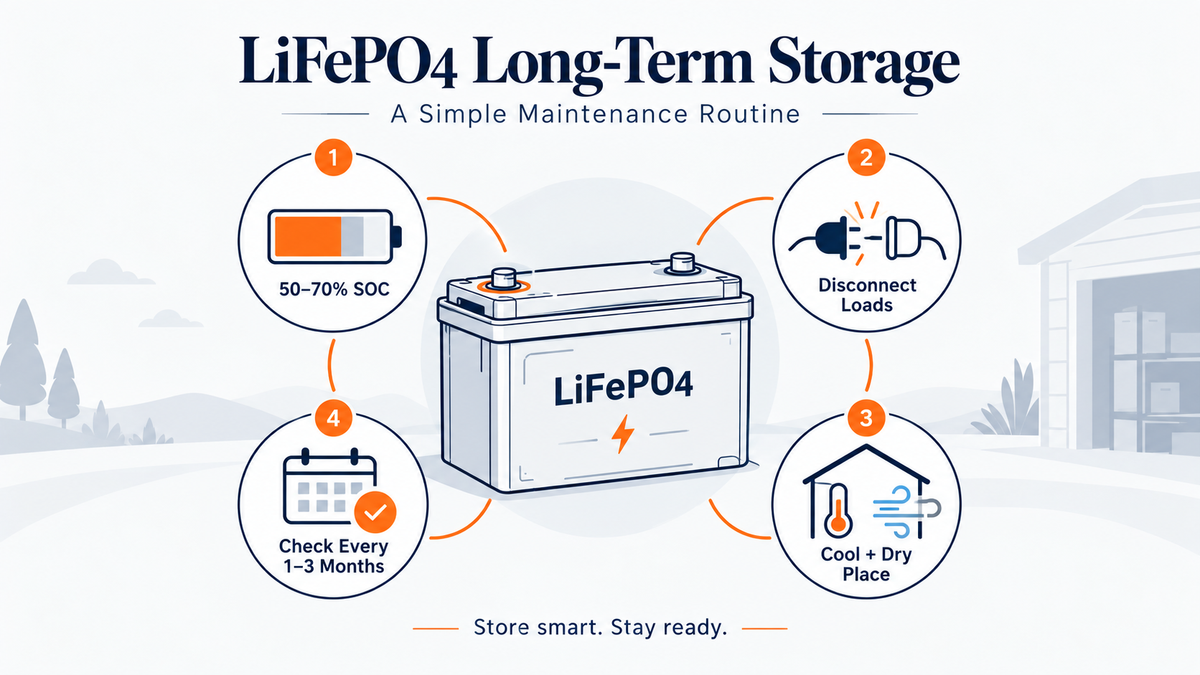

A practical routine for storage charge, disconnected equipment, regular checks, and winter conditions
A LiFePO4 battery can sit unused for months without needing the same maintenance as a lead-acid battery. It still needs a sensible storage setup. Most problems come from storing it empty, leaving equipment connected, or forgetting to check it for too long.
Partial charge > disconnect equipment > cool, dry storage > regular checks
Low maintenance still needs a routine
LiFePO4 batteries require less routine care than lead-acid batteries, but long-term storage still deserves some planning. The main risks are deep discharge, excessive heat, and equipment that continues to draw power while the battery appears to be idle.
A useful storage routine is short: set a partial state of charge, disconnect the system, choose a suitable location, and check the battery occasionally. Those steps help keep the battery ready for its next use without turning storage into a maintenance project.
Set the battery to a suitable storage SOC
BUKNUWO's current long-term storage guidance recommends approximately 50% to 70% state of charge. This partial charge keeps the battery away from the extremes of a completely empty or fully charged state during an extended idle period.
Do not leave the battery completely discharged for a long time. If it enters low-voltage protection and remains there while hidden loads continue to draw power, recovery may become more difficult.

Disconnect loads and charging equipment
Before storage, disconnect the inverter, charger, MPPT controller, and other connected loads. Devices with standby circuits can continue to consume a small amount of energy even when they look switched off.
Over enough time, that parasitic drain can lower the battery's SOC and may eventually trigger low-voltage protection. Physically isolating the battery removes that uncertainty and makes later battery checks easier to interpret.

Choose a cool, dry storage location
Store the battery in a clean, dry, and ventilated area. Keep it away from direct sunlight, strong heat sources, standing water, and corrosive surroundings.
High temperatures accelerate battery aging even when the battery is not being used. A stable storage environment is more useful than a location that is convenient but exposed to heat or moisture.
Check the battery every 1 to 3 months
BUKNUWO recommends checking the stored battery's SOC or voltage every 1 to 3 months. The purpose is to catch an unexpected drop before the battery sits at a very low charge for an extended period.
If the SOC becomes too low, recharge the battery with the correct LiFePO4 charger. After charging, disconnect the equipment again before returning the battery to storage.
Inspect the terminals, cables, and case
Check the battery before storage and again before returning it to service. Look at the terminals, cable lugs, and cables for loose connections, corrosion, or visible damage. Inspect the battery case as well.
This simple inspection separates a storage issue from a wiring issue. It also gives you a chance to correct a damaged cable or loose connection before the battery is placed back under load.
Take extra care during winter storage
Cold storage and cold charging are different concerns. The key rule is to avoid charging below the battery's permitted charging temperature.
If low-temperature protection is active, allow the battery to warm into its recovery range before charging. Use the temperature limits published for the exact battery model rather than assuming that all LiFePO4 batteries have the same limits.
Bring the battery back into service
Before reconnecting the system, inspect the battery case, terminals, cable lugs, and cables. Check the battery's SOC or voltage, then recharge if needed using a suitable LiFePO4 charger and permitted temperature conditions.
Reconnect the inverter, charger, MPPT controller, and loads only after the battery and wiring have passed the inspection. A careful restart is a better final check than assuming that an undisturbed battery is automatically ready for use.

Long-term storage checklist
The complete routine can be summarized in the table below. Keep it with the battery system records so the storage date and inspection schedule are easy to follow.
|
Step |
Action |
When |
|
Set storage charge |
Bring the battery to about 50% to 70% SOC |
Before storage |
|
Disconnect equipment |
Remove loads and charging equipment |
Before storage |
|
Choose the location |
Use a cool, dry, ventilated area |
During storage |
|
Check battery level |
Review SOC or voltage |
Every 1 to 3 months |
|
Recharge if needed |
Use the correct LiFePO4 charger |
If SOC becomes too low |
|
Inspect the system |
Check terminals, cables, lugs, and case |
Before storage and reuse |
A simple habit protects the next trip
LiFePO4 batteries are low maintenance, but they should not be stored and forgotten. A partial charge, disconnected equipment, a suitable environment, and occasional checks reduce the risk of deep discharge and hidden damage.
For BUKNUWO batteries, begin with the current 50% to 70% SOC guidance and a check every 1 to 3 months. Then use the exact model instructions for charging temperature and returning the battery to service.
Frequently Asked Questions
What SOC should a LiFePO4 battery be stored at?
For BUKNUWO batteries, current guidance recommends approximately 50%–70% SOC for long-term storage. Other brands may specify different ranges.
Can I store a LiFePO4 battery at 100%?
Short-term storage at full charge does not automatically damage a battery, but for extended storage it is generally better to follow the manufacturer's recommended partial SOC rather than leaving it at an extreme SOC for long periods.
How often should I check a stored LiFePO4 battery?
BUKNUWO recommends checking voltage or SOC every 1–3 months during long-term storage.
Should I disconnect the battery during storage?
Yes. Disconnecting loads, inverters and chargers helps prevent parasitic loads from slowly discharging the battery.
Do LiFePO4 batteries need regular maintenance?
They require much less maintenance than traditional lead-acid batteries, but periodic SOC, terminal, cable and storage-condition checks are still recommended.