
How to Choose a LiFePO4 Battery for an Off-Grid Shed or Workshop
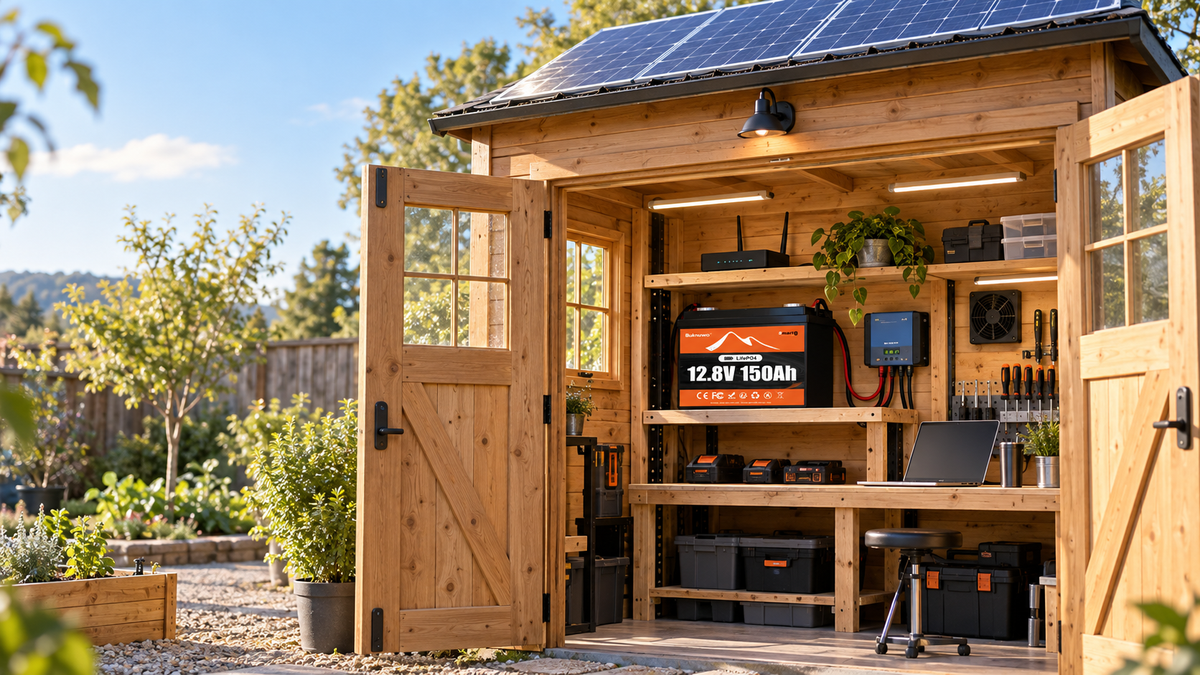
An off-grid shed can be much more than a storage space. With a correctly planned battery system, it may support lighting, internet access, device charging, ventilation and selected workshop equipment without extending utility power from the house. The important part is choosing a battery around the actual load—not simply buying the largest amp-hour rating available.
This guide explains how to choose a LiFePO4 battery for an off-grid shed or workshop, with a practical comparison between 100Ah, 150Ah and 314Ah 12.8V batteries. It also covers short-duration power demand, solar charging, installation conditions and the limits of what a small 12V system should be expected to run.
Quick answer
A 100Ah battery may suit a small shed used mainly for LED lighting, a router, phones and occasional charging. A 150Ah battery is often the most balanced starting point for a working shed with several low-to-moderate loads. A 314Ah battery may be more suitable when the workshop operates for longer periods, supports more devices or has limited opportunities to recharge. Always verify voltage, combined current and short-duration demand before choosing.
Start With the Shed’s Real Purpose
A garden shed used for fifteen minutes of evening lighting has very different requirements from a detached workshop used for several hours. Before comparing batteries, decide which of these descriptions is closest to your space:
- Basic shed: LED lighting, phone charging and perhaps a security camera.
- Connected shed: lighting, router, camera, phone or tablet and a small ventilation fan.
- Working shed: the connected-shed loads plus a laptop and cordless-tool battery chargers.
- Extended workshop: several work lights, multiple chargers, computer equipment and longer daily use.
This first decision prevents two common mistakes: buying too little capacity for a real workspace or installing a large battery for a shed that only needs occasional lighting.
Make a Simple Device and Energy List

Write down every device you expect to use, its rated power and the approximate number of hours it may operate. For a first estimate, use:
Estimated energy (Wh) = Power (W) × Time (hours)
Add the results for lighting, router, laptop, fan, cameras, USB charging and tool chargers. The total is a planning estimate rather than a guaranteed runtime. Device behavior, conversion losses, cable voltage drop, temperature, battery condition and actual usage can all change the result.
For equipment that cycles on and off, use realistic operating time rather than assuming it runs continuously. For cordless-tool chargers, consider how many battery packs are normally charged during one visit to the workshop.
Do Not Ignore Short-Duration or Startup Power
Stored energy and available power are related but different. Amp-hours and watt-hours help describe capacity, while the battery’s BMS discharge rating helps determine how much current it can support. Cables, fuses, connectors and power-conversion equipment also have limits.
Some fans, chargers and workshop devices may briefly demand more power when they start or change operating modes. Do not choose a battery solely from average watts. Check the manufacturer’s input or startup specifications and consider which devices may operate at the same time.
Large corded saws, air compressors, heaters, welders and similar high-demand equipment can exceed the practical scope of a small 12V shed system. This guide should not be treated as confirmation that every workshop tool can run from the batteries discussed here.
100Ah vs. 150Ah vs. 314Ah for an Off-Grid Shed
| Battery size | Nominal energy | Best-fit planning role | Example loads |
|---|---|---|---|
| 12.8V 100Ah | 1,280Wh | Basic or occasional-use shed | LED lights, phone charging, router, camera or small fan with managed use |
| 12.8V 150Ah | 1,920Wh | Balanced working shed | Lighting, router, laptop, phone, fan and intermittent tool-battery charging |
| 12.8V 314Ah | About 4,019Wh | Extended or multi-device workshop | Longer lighting and computer use, several chargers and more reserve between charging opportunities |
Nominal energy is voltage multiplied by capacity. It is not a promise of delivered energy or operating time. Final system suitability depends on verified device and installation requirements.
100Ah: Suitable for a Basic Shed
A 100Ah LiFePO4 battery for a shed may be enough when the goal is dependable lighting, device charging and a small amount of connected equipment. It is easier to position than a larger model and can work well when visits are short and the charging source is available regularly.
It becomes less comfortable when several chargers, a laptop and lighting are used together for long sessions. If you expect the shed to develop into an active workspace, planning some capacity margin may reduce the need for an early upgrade.
150Ah: The Balanced Workshop Choice
For many users, a 150Ah LiFePO4 battery for an off-grid workshop is the best place to begin. The 1,920Wh nominal capacity gives more flexibility than 100Ah while remaining more manageable than a large 314Ah battery. It can be considered for a mixture of LED lighting, router use, a laptop, phones, a small fan and intermittent charging of cordless-tool batteries.

Review the BUKNUWO 12.8V 150Ah Bluetooth LiFePO4 battery and compare its current specifications with the combined requirements of your equipment.
314Ah: More Reserve for Longer Sessions
A 314Ah model may be a better solar battery for an off-grid shed when recharging opportunities are limited or the workshop supports more devices for longer periods. Its approximately 4,019Wh of nominal energy provides considerably more planning reserve than the smaller options.

The tradeoffs are physical size, weight, mounting requirements and longer charging time. Confirm that the shelf or platform can support the battery securely and that the selected charger or solar system is appropriate for its specifications.
Match the Charging Plan to How the Shed Is Used
An off-grid shed battery system needs a realistic way to replace the energy used. A LiFePO4-compatible charger may suit a workshop that can occasionally connect to utility power. Solar can be useful where the shed receives adequate sunlight and regular charging is desired.
For solar charging, the panels, MPPT controller, battery, fusing and wiring need to be compatible. Panel wattage alone does not guarantee a daily amount of energy. Weather, season, shade, panel angle, controller limits and available charging hours all affect production.
If the shed is shaded for much of the day or used heavily in winter, calculate with conservative charging expectations and retain another suitable charging option where possible.
Plan the Installation for a Shed Environment

Sheds may experience more heat, cold, humidity, dust and vibration than an indoor utility room. A good installation should address the environment as well as the electrical design:
- Mount the battery securely on a strong, dry and level surface.
- Keep the battery away from roof leaks, direct water, sharp tools and falling materials.
- Stay within the battery manufacturer’s permitted charging, discharging and storage temperatures.
- Protect the positive conductor with a correctly selected fuse or circuit breaker near the battery, based on the actual circuit requirements.
- Select cable size for current, circuit length and acceptable voltage drop.
- Cover the terminals and prevent conductive tools or hardware from bridging them.
- Use suitable enclosures and cable protection where dust, pests or accidental impact are possible.
- Have uncertain fixed wiring reviewed or installed by a qualified professional.
Important: BUKNUWO deep-cycle LiFePO4 batteries discussed in this guide are not designed to start a vehicle, generator or other engine. Do not use them as starting batteries.
Control Loads Instead of Oversizing Everything
Battery capacity is only one way to improve an off-grid workshop. Energy-conscious equipment can reduce the required storage and charging system:
- Divide lighting into zones so only the occupied work area is illuminated.
- Switch off the router, monitor and chargers when they are not needed.
- Charge tool batteries during strong solar-production periods when practical.
- Avoid leaving chargers and conversion equipment in standby indefinitely.
- Use Bluetooth battery monitoring, where supported, to observe state of charge and usage trends.
These habits can be more valuable than selecting a larger battery while allowing unnecessary loads to run continuously.
Common Off-Grid Workshop Planning Mistakes
- Planning from amp-hours alone: voltage, watt-hours and discharge capability also matter.
- Ignoring simultaneous loads: several small devices can create a meaningful combined demand.
- Ignoring startup demand: average power may not show the highest short-duration requirement.
- Assuming every tool is suitable: high-demand workshop equipment may need a substantially different system.
- Expecting guaranteed solar charging: available sunlight changes throughout the year.
- Installing directly on the floor: water, impact and workshop debris can create avoidable risks.
- Forgetting future loads: a basic storage shed may later become a connected workspace.
Final Recommendation
Choose an off-grid workshop battery by first listing the devices, operating time, simultaneous loads and short-duration demand. A 100Ah battery may suit lighting and a compact connected shed. A 150Ah battery is the most balanced recommendation for a typical working shed with several everyday devices. A 314Ah battery may be worth considering for longer sessions, multiple chargers or limited recharging opportunities.
Before installation, verify every device’s input requirements, the battery and BMS ratings, cable and fuse selection, charging method, environmental conditions and mounting structure. A correctly sized, carefully installed system is more useful than one selected from capacity alone.
Frequently Asked Questions
What size LiFePO4 battery is best for an off-grid shed?
For basic lighting and device charging, 100Ah may be enough. For a working shed with lighting, router, laptop, fan and intermittent tool-battery charging, 150Ah is often a balanced starting point. Longer or heavier use may justify 314Ah after the loads and charging plan are verified.
Can a LiFePO4 battery run workshop tools?
Some low-to-moderate loads and tool-battery chargers may be supportable through correctly selected equipment, but suitability depends on voltage, continuous power and startup demand. Large saws, compressors, heaters and welders may exceed the practical scope of a small 12V system.
Can solar panels charge an off-grid shed battery?
Yes, when the panels, MPPT controller, wiring, protection and battery are compatible. Actual charging depends on weather, season, shade, panel placement and controller limits.
Is 150Ah or 314Ah better for an off-grid workshop?
150Ah is easier to manage and can suit an everyday multi-device workspace. The 314Ah option provides more nominal energy for longer sessions or limited charging opportunities, but it requires more space, structural support and charging time.
Can the battery be left in the shed all year?
That depends on the shed’s temperature, moisture exposure and the battery manufacturer’s permitted operating and storage conditions. Protect the battery from water, impact and temperature extremes, and inspect its state of charge periodically.
Can this battery start a generator, tractor or vehicle?
No. The BUKNUWO batteries covered here are deep-cycle energy-storage batteries and should not be used as engine-starting batteries.