
How to Choose a LiFePO4 Battery for Tailgating and Outdoor Events
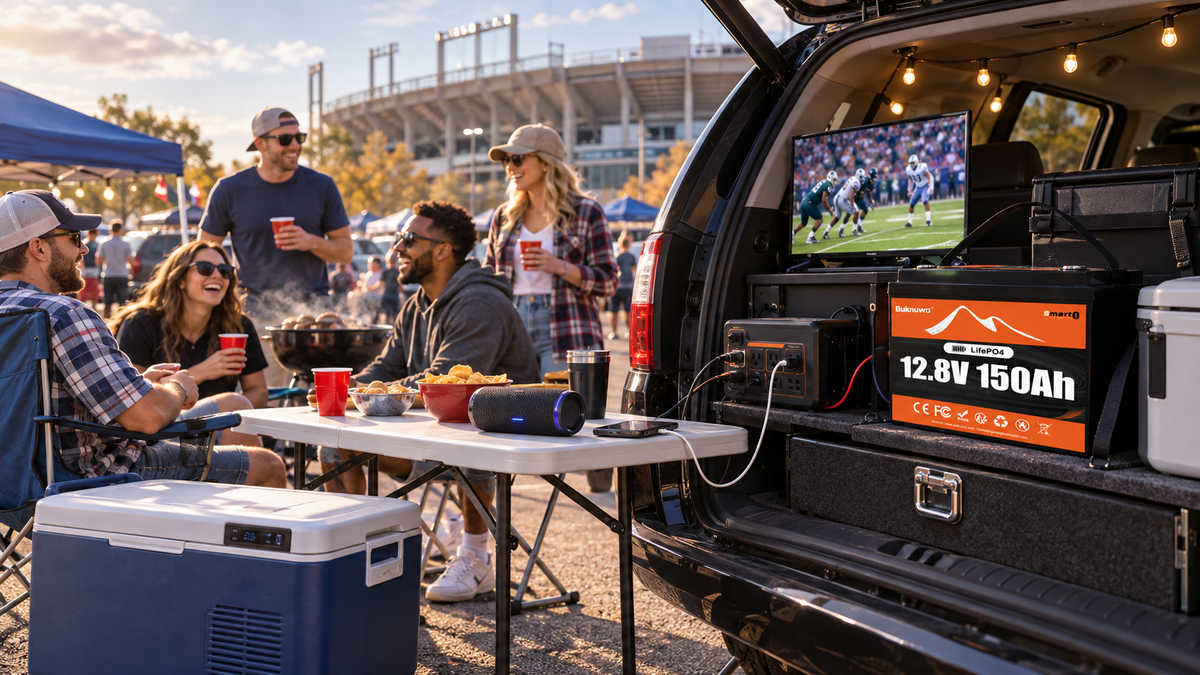
A television, electric cooler, speaker, string lights, phones, and cooking accessories can turn a parking-space gathering into a comfortable event—but they also create very different power demands. Choosing a LiFePO4 battery for tailgating starts with the equipment you plan to use, not with the size of your vehicle or the number of guests.
This guide shows how to estimate your event's energy needs, account for equipment startup power, and compare 12.8V 100Ah, 150Ah, and 314Ah batteries for tailgating, outdoor viewing parties, community events, and similar temporary setups.
Quick answer
A 100Ah LiFePO4 battery can be a practical starting point for lighting, phones, a modest speaker, and a limited number of efficient devices during a shorter event. A 150Ah battery is often the more balanced choice when a television, electric cooler, audio equipment, and charging ports may run together. A 314Ah battery may be worth considering for longer events, multiple high-use devices, or limited opportunities to recharge. The final choice must also satisfy voltage, BMS current, inverter, fuse, cable, and startup-power requirements.
What Does a Tailgating Power Setup Usually Run?
Every event is different. Start by listing all devices that could draw power from the battery:
- Television or portable display
- Portable speaker or audio system
- 12V electric cooler or refrigerator
- LED string lights and area lighting
- Phones, tablets, cameras, and laptops
- Fans or other compatible accessories

Do not size a tailgate battery from the largest-looking device alone. A television may draw more power continuously than a phone charger, while a compressor cooler may cycle on and off and briefly require more power when starting.
Step 1: Separate DC and AC Devices
Some equipment can operate directly from a compatible 12V DC circuit. Standard household-style AC appliances require an inverter that converts battery DC power into AC power.
- DC devices: calculate from the device's stated watts or amps at its actual operating voltage.
- AC devices: include the energy lost during inverter conversion and confirm the inverter can handle both running and startup power.
BUKNUWO does not sell inverters. If your setup includes AC equipment, select a compatible inverter separately and follow its manufacturer's specifications. A pure sine wave inverter may be required or preferred by some electronics, but compatibility depends on the actual device.
Step 2: Estimate Energy Use in Watt-Hours
Watt-hours make it easier to compare different devices and battery capacities:
Device energy (Wh) = device power (W) × operating time (hours)
Calculate each device separately and add the results. For an AC appliance, use the inverter manufacturer's efficiency at the expected load:
Estimated battery energy for an AC load = AC energy ÷ inverter efficiency
For example, if the inverter documentation gives efficiency as a percentage, convert it to a decimal before using the formula. Do not automatically apply one efficiency figure to every inverter or every load level.
The nominal energy of a battery can be estimated from:
Nominal battery energy (Wh) = nominal voltage (V) × capacity (Ah)
Nominal energy is not a guaranteed amount delivered to every appliance. Wiring losses, inverter losses, temperature, battery condition, protection settings, and the reserve you choose to keep can all affect the result.
Simple event-planning worksheet
| Device | Rated watts | Expected hours | Estimated Wh |
|---|---|---|---|
| Television/display | From label/manual | Your event | W × hours |
| Electric cooler | Manufacturer data | Allow for cycling | Use measured or supplied data |
| Speaker/audio | From label/manual | Your event | W × hours |
| Lights and charging | Add all devices | Your event | W × hours |
Step 3: Check Running and Startup Power
Energy capacity tells you how long a system may operate, but it does not prove that the system can start or continuously run every appliance. Compressor coolers, refrigerators, pumps, fans, and some audio equipment can briefly draw more power at startup than during normal operation.
Before connecting a high-demand or motor-driven device, confirm all of the following:
- The appliance's normal running power
- Its maximum or startup power
- The inverter's continuous and surge ratings
- The battery BMS continuous and peak-discharge limits
- The fuse or circuit breaker rating
- Cable gauge, cable length, terminals, and voltage drop
A larger amp-hour number does not automatically guarantee compatibility with a high-power appliance. Capacity, current capability, and the rest of the electrical system must all work together.
100Ah vs 150Ah vs 314Ah for Tailgating
| Battery | Nominal energy | Practical starting point | Move up when |
|---|---|---|---|
| 12.8V 100Ah | 1,280Wh | Shorter events with efficient lighting, device charging, modest audio, or a limited device list | You add a television, cooler, more guests' devices, or longer operating hours |
| 12.8V 150Ah | 1,920Wh | A balanced multi-device tailgating or outdoor event setup | Your calculated energy need and reserve approach the available capacity |
| 12.8V 314Ah | About 4,019Wh | Long events, repeated use, more devices, or limited recharging opportunities | Only after verifying size, weight, mounting, charging time, and system-current requirements |
12.8V 100Ah: a lighter one-day setup

A 100Ah LiFePO4 battery for outdoor events can be a sensible choice when your equipment list is short and efficient. It may suit LED lighting, phones, tablets, a modest speaker, and other compatible devices during a shorter gathering. Add the actual loads before assuming it will also support a television or electric cooler for the full event.
12.8V 150Ah: the balanced recommendation

For many mixed-device setups, a 150Ah LiFePO4 battery for tailgating provides a useful middle ground. Its 1,920Wh nominal energy gives more planning room for a television, cooler, audio equipment, lighting, and device charging without automatically moving to the largest battery.
See the BUKNUWO 12V 150Ah Bluetooth LiFePO4 battery if this capacity matches your calculated needs. Review the current product specifications, dimensions, charging requirements, and discharge limits before purchasing.
12.8V 314Ah: longer events and larger energy budgets

A 314Ah battery may be appropriate when several devices operate for long periods, an event continues into the evening, or you cannot recharge between uses. Its larger capacity does not remove the need to check inverter surge rating, BMS current, cable sizing, fuse protection, compartment space, and safe transport.
How to Set Up the Battery Safely

A temporary tailgating power setup still needs proper electrical and mechanical protection. Follow the current manuals for the battery, charger, inverter, and appliances.
- Secure the battery so it cannot slide, tip, or become a projectile during transport.
- Place it in a dry, protected location away from food, drinks, rain, and direct contact with the ground.
- Protect the positive circuit with a correctly selected fuse or circuit breaker positioned appropriately for the installation.
- Use cable and connectors sized for current, length, and allowable voltage drop.
- Cover exposed terminals and keep conductive objects away from the battery.
- Give the inverter the ventilation clearance required by its manufacturer.
- Do not charge or operate equipment in a closed location if the equipment manufacturer requires ventilation.
- Disconnect or safely shut down the system before driving away.
The installation image is illustrative. Fuse rating, cable gauge, inverter size, mounting method, and component placement must be selected for the actual equipment and vehicle.
Important: This Is Not a Vehicle-Starting Battery
The BUKNUWO deep-cycle LiFePO4 batteries discussed in this guide are intended for compatible auxiliary loads and are not designed or intended to start a vehicle engine. Do not connect them to the vehicle-starting circuit unless a complete system has been specifically designed and approved by qualified professionals and the relevant equipment manufacturers.
Common Tailgating Power Mistakes
- Adding only the advertised watts: energy planning also requires operating time.
- Ignoring inverter losses: an AC appliance draws more battery energy than the appliance output alone suggests.
- Ignoring startup power: compressor and motor-driven equipment may briefly draw substantially more power.
- Choosing by Ah alone: voltage, discharge current, BMS limits, charging, wiring, and fusing also matter.
- Placing equipment in the rain: do not assume the battery, inverter, or connections are waterproof.
- Leaving the system unsecured: every component must be stable during use and properly secured before transport.
- Using the battery for engine starting: these are deep-cycle batteries, not vehicle starter batteries.
Final Recommendation
Build your portable power for tailgating around a realistic device list. Calculate watt-hours, allow an appropriate reserve, include inverter losses for AC equipment, and verify both continuous and startup power.
A 100Ah battery can work well for a light one-day setup. A 150Ah battery is often the most balanced starting point for a television, cooler, speaker, lighting, and charging devices. A 314Ah battery can provide more energy for extended events or larger equipment lists, provided its size and the entire electrical system are suitable.
Frequently Asked Questions
What size battery do I need for tailgating?
The correct size depends on the watts and operating hours of every device, plus inverter losses and your chosen reserve. A light setup may fit 100Ah, while a multi-device setup may justify 150Ah or 314Ah.
Can a 100Ah battery run a TV and electric cooler?
It may be possible for some efficient devices and event durations, but the answer depends on their actual energy use, the cooler's duty cycle, inverter efficiency, and startup power. Calculate from the specific equipment rather than relying on a general runtime claim.
Is a 150Ah battery good for a tailgate party?
A 150Ah LiFePO4 battery can be a balanced option for many tailgating setups because it offers 1,920Wh of nominal energy. Compatibility still depends on the total load, runtime, inverter, BMS, wiring, fuse protection, and reserve.
Do I need an inverter?
You need an inverter for standard AC appliances unless they have another compatible power input. Direct-compatible DC devices may not require one. BUKNUWO does not sell inverters, so select one separately according to the appliances and battery system.
Can I use the battery to start my SUV or truck?
No. The deep-cycle LiFePO4 batteries in this guide are not designed or intended for vehicle engine starting.
Can the battery stay in the vehicle during the event?
It can only be considered when the battery is secured, protected from moisture and accidental contact, kept within its permitted temperature range, and installed with appropriate wiring, fusing, and ventilation for the other equipment. Follow all current product and vehicle requirements.