
Battery Backup for Aquarium Equipment During a Power Outage
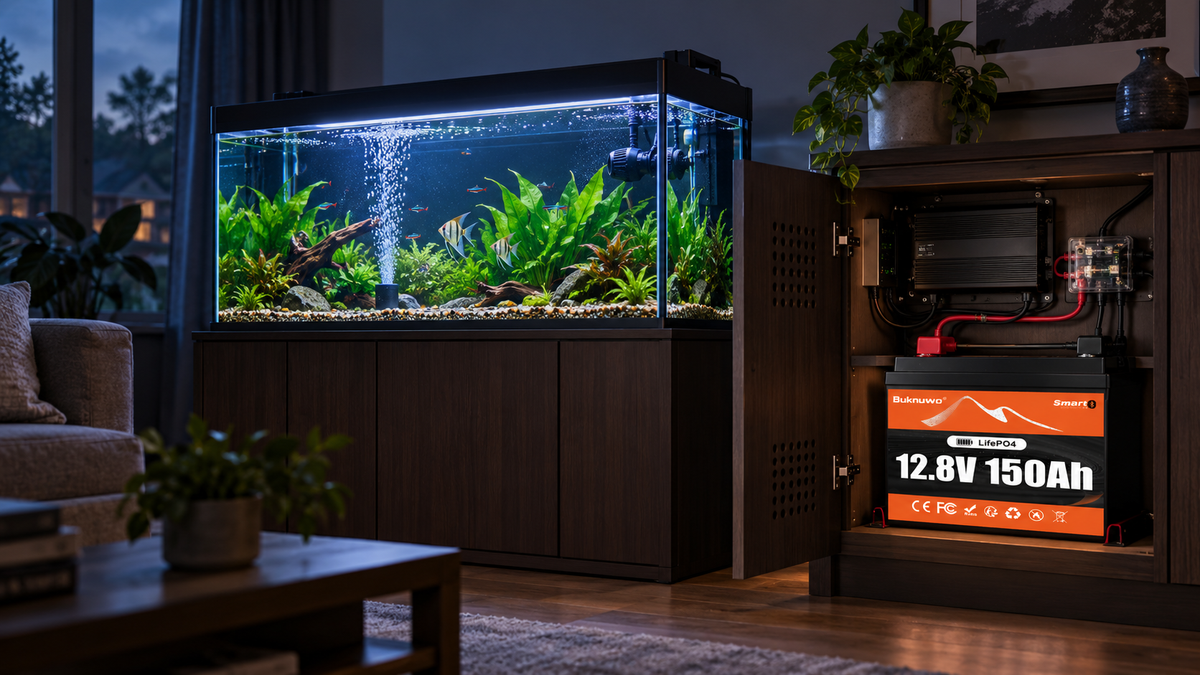
A power outage can stop aquarium aeration, water circulation, filtration, heating, cooling and monitoring at the same time. The most useful backup plan is not necessarily one that powers every device exactly as normal. It is one that identifies the equipment the aquarium needs most, confirms its electrical requirements and provides a safe way to operate it for the planned outage period.
This guide explains how to plan battery backup for aquarium equipment during a power outage, including air pumps, circulation pumps, filters, heaters, chillers, lights and monitoring devices. It also compares 100Ah, 150Ah and 314Ah LiFePO4 battery options without promising a fixed runtime or a guaranteed outcome for aquarium livestock.
Aquarium needs vary by species, stocking level, water temperature, tank size, filtration design and health conditions. Seek advice from an experienced aquatic professional or veterinarian when the livestock has specialized requirements.
Quick answer: protect life-support functions before convenience loads
For many aquariums, emergency planning begins with water movement and gas exchange. Filtration, temperature control and monitoring may also be critical, but their importance and energy use vary widely by system. Decorative lighting and nonessential accessories can often be treated as lower priority during a limited outage.
A practical backup plan usually follows this order:
- identify the life-support functions that cannot be interrupted for the intended outage period;
- measure or confirm their actual electrical consumption;
- check startup demand and AC/DC compatibility;
- choose the required reserve time;
- select a battery, power-conversion method and protective equipment as one system;
- test the complete arrangement before an outage.
A 100Ah LiFePO4 battery may be considered for a focused plan using efficient aeration, circulation and monitoring. A 150Ah model provides more nominal energy for additional filtration or a longer reserve. A 314Ah battery may suit a verified multi-tank installation or a system with more essential equipment. These are planning directions, not automatic recommendations.
1. Rank aquarium equipment by outage priority
Create three groups before calculating battery capacity.
Priority 1: essential life-support loads
- air pump or other aeration device;
- circulation pump or powerhead needed for water movement;
- selected filtration equipment when continuous operation is important to the system;
- temperature control when ambient conditions or livestock requirements make it essential;
- critical alarms or monitoring devices.
Priority 2: useful supporting loads
- additional filtration stages;
- secondary circulation pumps;
- automatic top-off equipment, if safe and necessary during the outage;
- router or gateway used for remote alerts;
- limited maintenance lighting.
Priority 3: deferrable loads
- decorative aquarium lighting;
- display lighting around the tank;
- nonessential accessories;
- equipment that can be paused safely under guidance for the specific aquarium.
This priority list must be adapted to the aquarium. A heater may use substantial energy but still be essential in a cold room with temperature-sensitive livestock. A chiller may be essential in a hot climate or for cold-water species. Do not remove a device from the backup plan solely because its wattage is high.

2. Build an aquarium outage load list
Record the following information for every device that may use backup power:
- device name and purpose;
- AC or DC input;
- required voltage and frequency, where applicable;
- normal operating watts;
- maximum or startup watts;
- expected hours of operation during an outage;
- whether it must run continuously or can operate in controlled intervals.
The basic energy calculation is:
Energy (Wh) = Power (W) × Operating time (hours)
Repeat this for each planned load and add the results. Include energy used by an inverter, DC converter, control system or communication gateway. Measured consumption is often more useful than assuming every device continuously draws its nameplate maximum, but the maximum rating remains important for compatibility and startup checks.
Use more than one operating scenario
Prepare at least two estimates:
- Essential mode: only the equipment needed to preserve the planned minimum life-support functions.
- Extended mode: filtration, temperature management, communications and other equipment added when energy permits.
This makes it easier to reduce demand during a longer-than-expected outage without making decisions under pressure.
3. Treat heaters and chillers as separate planning problems
Aquarium heaters cycle on and off, so their energy use depends on room temperature, tank insulation, aquarium size, setpoint, cover and heat loss. The heater’s printed wattage is not the same as daily energy unless it operates continuously.
Chillers may have a compressor or motor with both running power and short-duration startup demand. The inverter and battery system must support the starting event as well as normal operation. Actual duty cycle depends on ambient temperature, water temperature and the heat added by pumps and lighting.
Because temperature-control loads can dominate the energy budget, do not place them into a generic runtime table. Measure their behavior under representative conditions and seek aquarium-specific guidance about safe temperature limits. A smaller backup that supports aeration does not automatically provide adequate temperature protection.
4. Check pump and compressor startup power
Some return pumps, circulation pumps, filter motors and chillers briefly draw more power at startup than during normal operation. A battery may store enough energy for many hours yet still fail to start the connected equipment if another system component cannot support the momentary demand.
Verify:
- the battery BMS continuous and applicable short-duration current limits;
- inverter continuous and surge ratings for AC equipment;
- DC converter input and output limits;
- fuse or breaker characteristics;
- cable size, length and voltage drop;
- whether several devices restart simultaneously after transfer to backup power.
Do not estimate startup requirements from normal watts alone. Use device documentation or appropriate measurement. More pump-specific background is available in How to Choose a LiFePO4 Battery for a 12V Water Pump.
5. Confirm the AC or DC power path
Most household aquarium equipment uses AC power, while a 12.8V LiFePO4 battery supplies DC power. AC devices therefore require a correctly rated inverter or an integrated transfer/backup system. Confirm the waveform, voltage, frequency, continuous rating, startup capability and transfer behavior required by the equipment.
Some air pumps, monitoring devices or circulation pumps use low-voltage DC. They may be suitable for a regulated DC path, but a “12V” label alone does not prove compatibility with the battery’s full operating-voltage range. Use an appropriate regulated converter when required.
If automatic operation is important, confirm how the system changes from utility power to battery power and back again. Not every inverter provides UPS-style transfer, and a manual arrangement will not protect an unattended aquarium until someone activates it.

6. Decide how much outage reserve to plan
The appropriate reserve depends on local outage history, whether someone can reach the aquarium, the livestock’s sensitivity, room temperature and which devices remain connected.
A simple starting relationship is:
Planned battery energy = essential load energy × desired reserve period, plus system losses and an operating margin
Avoid treating every watt-hour on the battery label as guaranteed usable AC energy. Inverter consumption, conversion losses, wiring, temperature, battery condition and protective limits affect the final result.
Also decide what happens if the outage exceeds the planned reserve. A useful response plan may include:
- automatically disconnecting decorative lighting;
- retaining aeration and the most important circulation device;
- using alarms before the battery reaches protective shutdown;
- arranging a verified secondary charging source or relocation plan;
- keeping equipment instructions and livestock-specific emergency contacts available.
The battery BMS should remain a protection layer, not the normal control method for deciding when nonessential loads turn off.
7. Compare 100Ah, 150Ah and 314Ah LiFePO4 batteries
Nominal energy helps compare batteries, but it does not establish finished-system runtime or confirm that an inverter can start every device.
| Battery option | Nominal energy | Possible aquarium role | What to verify |
|---|---|---|---|
| BUKNUWO 12.8V 100Ah | 1,280Wh | Focused backup for efficient aeration, circulation, monitoring or a modest essential-load plan | Total AC/DC load, required reserve, conversion losses and automatic-transfer needs |
| BUKNUWO 12.8V 150Ah | 1,920Wh | More filtration equipment, longer planned reserve or a larger aquarium system | Pump startup, inverter rating, heater or chiller duty cycle and cabinet location |
| BUKNUWO 12.8V 314Ah | About 4,019Wh | Verified multi-tank fish room, additional essential equipment or deliberately extended reserve | Recharge time, charging equipment, branch protection, system current and physical installation |

A physically large aquarium does not automatically require the largest battery. An efficient essential-load plan may use less energy than a smaller tank with a continuously operating heater or chiller. Choose from measured or well-supported equipment data rather than tank volume alone.
8. Keep the battery system physically separated from water
Water and electrical equipment require deliberate separation. Do not place the battery under the aquarium, beside a sump, on a damp floor or where a leak, siphon, overflow or maintenance spill can reach it.
- Install the battery upright in a dry, ventilated and mechanically secure location.
- Protect terminals and install suitable DC overcurrent protection near battery positive.
- Use correctly sized cable, proper lugs and strain relief.
- Keep inverters, converters, transfer equipment and outlets away from splash and leak paths.
- Use drip loops where cords approach aquarium equipment.
- Follow applicable GFCI/RCD, grounding and electrical-code requirements.
- Do not handle battery connections or power equipment with wet hands.
- Keep the installation accessible for inspection but protected from children and pets.
An equipment cabinet must also manage heat. A tightly enclosed inverter or charger may overheat even when the outside of the cabinet appears dry and clean. Follow the ventilation and clearance requirements for each component.
9. Plan safe restart after utility power returns
Restoring power is not always as simple as energizing every device at once. Several pumps or compressors may restart simultaneously, creating a higher combined demand. Filters and sumps may also need inspection if water levels or flow paths changed during the outage.
Before relying on automatic restart:
- test the transfer and return-to-utility sequence;
- confirm that pumps prime and restart correctly;
- check that sumps and overflow systems remain within safe levels;
- verify alarms, temperature controllers and network devices reconnect;
- follow aquarium-equipment guidance for inspecting stagnant filter media or changed water conditions.
Testing should be supervised and should not risk livestock. If the filtration design has special restart procedures, include them in the written outage plan.
10. Understand Bluetooth monitoring limitations
Bluetooth monitoring on a compatible battery can help during local inspection by showing supported information such as state of charge, voltage, current and status. Bluetooth does not automatically provide an Internet alert when nobody is home.
Remote notifications require a compatible gateway, controller or aquarium monitor, along with functioning home-network equipment. If the router, modem and monitoring hub must remain online, include their energy use in the backup calculation. See LiFePO4 Battery for Emergency Communication Equipment for related communication-load planning.
11. Recharge the battery safely after an outage
Use a charger with the correct LiFePO4 profile and charging voltage for the exact battery. Charging time depends on energy removed, charger output, battery limits, temperature and whether aquarium loads continue operating while charging.
A battery that supports a longer outage also requires more energy to refill. Confirm that the charging source can restore the planned reserve before the next likely outage. Do not connect an incompatible charger or assume a lead-acid charging profile is suitable.
Common aquarium backup mistakes
- Trying to power everything: decorative lighting can consume energy needed by essential life-support equipment.
- Ignoring temperature control: heaters and chillers may be essential and can dominate energy use.
- Calculating from tank size alone: equipment design and operating conditions determine electrical demand.
- Checking energy but not startup power: a pump or chiller may fail to start even when nominal battery energy appears sufficient.
- Assuming automatic transfer: not every battery-and-inverter arrangement changes over without manual action.
- Installing the battery below the tank: leaks and maintenance spills create an avoidable electrical hazard.
- Using the BMS as normal load control: protective shutdown should not replace planned load management.
- Confusing Bluetooth with remote alerts: local battery monitoring does not keep the home network online by itself.
Aquarium outage-planning checklist
- Document tank type, livestock requirements and ambient-temperature risks.
- Rank aeration, circulation, filtration, temperature control, monitoring and lighting.
- Measure normal watts and identify startup demand.
- Create essential-mode and extended-mode load estimates.
- Choose a realistic reserve period and response for a longer outage.
- Verify inverter or DC-converter compatibility and transfer behavior.
- Compare battery nominal energy only after defining the complete load.
- Install the battery and power electronics in a dry, ventilated and protected location.
- Test transfer, pump restart, alarms and return to utility power under supervision.
- Inspect and recharge the system after use, then update the plan as aquarium equipment changes.

Frequently asked questions
What aquarium equipment should receive backup power first?
Aeration and necessary water movement are common priorities, followed by filtration, temperature control and monitoring according to the aquarium’s livestock and environment. The correct order must be adapted to the specific system.
Is a 100Ah LiFePO4 battery enough for an aquarium?
It may suit a focused essential-load plan, but tank size alone cannot answer the question. Add the watt-hours required by the selected air pumps, circulation, filters, monitoring and power-conversion equipment, then compare the result with the desired reserve.
How long will a 150Ah battery run aquarium equipment?
Runtime depends on the total connected watts, duty cycles, inverter consumption, losses, temperature and battery operating limits. A 150Ah model provides 1,920Wh of nominal energy, but that figure should not be treated as guaranteed usable AC energy.
Can an aquarium heater run from a LiFePO4 battery?
A compatible system may power a heater, but heating can consume substantial energy. Estimate the heater’s real duty cycle under representative room conditions and confirm the inverter, battery, wiring and protective devices can support it.
Can a battery backup operate automatically?
Only if the system includes compatible automatic-transfer or UPS functionality and has been configured for the aquarium equipment. A battery and ordinary inverter do not necessarily provide unattended transfer.
Where should the battery be placed?
Use a dry, ventilated and secured location away from the aquarium, sump, hoses, splash, overflow and likely maintenance spills. Do not install it beneath the tank or on a damp floor.
Does a larger battery guarantee aquarium safety during an outage?
No. Battery capacity is only one part of the plan. Equipment compatibility, temperature, oxygenation, water conditions, automatic transfer, installation safety and outage response all affect the result.
Can these batteries start a generator used for emergency power?
No. The batteries discussed here are intended for deep-cycle energy storage, not engine starting. Use purpose-built starting equipment specified by the generator manufacturer.
No battery system can guarantee livestock survival. Validate the plan with the requirements of the aquarium, fish and other organisms, and consult an appropriate aquatic professional when the consequences of interruption are significant.